




‘Lightweighting’ the F-150 Brings More Performance, Economy, Payload
Aluminum body and bed, redesigned steel frame, and a small but lively V-6 are the new truck’s highpoints.

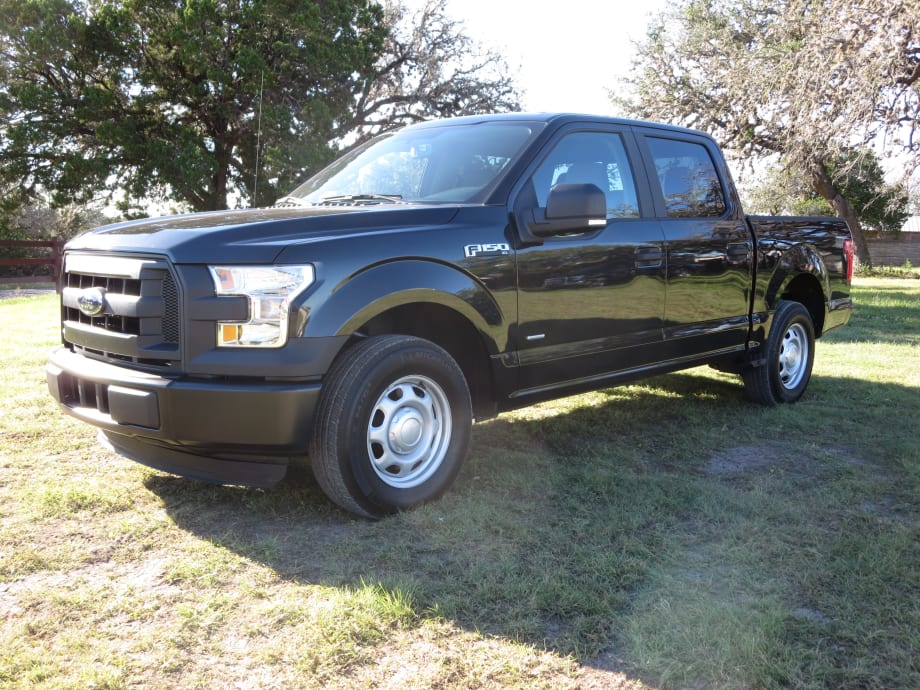
SuperCrew with XL trim looks plain, but it has metallic black paint, power windows and mirrors, and a double-turbo gasoline V-6 that help boost its list price with shipping to $38,985, including $1,195 increase for 2015. Base RegularCab XL shortbed with a naturally aspirated 3.5-liter V-6 begins at $26,615. Headlights are halogens; upscale trim levels get LED headlamps with illuminated amber surrounds, and of course lots of chrome. Photo: Tom Berg
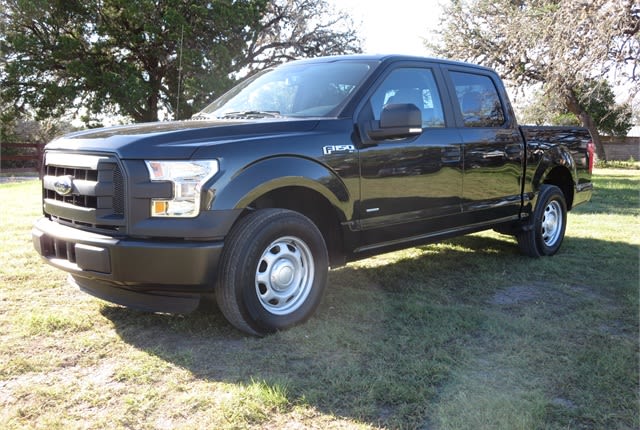
SuperCrew with XL trim looks plain, but it has metallic black paint, power windows and mirrors, and a double-turbo gasoline V-6 that help boost its list price with shipping to $38,985, including $1,195 increase for 2015. Base RegularCab XL shortbed with a naturally aspirated 3.5-liter V-6 begins at $26,615. Headlights are halogens; upscale trim levels get LED headlamps with illuminated amber surrounds, and of course lots of chrome.Photo: Tom Berg
Anybody who knows anything about pickups is aware that Ford Motor Company is switching its next F-150 from steel to aluminum for the body and bed. That’s what Ford people say. In the spirit of “trust but verify,” yours truly approached one of the trucks displayed at a ride-and-drive event last week with a magnet and held it against a front fender. The magnet didn’t stick and the material wasn’t fiberglass, so I can say with scientific certainty that the fender was made of a non-ferrous metal.
And unless it was zinc, copper, beryllium, titanium or even lead, it was almost certainly lightweight aluminum. With that comes a number of benefits, Ford executives said at the event near San Antonio, Texas. A 2015 F-150 weighs 570 to 786 pounds less than a comparable 2014 model, depending on cab and bed size. About 530 of that becomes extra payload, and a truck will tow an extra 1,100 pounds. Also, with less tare weight, smaller V-6 engines can do the work of once-common large V-8s and get 5% to 20% better fuel economy in the process. And the new trucks are quiet, ride and handle well, and really scoot.
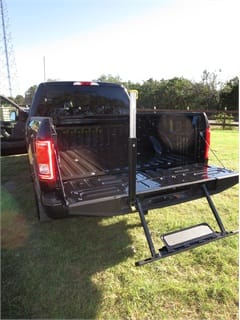
Optional (at about $400) fold-out step and handle make for an easy climb in or out. Aluminum beds save hundreds of pounds over steel, and fleet testing helped determine the gauge and cross section of interior panels. Photo: Tom Berg
Ford’s marketers call the 2015 F-150 “all new,” a claim many auto and truck makers use and one I usually refuse to repeat because there’s always something that’s carried over from the previous model. If an F-150 is equipped with a brand-new 2.7-liter EcoBoost V-6, then OK, except that the 6-speed TorqShift automatic transmission is used in current trucks. Other available engines – two other V-6s and a V-8 -- are carryovers. So I’ll call the full-size truck “largely new.”
The aluminum cab is 2 inches wider than the current steel cabin for more lateral space, and several inches longer for more rear leg room. The trucks overall are 1 inch wider. All trucks but one in this demo were SuperCrew 4-doors; the other was a 4-door SuperCab, with shorter rear doors that remain rear-hinged, and they now open 170 degrees, almost against the bed. As before, there’s no B-pillar, so it’s easy to load people or stuff. There’ll also be a 2-door Regular cab, but none were present at this event. The aluminum cargo beds are the same lengths as now – 5.5, 6.5 and 8 feet, depending on cab configuration and customer desires.
Aluminum cabs as such are not new, as they’re used in many medium- and heavy-duty trucks. Light weight and corrosion resistance are the main claims made for them. Yet some people have wondered about getting those and the rest of the aluminum structures repaired. Doug Scott, Truck Group marketing manager, said a study showed that 90% of F-150 owners now live within two hours of a shop that does aluminum work, and more body shops will learn the techniques as this truck gains popularity. The next-generation SuperDuty pickups will also be aluminum.
The F-150’s frame is new, with boxed main sections and parts of the five crossmembers made of high-strength steel, which account for 45 to 70 pounds of the weight reduction. How much steel or aluminum depends on frame and body length, with the Super Crews using the most and also dropping the most pounds. Aluminum and high-strength steel are premium materials, so how can Ford afford to use them and keep the trucks competitively priced? Because finite element analysis determines where metal should and shouldn’t be used in a given panel or member, which reduces the overall amounts needed, engineers explained. It’s also true that aluminum has come down in price in recent years, and likely that Ford has locked in good commodity prices for a long period.
Speaking of price, in July Ford announced an across-the-board $1,195 hike for each of the 2015 F-150 trim levels – XL, XLT, Lariat, King Ranch and Platinum -- which will help pay for increased material costs, development that began in 2008, and yield profits that pickups are famous (or infamous) for. Customers will be buying a strong truck. Our hosts showed us a bare cab, nose and bed, and pointed out some of the complex members that comprise it. For instance, extruded aluminum channels with multi-boxed sections form the door sills and rocker panels, making them strong yet light. Even the B-pillarless SuperCab will do very well in a rollover accident, engineers said, though like proud parents, they’d prefer the new trucks to stay on four wheels most of the time.
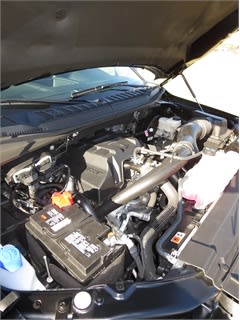
New 325-hp 2.7-liter EcoBoost V-6 is fast and should sip fuel if drivers resist the fun of punching the pedal. Ford offers two other V-6s and a small V-8, but no diesel in the aluminum F-150.Photo: Tom Berg
That brings up an exciting ride I had in an F-150 XLT with an otherwise mild-mannered newspaper reporter from Detroit who stormed over a twisting gravel road as though he were on his way to rescue Lois Lane. Twice I winced and closed my eyes as he got this close (here I’m holding my thumb and forefinger about a half-inch apart) to a fence and the edge of a culvert while doing about a mile a minute on a path better taken at half that, at least by old guys like me.
But lordy, did the truck handle nice – no wild bouncing or banging or side-hopping of the rear wheels because the solid axle sits on wide leaf springs damped by staggered outboard-mounted shocks, according to the engineer in the back seat who seemed calm through it all.
The truck had the new 2.7-liter (165-cubic-inch) double-turbo V-6 which Clark Kent punched whenever he could to make the pickup fly, presumably because he had left his cape at home. OK, I also took joy in getting on the gas during my time behind the wheel. The little engine makes up to 325 hp and 375 lb-ft when it winds up and its Borg-Warner turbos cram maximum air – something like 30 psi -- into the intake manifold. The V-6 can also be smooth and docile. I think this’d be the engine I’d order if I were buying a new F-150, because it should also be pretty good on gasoline, assuming I kept my foot out of it. EPA economy numbers aren’t out yet, but Ford folks are predicting 24 mpg combined City and Highway.
We spent more time in a Super Crew with the base XL trim package (the one in the photos) because that’s what fleet people are more likely to order as a work truck, figured Clark (his real name was Tony) and I. But except for its plain steel wheels and black grille and bumpers, the truck was not a strippo; it had a carpeted floor, power windows, mirrors and locks, and very nice contoured, cloth-covered seats. The instruments were attractive, and controls bleak in appearance but nicely arranged.
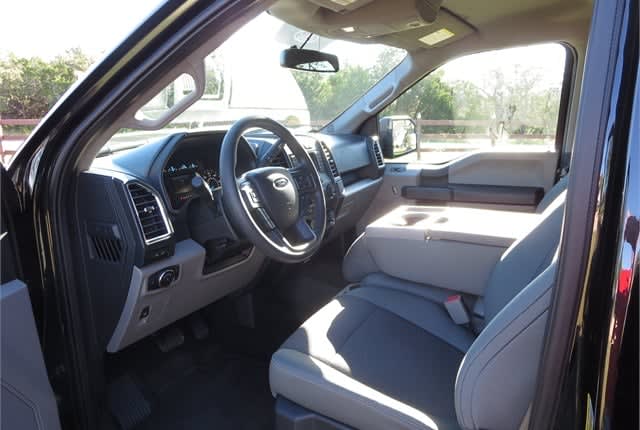
Cloth-covered seats are contoured for excellent comfort. Controls are bleak-looking but most function well. And look – the driver’s A-pillar has a grab handle, which current F-150s lack.Photo: Tom Berg
An exception was the HVAC setup, with two knobs flanking a small panel with eight or nine pushbuttons for various vent and function settings that should’ve been another knob (yes, that’s a rant). On the other hand, the audio system has “redundant” controls, including real knobs for on/off/volume and tuning. So, traditionalists can use the knobs while techies can punch virtual buttons on a MyTouch screen, depending on which infotainment package a truck has.
Speaking of hands, the grab handle has been returned to the A-pillar on the driver’s side, easing the climb in and out, especially with 4x4s that stand higher off the ground. For some reason Ford had deleted that handle on the current F-150, while including them at the passenger side and on either side of rear-seat areas. Just grab the steering wheel, they thought (and still do at General Motors, whose Silverado and Sierra pickups don’t have a handle for the driver).
A wise fleet manager, knowing that his work trucks would go like the dickens with turbocharged EcoBoost engines (either the 2.7 or 3.5), would probably spec the base 3.5-liter naturally aspirated V-6 or maybe the 5-liter NA V-8. Both are smooth and entirely adequate in power, and the V-8’s rather nice, actually. I drove one while pulling a 10,000-pound trailer and found it performed pretty much like Ram’s 3-liter V-6 EcoDiesel that was on hand for comparison.
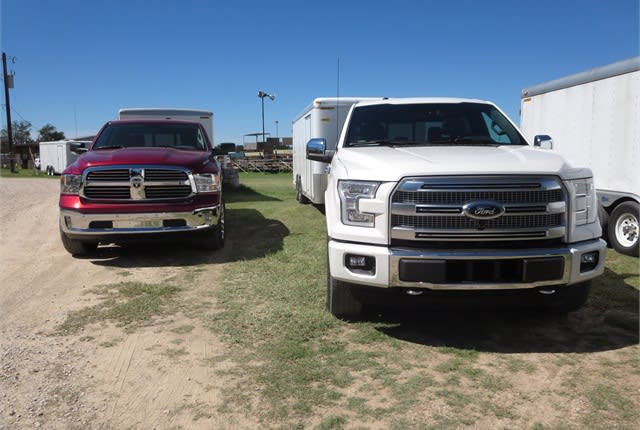
EcoBoost 3.5 V-6 in the white Ford seemed to pull its 10,000-pound trailer as well as the red Ram’s 3-liter EcoDiesel. Ford’s 5-liter V-8 also towed well.Photo: Tom Berg
Another was an F-150 XLT with the 3.5 EcoBoost hitched to a trailer, and I decided this would be my engine if I towed a lot. It really pulled well, and I know from spending a week with one in the current F-150 that it’s plenty gutsy, if not as lively as the smaller 2.7 turbo V-6 (which by the way is only a truck engine for now).
The previous evening I drove several Fords through a slalom course and found them very quick and nimble, with very flat cornering and no front-end plowing. Competitor trucks with their steel bodies seemed less agile, though maybe I was imagining that (check the video posted on TruckingInfo).
Now, in my daily life I neither run slaloms nor race at drag strips – the other part of the performance demo the previous evening -- but those exercises do show what a vehicle is capable of. And these lighter-weight aluminum F-150s seem able to do a lot. They go into production in Dearborn, Mich., and Kansas City, Mo., later this year. Watch for them at your Ford dealer soon thereafter.
More Equipment

PlusAI Going Public to Fund Autonomous Truck Launch
A SPAC deal could provide PlusAI with up to $300 million as it works toward a 2027 commercial launch of factory-built autonomous trucks.
Read More →
NHTSA Moves to Rewrite Truck Fuel-Economy Rules
The National Highway Traffic Safety Administration says it lacks authority to regulate medium- and heavy-duty truck engines separately from complete vehicles, but the existing standards have not yet been eliminated.
Read More →
Detroit Opens Orders for EPA 2027 Engines
Detroit isn’t starting from scratch to meet EPA 2027 diesel emissions standards. Its Gen 6 DD13 and DD15 engines keep much of today’s platform while updating the fuel and aftertreatment systems.
Read More →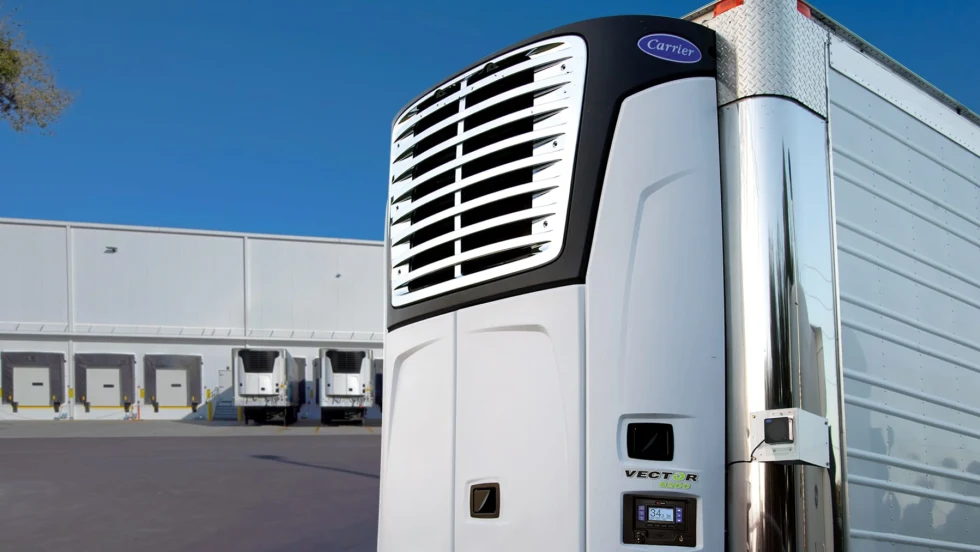
Carrier Transicold Adds All-Electric TRU for Stationary Cold Storage
Carrier Transicold’s new Vector 8200 all-electric transport refrigeration unit gives fleets a diesel-free option for temporary refrigerated and frozen trailer storage.
Read More →
A Closer Look at Kenworth’s Electric T880E Vocational Truck [Video]
Learn more about Kenworth's T880E battery-electric vocational truck at the Paccar Technical Center, including its range, applications, upfitting considerations, and PTO options, in this HDT Spotlight video.
Read More →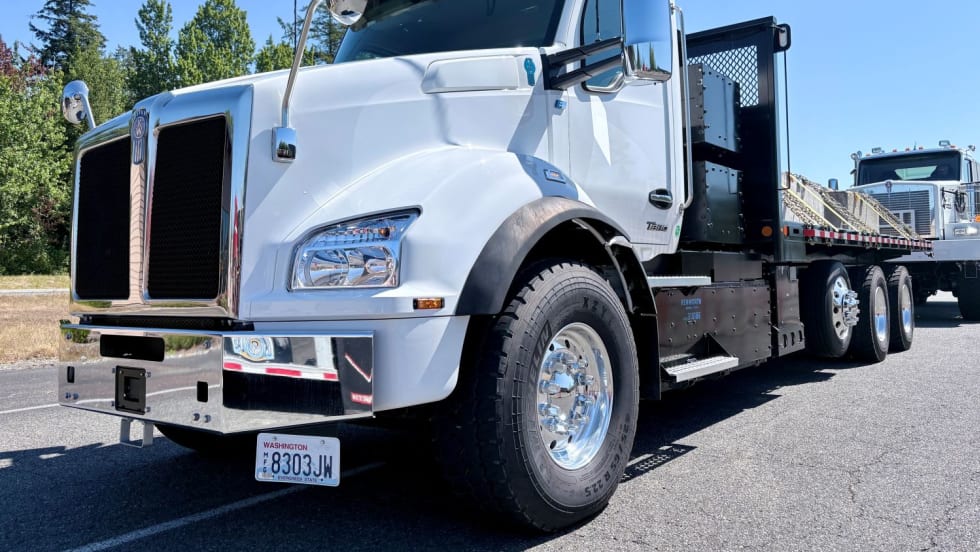
Kenworth T880E Brings EV Power to Vocational Trucks
A closer look at the Kenworth T880E’s range, charging, powertrain and upfit options — and where fleets are showing the most interest.
Read More →
What the U.S.-Canada Trade War Means for Trucking
Escalating U.S.-Canada tariffs could disrupt cross-border freight, reduce truck volumes, raise costs, and create new uncertainty for carriers on both sides of the border.
Read More →
Autonomous Truck Testing Moves Ahead in California as Teamsters Challenge Rules
California has begun permitting heavy-duty autonomous truck testing, with Aurora and Kodiak among the first to receive approval, as the Teamsters sue the DMV over the new regulations.
Read More →
Behind the Wheel of the New Mack Anthem [Video]
HDT takes the new Mack Anthem around Mack’s Pennsylvania test track to see how its driver-focused design, technology, visibility and handling perform from behind the wheel.
Read More →
DTNA Plans New U.S. Truck Plant as Manufacturing Footprint Shifts
Daimler Truck North America is evaluating sites for a new assembly plant expected to open in 2029 while winding down operations at its longtime Portland manufacturing facility.
Read More →