





Related: Anthony Levandowski on the Future of Autonomous Trucks
Jeff Sass: Electric Trucks, Connectivity Are In, Platooning and Autonomous Trucks Are Out
Trucking shouldn't waste time on pipe-dreams like platooning and autonomous trucks and instead focus on improving logistics and making the trade appeal to young people, said Hendrickson's Jeff Sass while speaking at the Heavy Duty Trucking Exchange in Phoenix.
May 16, 2019
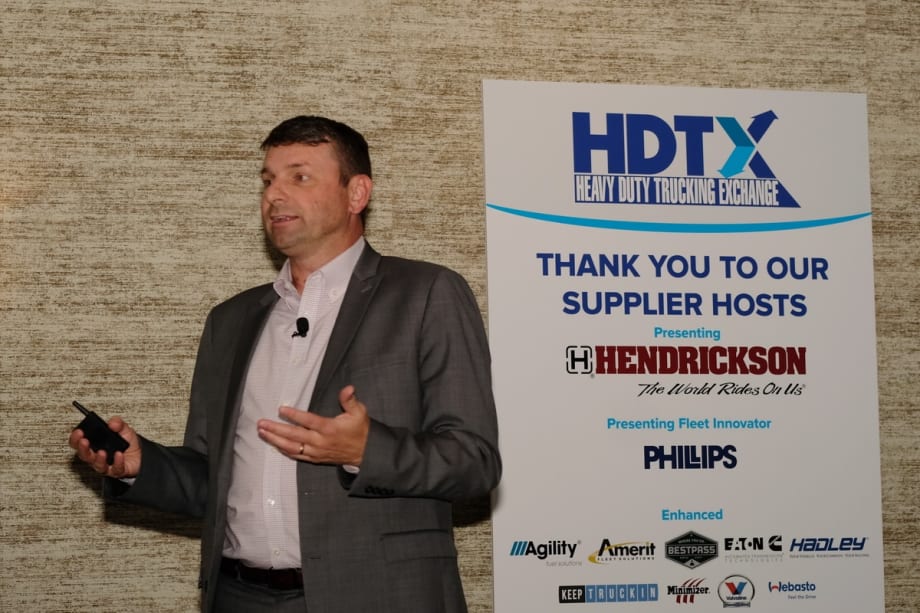
Trucking shouldnt waste time on pipe-dreams like platooning and autonomous trucks and instead focus on improving logistics and making the trade appeal to young people, said Hendrickson's Jeff Sass while speaking at the Heavy Duty Trucking Exchange in Phoenix.
Photo: Jim Park
6 min to read
The future of trucking may not be quite as sexy as some would have us believe, but it's for certain going to be different than the way the industry works today. Jeff Sass, Hendrickson's witty and outspoken vice president of marketing, told an audience at Heavy Duty Trucking Exchange last week in Phoenix that trucking will have to get better at logistics and making the trade appeal to young people, and that we shouldn't waste too much time on pipe-dreams like platooning and autonomous trucks — at least not for some time to come.
As someone who's been in the industry since 1994, working for two different truck makers before coming to Hendrickson, the overall tone of Sass' 30-minute presentation seemed to be, let's fix the fundamentals and ignore the distractions. He pointed out that it's normal for trucking to give away two hours of a driver's work shift every time a truck backs into a dock.
"Shippers allow your trucks to sit at a dock for two hours," he said. "We talk about driver shortages, we hear numbers like 50,000, 60,000 to 100,000 drivers short. Think about this: We have about 4 million drivers on the road today. Two hours out of 11 hours of driving is 18%. If we have a shortage of 80,000 drivers out of 4 million, that's 0.2%. Could we solve the entire driver shortage with improved logistics, just by cutting down on dock dwell times and by making existing trucks more productive?"
Connected vehicles can make that happen, and the industry has already proved it with over-the-air diagnostics, automatic parts ordering and service scheduling, he said. If we can keep trucks out of dealerships for extended periods, why, Sass asks, can't we get our customers to cooperate and reduce dwell times? He noted that we can tell where a truck is on the road to within a few feet, and we can predict pretty accurately when it will arrive at a customer's door.
"Next-generation drivers are not going to wait two hours at a loading dock," he said. "They grew up in a world if instantaneous data, instantaneous gratification, and having everything they buy online [delivered] in two days. They aren't going to wait around, so we have to improve our logistics."
Connectivity will also improve safety, he said, noting the advances made in driver and vehicle monitoring and the stapes the industry has taken so far in trying to curb some risky behaviors. He said safety will improve further when vehicle-to-vehicle (V2V) and vehicle-to-infrastructure (V2I) communications come into their own. But, with his tongue planted firmly in his cheek, he warned aftermarket suppliers that a dramatic reduction in collisions could hurt hood, bumper and fender sales.
On a more serious note, he spoke of the advantages of connectivity, but cautioned that opening up those lines of communication means, well, opening them up.
"If a Class 8 truck can be hotwired by a 12-year-old in Nebraska, then it's a problem," he hardly needed to point out. "There has to be some sort of security on board to prevent this from happening. I know the industry is devoting a lot of resources to the issue of telematic and onboard security, but every time we build something more secure, people figure out how to get around it. Build a 10-foot wall; somebody builds an 11-foot ladder. The IT piece of these connected trucks will have to continue evolving."
Platooning & Autonomous Trucks
Being a vice president of marketing, Sass has to have a little of the dreamer in him, but he was showing his realist side when he spoke about platooning. "I don't see it in the marketplace. It's the most mature technology we have and it could be implemented tomorrow, but there are too many reasons not to do it," he said.
Indeed, as an industry we have been flirting with platooning for more than five years now. After that length of time, it should have been green-lighted, but it hasn't.
"The first problem is driver safety," Sass said. "I don't know if any of you have had the opportunity to be in a platoon, but when you're driving at 55 mph and you're 30 feet from the trailer in front of you, it's unnerving to be doing that, especially because you really don't have control of the truck. Drivers do not want to be put in that position. That's reason number 1. Number 2 is the commercial aspect.
"There is a hierarchy in platooning. The trucks with the lighter loads and better brakes go in the trailing position. Well, 90% of the benefit of a platoon goes to the trail position. Could you imagine two platoon-capable fleets in a situation where they could partner up in a platoon? Which one would be happy about handing that fuel economy benefit to its competitor?" he asked. "It will never happen. Until it's either legislated or there are commercial agreements in place, or you get two trucks from the same fleet going in the same direction at the same time — which hardly ever happens — platooning just won't work commercially."
Sass said he spoke on a platooning panel three years ago where he was the only industry person on the panel. "The rest were scientists, researchers and engineers. I made these same comments then. You would have thought I was Barabbas or something."
There are those who feel differently about platooning, but in January, Daimler CEO Martin Daum said much the same thing as Sass. "The technology we have to put into a truck does not qualify the savings our customers will see with automation," said Daum, speaking at the CES electronic show in Las Vegas. "We will continue with the projects where we have ongoing commitments, but we will not be starting another venture project on platooning."
"I just don't see a place for platooning in our industry in the near future," Sass reiterated.
On autonomous vehicles, Sass is a little more open-minded – but still skeptical.
"I have a different view of autonomous trucks," he began, answering a question from the audience. "How many of you flew here today? Was there a pilot in the cockpit? Did you feel comfortable knowing there was a pilot in the cockpit? Did the pilot actually fly the plane most of the time?
"I don't see a fully autonomous vehicle in my lifetime. One of the biggest problems, as I see it, will be load security. Think about this: You have a completely autonomous truck, and all of a sudden three Toyota Celicas pull up alongside it. One pulls in front and slows down while the other two remain beside the truck. The algorithm in the truck will have it stop. Until the trailers are built like safes, the cargo will be very easy to steal."
Electric trucks are coming
Sass was more upbeat about electric trucks.
"They are coming," he insisted. "All the OEMs have projects in the works. They are all working on something. And then there are the new entrants: Lion and Tesla and Nikola and XOS. They are all in the marketplace and trying to come up with new technology. Then you have component suppliers like Hendrickson. We have nothing. We're not doing electric right now. But there's Meritor and Dana and Allison, they are all participating.
"If I was a betting man — and I'm not — I'd bet on the existing OEMS, like Volvo, Freightliner, Navistar and Paccar. They have the infrastructure today that knows how to maintain and take care of their products."
He sees room for partnerships and working arrangements between the big four OEM, the tier 1 suppliers and the startups, "but no matter what shape they take or whose name in on the hood, there will be electric truck on the road in the next three to five years," Sass said.
"It won't be an over-the-road Class 8. It will start with the port and drayage applications, final mile applications, school buses — they are perfect for this application — but they are coming."
Subscribe to Our Newsletter
More Equipment

How Volvo Updated Its D13 for EPA 2027 [Watch]
Volvo’s updated D13 promises lower emissions without sacrificing performance or fuel economy. Take a closer look at what changed inside the engine in this HDT Spotlight video.
Read More →
Michelin Tire Improves Efficiency and Durability for Regional Fleets
The Michelin X Multi Energy D2 is a regional haul drive tire engineered to help fleets improve fuel efficiency, durability and traction in demanding stop-and-go operations.
Read More →
ZF Expands Commercial Vehicle Push in North America
ZF is expanding its North American commercial-vehicle presence with new transmission applications, electrification, trailer technology and autonomous-driving systems.
Read More →
Tesla Wants a Self-Driving Semi. Are Cameras Enough?
Could Tesla’s camera-only autonomous driving technology work on an 80,000-pound Semi? In this commentary, HDT's Deborah Lockridge takes a look at Tesla, Cybercab, and how autonomous trucks see the road.
Read More →
Kodiak: Driverless Long-Haul Truck Launch on Track for 2026
Kodiak AI says its driverless long-haul safety case is 93% complete and it remains on track to begin commercial operations by year-end 2026.
Read More →
What DOT’s Automated Vehicle Strategy Means for Trucking
The U.S. Department of Transportation issued a new automated-vehicle strategy that outlines plans for driverless-truck regulations, cross-state freight corridors, and federal safety standards.
Read More →
East Coast Port Launches $45M Electric Truck Push
The Port Authority of New York and New Jersey announced millions in incentives for zero-emission drayage trucks, yard tractors, and new charging hubs near the port.
Read More →
PlusAI Going Public to Fund Autonomous Truck Launch
A SPAC deal could provide PlusAI with up to $300 million as it works toward a 2027 commercial launch of factory-built autonomous trucks.
Read More →
NHTSA Moves to Rewrite Truck Fuel-Economy Rules
The National Highway Traffic Safety Administration says it lacks authority to regulate medium- and heavy-duty truck engines separately from complete vehicles, but the existing standards have not yet been eliminated.
Read More →
Detroit Opens Orders for EPA 2027 Engines
Detroit isn’t starting from scratch to meet EPA 2027 diesel emissions standards. Its Gen 6 DD13 and DD15 engines keep much of today’s platform while updating the fuel and aftertreatment systems.
Read More →