





Why Derek Leathers Says Trucking’s Longest Downturn Could Spark a Lasting Upturn
Is Trucking Capacity Tighter Than It Looks?
Based on data released in September, it looks like a tight driver supply might be closer than we thought.
October 13, 2025

FTR's Avery Vise looks into payroll statistics and what they may say about trucking's overcapacity problem.
HDT Graphic
4 min to read
Everyone is debating the probable trucking capacity effects of severe restrictions on non-domiciled commercial driver’s licenses and strict enforcement of English language proficiency, and rightly so. As FTR addressed recently in its analysis for clients, the rising pressure on foreign drivers, as well as soaring insurance premiums, are the most likely catalysts for a capacity-driven recovery in trucking.
And based on data released in September, it looks like a tight driver supply might be closer than we thought.
What Payroll Employment Numbers Say About the Truck Driver Workforce
One of the key indicators of driver capacity is payroll employment in trucking. These figures include all employees, not just drivers. However, the driver force represents the bulk of employment and mostly accounts for notable changes in employment levels.
The latest official Bureau of Labor Statistics figures available show seasonally adjusted payroll employment in trucking at just 0.4% below pre-pandemic (February 2020) levels. General freight truckload jobs are even closer to that level. Less-than-truckload employment is well below (4.6%) the pre-pandemic level, not surprisingly, due to Yellow’s failure in 2023.
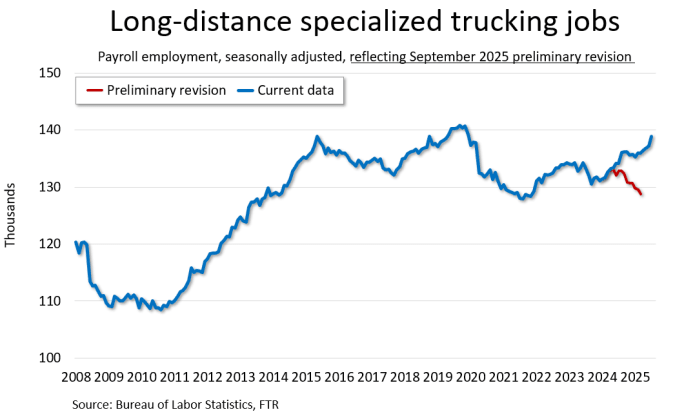
Current BLS figures show something quite fascinating regarding payroll employment in long-distance specialized trucking.
While truckload employment peaked in October 2022 at 6.4% higher than February 2020, long-distance specialized trucking jobs never exceeded pre-pandemic levels – until July 2025. Due to the government shutdown, that’s the latest data available. According to current BLS figures, specialized employment has risen sharply this year, especially in the month of July.
Note the qualifiers “official” and “current.” That’s because these numbers will change.
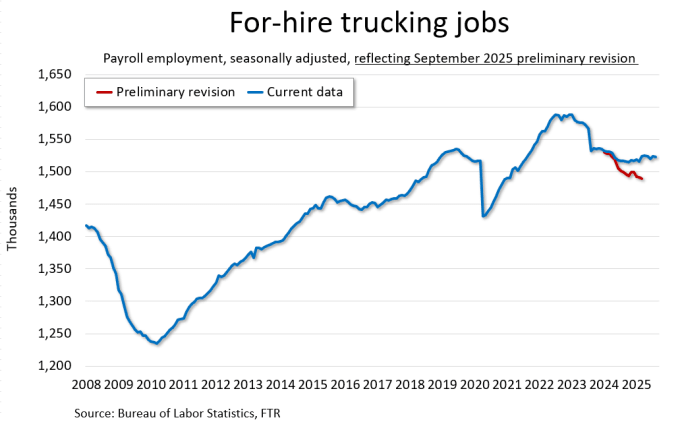
Each February, BLS publishes a benchmark revision of its monthly payroll job estimates based on the Quarterly Census of Employment and Wages, which is more comprehensive than its monthly sampling. During the summer before that revision, BLS releases a preliminary version based on the first quarter. And that revision is rather different than the current monthly estimates.
Source: FTR/BLS
BLS Monthly Estimates vs. Annual and Preliminary QCEW Reports
Each February, BLS publishes a benchmark revision of its monthly payroll job estimates based on the Quarterly Census of Employment and Wages (QCEW), which is more comprehensive than monthly sampling by the statistical agency.
During the summer before that revision, BLS releases a preliminary benchmark revision of the data based on the QCEW for the first quarter of that year. However, BLS does not adjust its monthly estimates until it finalizes the revision.
For the entire U.S. economy, that preliminary revision released in September indicated that the U.S. as of March had 911,000, or 0.6%, fewer jobs than current estimates. That is quite a bit larger than the downward revision of 610,000 jobs in this year’s final benchmark revision, but it’s not all that far off from last year’s preliminary downward revision of 818,000 jobs.
For trucking, September’s preliminary QCEW revision was notably larger than that for the U.S. in percentage terms.
According to the preliminary figures, trucking’s payroll employment in March was 35,100 jobs, or 2.3%, below the currently published BLS estimate, seasonally adjusted. The latest preliminary revision is just a bit larger than the 32,500-job (2.1%) reduction indicated in last year’s preliminary revision. The final revision as of December 2024 was 27,800 jobs below the prior BLS estimate for the month.
General freight truckload’s preliminary revision resembled the overall revision in percentage terms at a decrease of 11,400 jobs, or 2.2%, as of March. The other two general freight sectors – LTL and local – saw only minuscule preliminary revisions.
The preliminary revision for local specialized trucking is comparable to that for truckload in percentage terms at a reduction of 4,500 jobs, or 2%, as of March of this year.
Current BLS figures show something quite fascinating regarding payroll employment in long-distance specialized trucking.
Source: FTR/BLS
The biggest preliminary change, though, was for long-distance specialized trucking.
Current BLS estimates show payroll employment for that sector mostly surging since the beginning of 2024. But the preliminary revision implies a very different situation, suggesting that employment fell sharply between the middle of 2024 and March of this year.
The QCEW data puts March payroll employment for long-distance specialized 7,100 jobs, or 5.3%, below the current BLS estimate.
Then Why Doesn’t Capacity Feel Tighter?
How could these figures be so low and capacity still be loose?
BLS payroll employment data does not capture the vast majority of very small for-hire carriers because few of them use payroll employees. Based on FTR’s analysis of Federal Motor Carrier Safety Administration registration data, for-hire carriers with 1 to 5 trucks still have about 38% more drivers than they did before the pandemic.
Small carriers have weathered much adversity over the past three years. Enforcement against foreign drivers and cost increases from insurance premiums represent near-term threats to this group, but they also could bring a rebound in spot rates that ultimately could bolster very small carriers.
The balance between demand and capacity is not necessarily as simple as it seems.
Subscribe to Our Newsletter
More Fleet Management

Sponsored•September 16, 2026
Color Match Smarter: Tools That Restore & Perform
For fleet managers and collision repair professionals keeping heavy-duty trucks on the road, getting the color right the first time isn't just about appearance — it's about efficiency, turnaround time, and bottom-line results. Discover how today's digital color tools are transforming the repair process from guesswork to precision.
Read More →
FMCSA Pauses Biennial-Update Enforcement Amid Motus Transition
Carriers whose updates were due on or after June 1 have more time, while FMCSA works to stabilize its new registration system and warns of phishing sites impersonating its new carrier registration system, Motus.
Read More →
Sponsored•September 14, 2026
2026 Blueprint for Countering Smarter Supply Chain Theft
Cargo theft is no longer just the cost of doing business. It's a multi-billion-dollar criminal enterprise exploiting vulnerabilities across your fleet, drivers, and supply chain.
Read More →


Sponsored•September 1, 2026
How Telematics Improves Visibility, Control, and Performance in Refrigerated Fleets
Explore how telematics help refrigerated fleets improve visibility, uptime, efficiency, compliance, and cargo protection across connected cold chain operations.
Read More →
What the U.S.-Canada Trade War Means for Trucking
Escalating U.S.-Canada tariffs could disrupt cross-border freight, reduce truck volumes, raise costs, and create new uncertainty for carriers on both sides of the border.
Read More →
What Are Trucking’s Top Concerns for 2026?
The American Transportation Research Institute wants to know what's worrying trucking fleet managers, drivers, and other stakeholders in its annual Industry Issues survey.
Read More →
American Trucking Associations Looks for a New Leader
ATA President and CEO Chris Spear abruptly left his job at the association on August 21, at a pivotal time for the trucking industry.
Read More →
Public Wi-Fi Cybersecurity Risks: How Truck Drivers and Fleets Can Protect Their Data
Public Wi-Fi can expose truck drivers and fleets to credential theft, malware, and other cyber threats. Here’s how to reduce the risk on the road.
Read More →
For Nicky Cupp, Fleet Innovation Starts With Frustration
HDT Truck Fleet Innovator Nicky Cupp turns everyday pain points at Fraley & Schilling into opportunities for better technology and smarter processes.
Read More →
Adam Buttgenbach’s Approach to Electric Trucks: Start With Where They Fit
HDT Truck Fleet Innovator Adam Buttgenbach helped PepsiCo build one of North America’s largest EV fleets by focusing on where electric trucks make operational sense.
Read More →