




Infrastructure Funding: What Now?
It's more than two years late and still no one knows if Congress will pass a highway bill this year, much less what will be in it

It's more than two years late and still no one knows if Congress will pass a highway bill this year, much less what will be in it.
Any bill that passes will not contain enough money to do what needs to be done. Yet beneath the politicking that is the public face of this process, Congress actually is considering changes that could lead to proper reinvestment in the nation's premier capital asset - our surface transportation infrastructure.
Go back to 2007, when a panel of congressionally appointed transportation experts finished the comprehensive analysis that was supposed to provide the structure for the pending 2009 reauthorization of the federal highway program - the legislation that Congress is now considering.
"Failure to act would be catastrophic to this nation," said Jack Schenendorf, vice chairman of the National Surface Transportation Policy and Revenue Study Commission, as he introduced the report.
The commission, a bipartisan group of 12 officials from industry, academia and government, spent almost two years analyzing the nation's surface transportation system and arrived at several themes.
First, the social contract that has shaped our governance of the system has outlived its usefulness and needs to be changed.
The bargain that was struck in 1956 to build the Interstate System was simple: Pay a user fee and get a highway system. Now that system is complete, and support for the user fee has been diluted by the perception that highway funds have been poorly spent.
As the public became less sure that it was getting its money's worth, it has become less and less willing to put more money in. Despite repeated efforts, Congress has not been able to raise the federal fuel tax, the principal source of funding for federal-aid highways, since 1993.
Second, the country has fallen behind on transportation system maintenance and improvement - with potentially disastrous consequences if the situation is not remedied.
The infrastructure is aging and needs more investment just to keep pace, much less improve.
Safety goals need to be more aggressively pursued. Congestion is wasting billions of dollars and will only get worse, with the consequence of weakening the competitive stance of the U.S. in the world.
Third, the fight over how to solve these problems will revolve not just around the details of how to raise money and fix the system, but also around deeply held philosophical differences over the role of the federal government. There is a political divide between those who believe the government is, in fact, there to help and those who believe the private sector is better suited to the task.
To address these issues, the commission recommended reforms to restore public trust in the governing and funding processes, as well as massive increases in investments from a variety of sources, including fuel taxes.
The investment increases are not going to happen this time around. The House and Senate are scrounging for enough loose change to keep funding at current levels for either five years, in the House bill, or two years, in the Senate bill.
Both bills, however, contain significant structural reforms that are aimed at restoring public trust.
They eliminate earmarks, the mechanism by which individual legislators direct federal spending on local projects.
Most earmarks went to legitimate projects that reflected the wishes and needs of local constituents. Some, however, were wasteful. Just as bad, the process was opaque to the public. The term became an epithet signifying reckless spending at best or outright corruption at worst.
The classic example was the $398 million Gravina Island Bridge in Alaska, an earmark by the Alaska congressional delegation, which became known as the Bridge to Nowhere because it would serve just a small airport and a town of about 50 souls. It became a symbol of the loss of trust in federal highway investment during the 2008 presidential election.
Both bills consolidate the profusion of programs at the Department of Transportation, the Senate paring some 90 programs down to less than 30 and the House consolidating or eliminating almost 70 programs. The idea is to streamline the bureaucracy and make it more efficient.
Both give states more control over money set aside for enhancement projects, such as bike paths and beautification. This would help temper complaints that the system takes money from, say, bridge repair, to spend on non-highway projects.
Both take steps to speed the delivery of highway projects. Some projects have taken as long as 14 years to move from concept to completion, while the inflation rate for highway construction costs is more than 7% a year. The bills accelerate the approval process and focus in particular on speeding up environmental reviews.
Other provisions target performance management issues. For example, the Senate bill would hold states and metropolitan planning organizations accountable for improving the condition and performance of their assets, and it would improve planning processes to help states and MPOs make better use of their resources.
These provisions do not mesh perfectly between the bills, but those are differences that can be worked out. The important thing, Schenendorf said in a recent interview, is that they make an effort to restore trust in the process. Schenendorf has had a hand in practically all of the modern-era highway reauthorization bills, having served for many years on the staff of the House Transportation and Infrastructure Committee, including serving as chief of staff. (He's now in private law practice in the Washington, D.C. law firm of Covington & Burling).
"I think Congress is taking a big step toward reform," he says. "It's an essential step. The program has become so tarnished by the 'bridge to nowhere' and all these studies pointing out problems, and earmarks. There is a need to refocus and reform the program, and I think both the House and the Senate are making very creditable efforts in trying to do that."
The U.S. Chamber of Commerce, a staunch supporter of reinvestment in infrastructure, sees it the same way. Janet Kavinoky, executive director of transportation and infrastructure for the Chamber, says it is tremendously significant that the bills consolidate DOT programs.
"It is very hard for Congress to get rid of a program once it is created," she says. "The combination of flexibility for states to make decisions, combined with some performance and accountability, should result in changes in decision-making and culture at state DOTs."
Speeding project delivery creates a real opportunity to reduce the time and cost of planning and implementation, she says. "In short, these are truly reform bills."
Darrin Roth, director of highway operations at American Trucking Associations, says the decision to eliminate earmarks in the bills is particularly helpful.
"Earmarks are the image the public has of the program - just a bunch of pork-barrel spending," he says. "The more you can eliminate those parts of the program that contribute to that image, the greater success you're likely to have to sell some sort of tax increase."
Another major voice in the issue, John Horsley, executive director of the American Association of State Highway and Transportation Officials, sees more similarities between the House and Senate bills than he see differences.
"We think there's a lot of substantive policy change in the House and Senate bills that will make a real difference," he says.
Schenendorf believes if these reforms are put in place and prove successful, there's a chance the public will then support more infrastructure investment.
"I think you can make a compelling case that (reforms) need to be done and the public's confidence needs to be reestablished before you're r
More Fleet Management

What the U.S.-Canada Trade War Means for Trucking
Escalating U.S.-Canada tariffs could disrupt cross-border freight, reduce truck volumes, raise costs, and create new uncertainty for carriers on both sides of the border.
Read More →
What Are Trucking’s Top Concerns for 2026?
The American Transportation Research Institute wants to know what's worrying trucking fleet managers, drivers, and other stakeholders in its annual Industry Issues survey.
Read More →
American Trucking Associations Looks for a New Leader
ATA President and CEO Chris Spear abruptly left his job at the association on August 21, at a pivotal time for the trucking industry.
Read More →
Public Wi-Fi Cybersecurity Risks: How Truck Drivers and Fleets Can Protect Their Data
Public Wi-Fi can expose truck drivers and fleets to credential theft, malware, and other cyber threats. Here’s how to reduce the risk on the road.
Read More →
For Nicky Cupp, Fleet Innovation Starts With Frustration
HDT Truck Fleet Innovator Nicky Cupp turns everyday pain points at Fraley & Schilling into opportunities for better technology and smarter processes.
Read More →
Adam Buttgenbach’s Approach to Electric Trucks: Start With Where They Fit
HDT Truck Fleet Innovator Adam Buttgenbach helped PepsiCo build one of North America’s largest EV fleets by focusing on where electric trucks make operational sense.
Read More →
Deen Albert: Let Automation Do the Math, People Make the Decisions
HDT Truck Fleet Innovator Deen Albert makes sure people are still at the heart of operations at Grand Island Express, even while adopting artificial intelligence tools. AI-assisted dispatch helped boost revenue 25% with the same number of trucks.
Read More →
Trimble’s New AI Agent Takes Aim at Fleet Back-Office Busywork
Arc Agent works across Trimble TMS products to automate repetitive tasks such as freight orders, maintenance, invoices, fuel costs and more.
Read More →
How HDT’s 2026 Truck Fleet Innovators Are Rethinking Fleet Operations
Meet five trucking leaders who are challenging assumptions, solving operational problems, and putting innovative ideas to work.
Read More →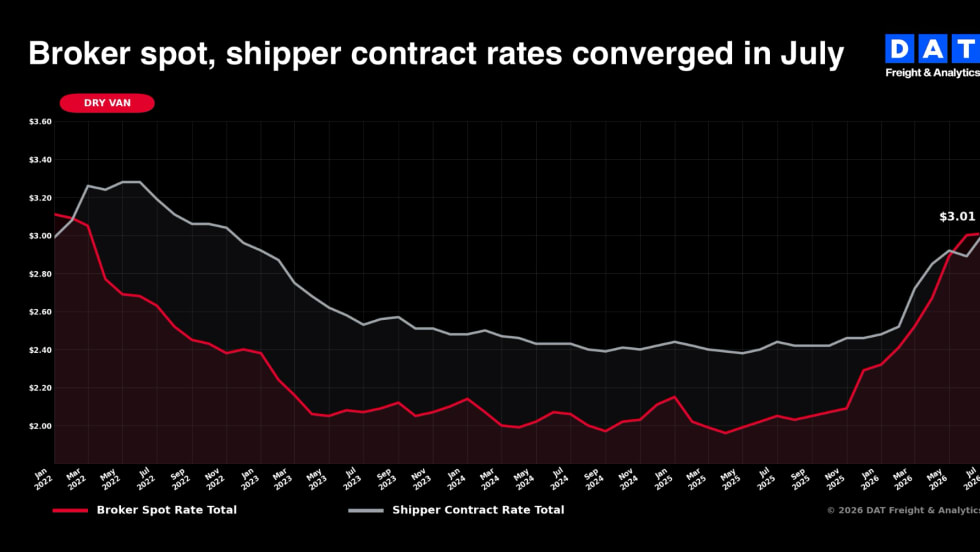
Tight Trucking Capacity Pushes Rates Higher Even as Freight Volumes Fall
“Spot rates moving ahead of contract rates have historically signaled a tightening market, but we haven’t seen a capacity-driven market quite like this one,” said DAT's Dean Croke.
Read More →