





Related: Does Your Fleet Need Smart Trailers?
How to Rebuild Tank Trailers
What's a fleet to do with a worn-out tank trailer with a perfectly good barrel? Rebuild the thing, of course. Refurbishing gives owners the benefit of the latest lighting, brake, and suspension innovations on a virtually new chassis for about half the cost of a whole new tank trailer – and you don't have to pay the federal excise tax.
December 31, 2019
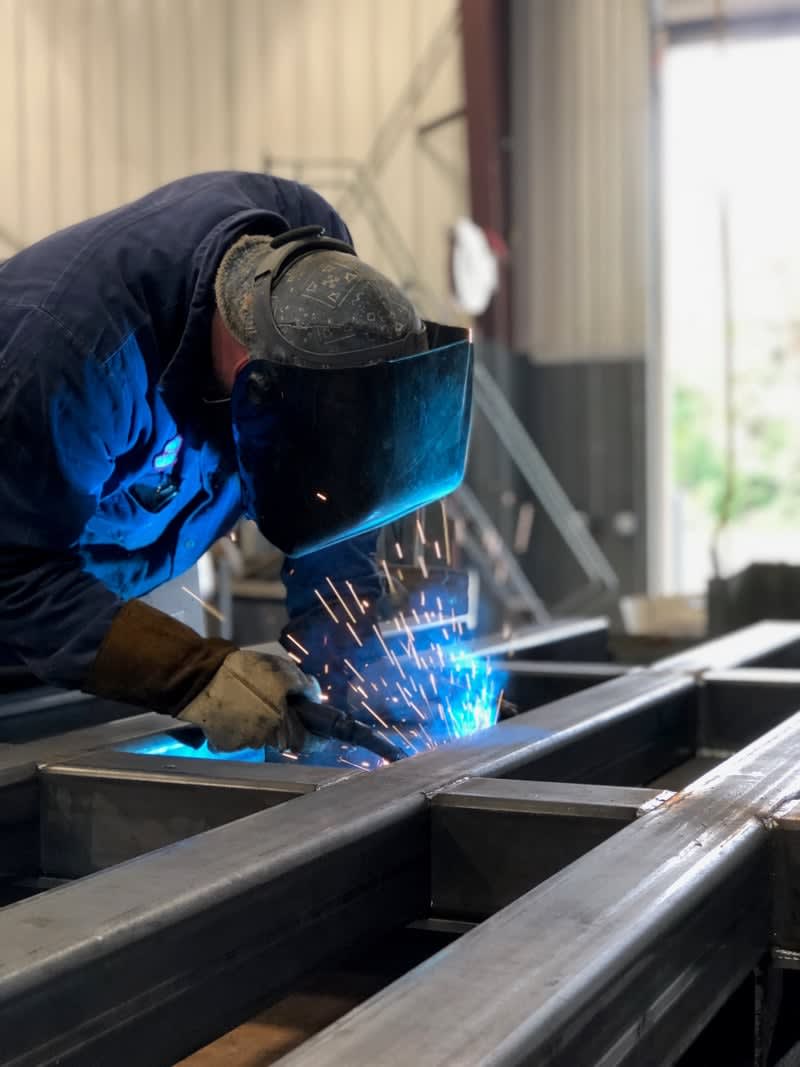
St. John builds stainless steel subframe for a tanker refurb, doubling the life expectancy of the equipment.
Photo: Jim Park
5 min to read
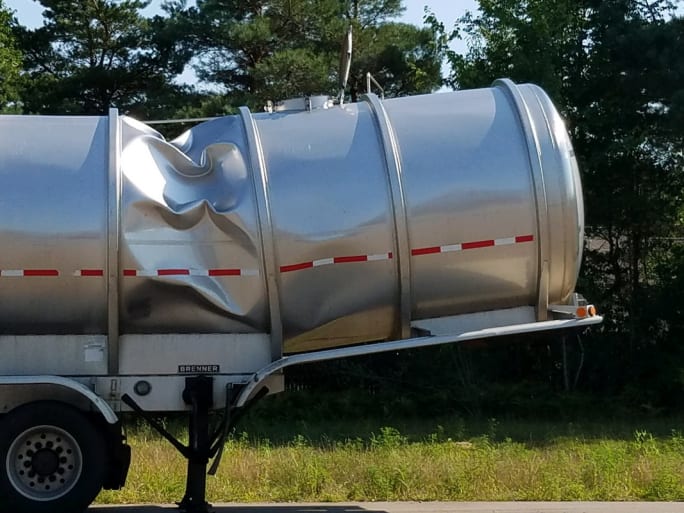
When a tank is not vented during unloading, the barrel will crush under the vacuum. Repairing such damage is an exacting process, but the tank can be returned to service.
Photo: Jim Park
You could hardly call it planned obsolescence, but what's a fleet to do with a worn-out tank trailer with a perfectly good barrel? Rebuild the thing, of course. Refurbishing gives owners the benefit of the latest lighting, brake, and suspension innovations on a virtually new chassis for about half the cost of a whole new tank trailer – and you don't have to pay the federal excise tax.
A stainless steel tank barrel, the type used in chemical and food-grade transport, can easily outlast its chassis, because stainless steel is almost impervious to the metal-munching impact of corrosion, especially in the Northeast where road de-icing chemicals have become extremely aggressive. Barring any severe damage or structural deficiency, such tank barrels can be removed from an aging chassis and dropped onto a new one for an additional 10-15 years of service.
The same can be done with aluminum petroleum tank bodies, but they may not last quite as long as stainless steel bodies.
"Tank barrels are usually good for 20-30 years, but the chassis rot out in 10-15 years due to the corrosive materials they are using on the road these days," says Brian Noppert, president of St John Truck & Trailer Service in Muskegon, Michigan. "We fabricate new stainless steel frames and install new running gear, such as axles, suspensions, landing gear, brakes, etc., and basically double the equipment's expected life."
St John Truck & Trailer Service has been rebuilding and repairing tank trailers since the early 1990s, but that's just part of what the company does. It's a full-service truck and trailer repair facility doing engine work, driveline work, brakes, suspensions – pretty well everything except tires. St John also does annual and five-year inspections along with highly specialized welding work. It has an "R" stamp from the National Board of Boiler and Pressure Vessel Inspectors, which allows the company to work on most types of tank trailers, including petroleum and liquified propane tanks.
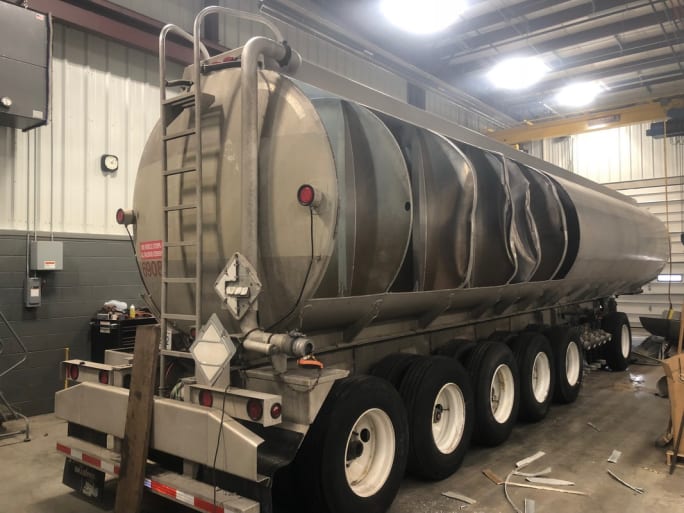
In addition to refurbishing tank trailers, St. John Truck & Trailer Service can also do complex repairs.
Photo: Jim Park
The company also sells new tanks. St John inked a deal in 2018 to sell tanks built by Advance Engineered Products Group of Drummondville, Quebec. Noppert says the deal was a good fit because of Advance's experience building multi-axle, high gross weight equipment for the Canadian market. In one collaboration, St John and Advance came up with a "weight-saving design where customers can scale 13,400 gallons of fuel oil on six axles whereas everyone is used to about 12,100 gallons," he says.
St John employs about 40 people at two locations; the 32,000-square-foot main shop in Muskegon, and a smaller 8,100-square-foot welding and fabrication shop called Exit 16 Fleet Repair in Coopersville. It also has a wash bay for external truck cleaning and a steam rack for cleaning and degassing the petroleum tanks.
"The company started in 1946 as a corner gas station and automotive repair shop owned by Ivan St. John, before he grew it into a heavy truck repair business," Noppert says. "We are located right between three major gasoline terminals, so there are lots of tanks and tank trucks operating in the area. It's a pretty natural fit for us to be servicing that industry."
Noppert says the biggest part of St Johns' repair and refurbishing business is aluminum tanks in the petroleum hauling sector. In Michigan, the typical petroleum tank is a 13,400 gallon, six-axle tank usually plated for 130,000 pounds gross weight.
Rebuild and refurbish
Major refurbishing operation at 10-15 years are pretty typical for many tank fleets, but it's more common for smaller operations. Noppert says larger companies might be more inclined to sell off older equipment and keep the fleet up to date whereas smaller companies will keep a tank in service as long as they can.
"They will typically do one frame rehab or refurb, sometimes two, but usually after the second refurb the tank barrel is up to 30 years old," he says. "At that point, it's usually sold as a water hauler or for fertilizer and could see another 10 years of work in non-spec service."
St. John usually builds new stainless steel subframes for the tanks along with new stainless cabinets, fenders, discharge plumbing, and all the running gear. They do most of this work in advance of actually pulling the trailer off the road so the downtime for the customer is kept to a minimum. When the subframe is ready, they lift the barrel off the old chassis and drop it onto the new one.
Durability and low maintenance are tops of the customer's specs, Noppert says. "Sealed hub assemblies are popular with customers now. The ones we install from SAF Holland come with a five-year wheel-end warranty. And they are asking for disc brakes and air suspensions too."
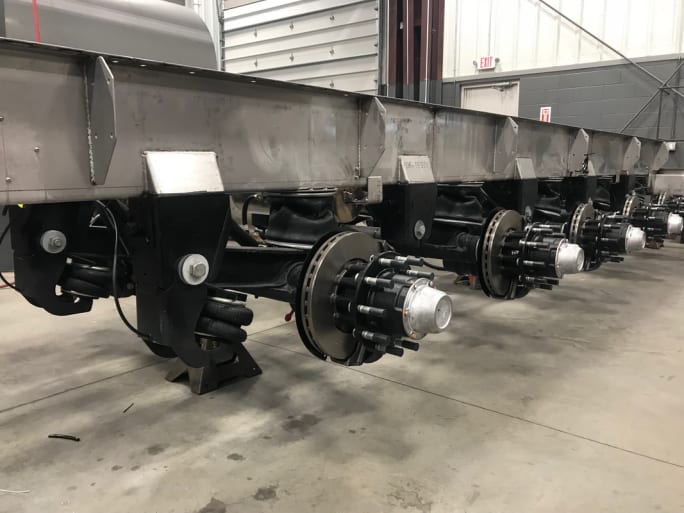
Suspension and brake equipment are updated to the latest technology, along with trailer wiring, fenders, cabinets, etc.
Photo: Jim Park
The suspension of choice is SAF Holland's CBX 2530, which is a 25,000-pound suspension at highway speed, but it's good for 30,0000 pounds at lower speeds. "It has to be a pretty robust suspension to take the extra stress when the trucks are cornering and maneuvering with three of the six axles raised. That means you have the full loaded weight on just half the number of axles. The 2530 has extra-heavy hangers." he says.
A full refurb usually includes new wiring and lighting, which tend to suffer greatly from the ravages of corrosion, time, and poor repair techniques. Noppert says most customers opt for a new harness with the latest connector and sealed junction boxes. Fenders and cabinets are usually replaced with new parts, while the discharge plumbing is usually inspected and repaired if necessary and replaced only as needed.
"When you have a 10- or 15-year-old-truck, the suspensions and braking systems are outdated and pretty well worn out," says Noppert. "A full refurbishment is a good way to renew an asset, which basically doubles its life expectancy."
Subscribe to Our Newsletter
More Equipment

How Volvo Updated Its D13 for EPA 2027 [Watch]
Volvo’s updated D13 promises lower emissions without sacrificing performance or fuel economy. Take a closer look at what changed inside the engine in this HDT Spotlight video.
Read More →
Michelin Tire Improves Efficiency and Durability for Regional Fleets
The Michelin X Multi Energy D2 is a regional haul drive tire engineered to help fleets improve fuel efficiency, durability and traction in demanding stop-and-go operations.
Read More →
ZF Expands Commercial Vehicle Push in North America
ZF is expanding its North American commercial-vehicle presence with new transmission applications, electrification, trailer technology and autonomous-driving systems.
Read More →
Tesla Wants a Self-Driving Semi. Are Cameras Enough?
Could Tesla’s camera-only autonomous driving technology work on an 80,000-pound Semi? In this commentary, HDT's Deborah Lockridge takes a look at Tesla, Cybercab, and how autonomous trucks see the road.
Read More →
Kodiak: Driverless Long-Haul Truck Launch on Track for 2026
Kodiak AI says its driverless long-haul safety case is 93% complete and it remains on track to begin commercial operations by year-end 2026.
Read More →
What DOT’s Automated Vehicle Strategy Means for Trucking
The U.S. Department of Transportation issued a new automated-vehicle strategy that outlines plans for driverless-truck regulations, cross-state freight corridors, and federal safety standards.
Read More →
East Coast Port Launches $45M Electric Truck Push
The Port Authority of New York and New Jersey announced millions in incentives for zero-emission drayage trucks, yard tractors, and new charging hubs near the port.
Read More →
PlusAI Going Public to Fund Autonomous Truck Launch
A SPAC deal could provide PlusAI with up to $300 million as it works toward a 2027 commercial launch of factory-built autonomous trucks.
Read More →
NHTSA Moves to Rewrite Truck Fuel-Economy Rules
The National Highway Traffic Safety Administration says it lacks authority to regulate medium- and heavy-duty truck engines separately from complete vehicles, but the existing standards have not yet been eliminated.
Read More →
Detroit Opens Orders for EPA 2027 Engines
Detroit isn’t starting from scratch to meet EPA 2027 diesel emissions standards. Its Gen 6 DD13 and DD15 engines keep much of today’s platform while updating the fuel and aftertreatment systems.
Read More →