





How Cylinder Deactivation Can Help Meet 2027 Emissions Targets
How CDA Works to Cut Emissions, Improve Efficiency
Cylinder deactivation can reduce NOx emissions through hotter exhaust temperatures and allow more efficient engine operation on fewer cylinders under low-load conditions.
June 17, 2021
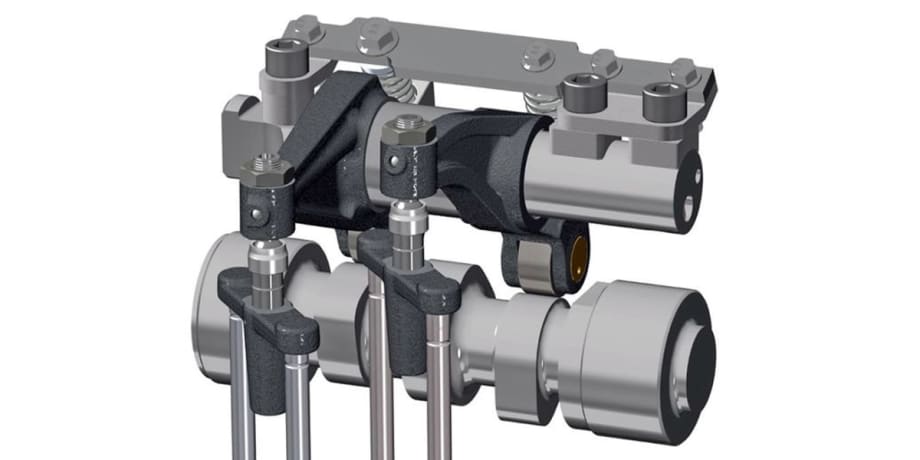
Cylinder deactivation keeps certain intake and exhaust valves closed, effectively turning off several cylinders and forcing the remaining cylinders to work harder but more efficiently.
Photo: Jacobs
6 min to read
There has always been some debate over the relative fuel efficiency of engines of varying displacement. But regardless of the displacement, a certain amount of energy (fuel) is required to do a certain amount of work (horsepower). When considering factors such as mechanical drag, pumping and compressing efforts, and fuel-to-air ratios, there would not be huge differences between a 13L engine and a 15L engine.
However, the dynamics change quite a bit when considering the relative efficiency of a 15L engine compared to a 7.5L engine. And that’s what cylinder deactivation (CDA) does. By “turning off” three of the six cylinders, you effectively reduce the working displacement of the engine. The inherent mechanical efficiencies resulting from using fewer cylinders to produce the same power can be surprisingly high.
DDA also offers huge potential to reduce nitrogen oxide (NOx) emissions. It will play a significant role in meeting 2024 and 2027 federal emissions requirements, as well as the new NOx-reduction and low-load-cycle emissions regulations currently being developed by the Environmental Protection Agency and the California Air Resources Board.
While CDA can reduce fuel consumption, its most significant benefit lies in emissions reduction – which also has an impact on fuel consumption.
How does CDA work?
Diesel engines work across a broad range of power requirements, from basically zero at idle up to the full rated output. At full power, all cylinders contribute to the effort and the user needs every cubic inch of displacement. Under low-load conditions, however, the required power can be easily produced by three or fewer cylinders.
If you were using all six cylinders, you’d be at maybe 10% or 20% throttle. But if you run on three cylinders at, say, 25% load, those three cylinders are more thermodynamically efficient. They will run hotter, the turbo is going to be more efficient, and the air-mass-flow through the engine is reduced when running on only three cylinders.
Reducing the mass-flow through the engine helps in a couple of ways.
One, it reduces the pumping effort required to move the air.
Two, the reduced volume of air allows for a lower air-to-fuel ratio. Depending on the precise duty cycle, that can result in a reduction in fuel consumption of about 40%, said Greg Shaver, professor of engineering at Purdue University, speaking during a webinar on the benefits of cylinder deactivation sponsored by Eaton, Cummins, and Perdue.
“CDA allows us to put less fuel into the engine for the same load,” he explained. “If the air-to-fuel ratio was 32 before, it might be 27 under CDA. It’s not starving the engine of air, therefore we don’t run into a soot-formation problem, either.”
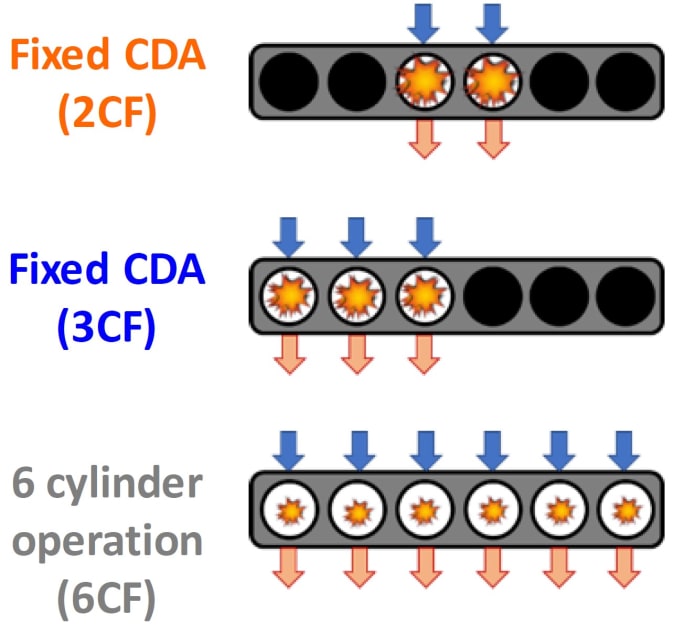
Running six cylinders at low load (bottom) produces low exhaust temperatures, while using two or three cylinders to produce the same output requires less fuel but produces hotter exhaust, which helps maintain high SCR temperatures.
Photo: Greg Shaver
CDA is accomplished by managing the valve train hydraulically to keep the exhaust and intake valves closed on certain cylinders while cutting off fueling to those cylinders, says Robb Janak, director of new technology for Jacobs Vehicle Systems.
“We basically just turn off the intake and exhaust valve main events with a bridge mechanism. Even though the rocker arms are still moving up and down, they’re no longer opening the intake and exhaust valves. That, combined with turning off fuel injection, shuts down the entire cylinder and forces the remaining cylinder to do the work, but more efficiently,” Janak says.
When you add electronics to control the intervals when CDA is applied and then manage the number of cylinders affected and the duration of the CDA events, you can very precisely control the performance. That’s what Jacobs and Cummins have been doing with Silicon-valley-based tech company Tula.
Tula’s Dynamic Skip Fire (DSF) is an advanced cylinder deactivation control strategy that makes decisions for an engine’s cylinders on an individual basis to best meet torque demands while saving fuel and maintaining performance. The company’s original DSF software has been shown to significantly reduce CO2 emissions in gasoline engines. It has been in production since 2018 with more than 1 million passenger cars and light trucks already on the road.
Testing of the Tula technology on a Cummins engine with Jacobs CDA technology has already shown a 74% reduction in NOx emissions.
Emissions reduction
While taking some cylinders out of service during low-load operation does reduce fuel consumption, the real benefit of CDA is reducing NOx emissions. Under low-load conditions, the exhaust temperature (from six lightly loaded cylinders) is too low maintain optimum NOx conversion in the selective catalytic reduction system.
Running loaded at highway speed, the SCR inlet temperature of the aftertreatment system would be around 250 degrees Celsius (about 480 Fahrenheit) or higher. While idling or driving in stop-and-go traffic, that temperature can drop to around 150 degrees C/300 F, well below the SCR catalyst’s optimum operating temperature.
“You’re producing a lot of NOx in traffic,” says Gabe Roberts, director of product development at Jacobs. “NOx conversion goes from 100% basically down to 10% or 20% in what we call the cruise-creep cycle.”
With CDA, the temperature will still drop, but it will plateau at about 180 C/350 F.
“That means the catalyst stays hotter for longer,” Roberts says. “Under this cycle, it still eventually cools off, but it stays hotter longer, so NOx conversion takes a lot longer to drop off. You produce a lot less NOx in CDA mode than in full six-cylinder mode.”
CDA is also proving useful in reducing the frequency and duration of active regeneration events. High exhaust temps enable the efficient oxidation of ash in the diesel particulate filter. In the absence of high exhaust temps, hydrocarbon dosing is used to raise the temperature inside the diesel oxidation catalyst and the DPF. Using CDA to maintain high exhaust temps when coasting or under other light-load conditions helps reduce or even eliminate the need for hydrocarbon dosing, improving vehicle fuel efficiency.
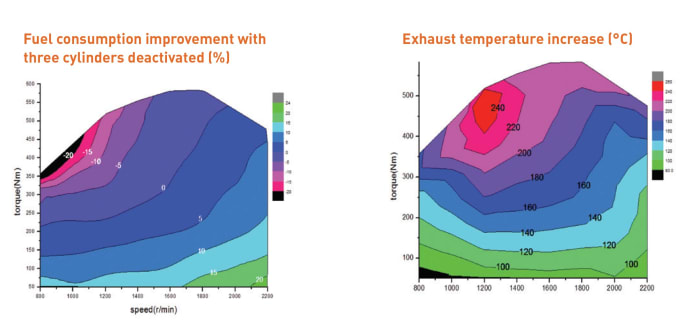
CDA improves fuel economy at low load conditions and reduces emissions by keeping the aftertreatment system hot during low load operation. In addition, the system allows for faster engine and aftertreatment system warm-up.
Photo: Jacobs
Detroit Diesel is doing something somewhat similar to maintain exhaust temperatures for more efficient regeneration. Rather than valve-controlled cylinder deactivation, Detroit uses asymmetric injection where fuel is cut off to three cylinders while fueling to the remaining three cylinders is increased. Detroit claims this is especially useful at startup to heat the aftertreatment system faster and at idle to keep exhaust temperatures high, thus lowering soot production. It can also be used along with the engine brake during coasting to boost exhaust temps.
“With the DD15 Gen 5, we can activate the engine brakes during driving regens to reduce the temperature drops while the truck is coasting and the engine is at very low load,” says Len Copeland, Detroit heavy-duty product marketing manager. “We can apply engine braking to three cylinders and add fuel to the remaining cylinders. In effect, the cylinders are fighting each other just for the purpose of generating heat.”
Copeland says the process is invisible to the driver.
When will we see CDA?
There are presently no CDA-equipped heavy-duty diesel engines in production.
Jacobs says it’s being tested on at least eight different manufacturers’ engines around the world in the research and development phase.
Eaton is also developing several CDA and variable valve actuation technologies it believes will be needed to reduce carbon dioxide by up to 20% by 2024 and up to 27% by 2027.
Mandated emissions reductions are coming in Europe, Japan, China, India and other markets in the coming years, but they are expected to be significantly different from the U.S. EPA rules. CDA is seen as means of getting closer to those targets without making substantial modifications to existing base engine designs globally.
This article first appeared in the June 2021 issue of Heavy Duty Trucking.
Subscribe to Our Newsletter
More Fuel Smarts

How Volvo Updated Its D13 for EPA 2027 [Watch]
Volvo’s updated D13 promises lower emissions without sacrificing performance or fuel economy. Take a closer look at what changed inside the engine in this HDT Spotlight video.
Read More →
Diesel Price Spike Shortens Payback for Natural Gas Trucks, Report Says
Energy Vision estimates fleets could recover the higher purchase price of an RNG-fueled Class 8 tractor in 1.3 to 2.8 years under current fuel-price scenarios.
Read More →
Calstart Becomes Catalyst Mobility, Reflecting Broader Focus
Calstart is now Catalyst Mobility, reflecting the nonprofit’s growing national role in clean transportation, including zero-emission trucks, infrastructure and incentive programs.
Read More →

Record Diesel Prices Squeeze Trucking Fleets
Average U.S. diesel prices have climbed to nearly $6 a gallon, surpassing the 2022 record as tight refinery capacity and Middle East disruptions keep fuel costs elevated.
Read More →
Sponsored•September 9, 2026
How Fuel Delivery Shapes Engine Performance
Fuel delivery depends on more than what happens at the injector. For fleet, maintenance and technical professionals, looking at the full path from pump to injector can provide useful context for understanding engine performance.
Read More →
East Coast Port Launches $45M Electric Truck Push
The Port Authority of New York and New Jersey announced millions in incentives for zero-emission drayage trucks, yard tractors, and new charging hubs near the port.
Read More →
California Bill Could Shed Light on Electric Truck Prices
Why do battery-electric Class 8 trucks remain so expensive? A California bill headed to Gov. Gavin Newsom would give fleets and state agencies more visibility into what manufacturers charge.
Read More →
Detroit Opens Orders for EPA 2027 Engines
Detroit isn’t starting from scratch to meet EPA 2027 diesel emissions standards. Its Gen 6 DD13 and DD15 engines keep much of today’s platform while updating the fuel and aftertreatment systems.
Read More →
Zero-Emission Truck Corridor Planned for West Coast
California, Oregon, Washington, British Columbia and Baja California are coordinating plans for truck charging and hydrogen fueling from Canada to Mexico.
Read More →
A Closer Look at Kenworth’s Electric T880E Vocational Truck [Video]
Learn more about Kenworth's T880E battery-electric vocational truck at the Paccar Technical Center, including its range, applications, upfitting considerations, and PTO options, in this HDT Spotlight video.
Read More →