




High-Tech Solutions Could Address Truck Parking Problem
Nearly 100 people participated in a webinar last month on the truck parking shortage and innovative ways this problem can be addressed. The webinar was put on by the Trucking Industry Mobility and Technology Coalition. Several studies dating back to the 1990s have found that there is an inadequate supply of truck parking, especially along key freight corridor

Smartphones are one way drivers could learn about available truck parking spaces.
Nearly 100 people participated in a webinar last month on the truck parking shortage and innovative ways this problem can be addressed.
The webinar was put on by the Trucking Industry Mobility and Technology Coalition.
Several studies dating back to the 1990s have found that there is an inadequate supply of truck parking, especially along key freight corridors
, and that these shortages negatively impact highway safety, said Tom Kearney, manager of freight operations with the Federal Highway Administration.
As the result of one National Transportation Safety Board report, the Federal Motor Carrier Safety Administration initiated an investigation into technology-based approaches to developing solutions for the truck parking shortage. In turn, this research led to the multi-phase "Smart Park" initiative.
In recent years, Congress authorized $25 million in as part of highway funding for the Truck Parking Facilities Discretionary Program, which provided funding for truck parking space construction, ITS technology research and development, and to make improvements to public truck parking facilities.
However, this program was not continued under MAP-21. Instead, the seven eligible activities identified under SAFETEA-LU Section 1305 are now eligible for National Highway Performance Program, Surface Transportation Assistance Program and Highway Safety Improvement Program funds.
In a recent survey by the American Transportation Research Institute, both drivers and carriers said the best way to get information on truck parking availability was roadside variable message signs.
About half the respondents would most like to receive parking availability information 20 miles away from the truckstop/rest area. While slightly more than half of all of the survey respondents would like the ability to reserve a truck parking space, many would be unwilling to pay or, at most, pay only a minimal fee for this service.
One example of a truck parking information system in the works is Michigan's I-94 Truck Parking Information and Management System. This project will deploy sensing technology to monitor and manage parking availability to provide timely information to drivers and carriers, according to Dave Miller, founder and COO of Gnosis Management. Currently, the system plans to disseminate information through three channels: Dynamic truck parking signs, MiDrive website and a connected vehicle application. A smartphone application is also being developed.
The University of Minnesota and the Minnesota Department of Transportation are also developing a comprehensive real-time information system for truck parking availability. Ted Morris, Department of Computer Science and Engineering at the University of Minnesota, spoke about the automated parking availability detection system.
This approach uses 3-D object reconstruction to measure space occupancy by "seeing" if a vehicle is present or not. Multiple cameras are used to observe the scene and can overcome common problems such as sharp shadows, lighting changes and weather-related changes (i.e. rain, ice and snow) that can confound non-3-D image processing techniques. Field installation of the parking system at the first of four rest areas began this fall.
To view a complete recording of the "Truck Parking Issues & Opportunities" webinar, visit www.freightmobility.org.
More Safety & Compliance
A Camera Isn't a Safety Program. Here's What Brokers Are Screening for Now
Footage alone may not be enough to pass broker vetting processes. Here's what counts as a defensible safety program now.
Read More →
Marijuana and Trucking’s Drug-Testing Dilemma
Marijuana is getting stronger, laws are changing, and drug tests still can’t reliably establish impairment. What does that mean for truck drivers and the fleets that employ them?
Read More →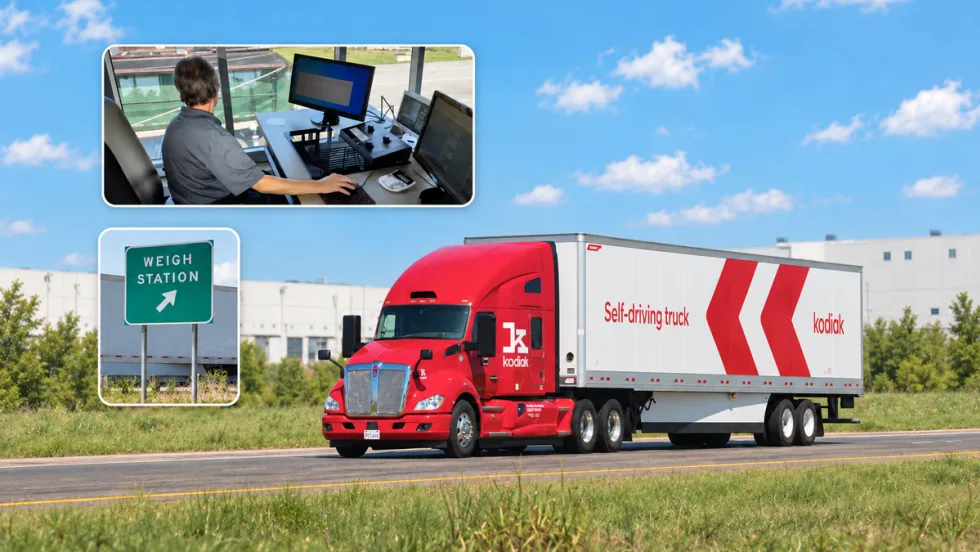
PrePass, Kodiak Connect Driverless Trucks to Roadside Enforcement
The system will allow enforcement agencies to verify Enhanced Inspection information and decide whether Kodiak’s autonomous trucks can bypass roadside screening sites.
Read More →

From One Generation to the Next: How Mentorship Builds Safer Truck Drivers
After three decades in trucking, Harold Perry shares what he's learned about driver safety, mentorship, and helping the next generation build confidence behind the wheel.
Read More →
FMCSA Pauses Biennial-Update Enforcement Amid Motus Transition
Carriers whose updates were due on or after June 1 have more time, while FMCSA works to stabilize its new registration system and warns of phishing sites impersonating its new carrier registration system, Motus.
Read More →
ZF Expands Commercial Vehicle Push in North America
ZF is expanding its North American commercial-vehicle presence with new transmission applications, electrification, trailer technology and autonomous-driving systems.
Read More →
Truck Drivers Need More Than Another Alert
Fleets have more visibility into truck health, safety events, and driver activity than ever. The next challenge is turning all that information into useful guidance for the person who has to decide what to do next.
Read More →
Tesla Wants a Self-Driving Semi. Are Cameras Enough?
Could Tesla’s camera-only autonomous driving technology work on an 80,000-pound Semi? In this commentary, HDT's Deborah Lockridge takes a look at Tesla, Cybercab, and how autonomous trucks see the road.
Read More →
What DOT’s Automated Vehicle Strategy Means for Trucking
The U.S. Department of Transportation issued a new automated-vehicle strategy that outlines plans for driverless-truck regulations, cross-state freight corridors, and federal safety standards.
Read More →
NYC Expands Speed, Pedestrian Safety Tech Across Fleet
New York City is expanding intelligent speed assistance and pedestrian-alert systems across its municipal fleet, moving the technologies from pilot programs into vehicle procurement and retrofit requirements.
Read More →