




Heavy Hauler Goes Big
Henderson Heavy Haul has to maneuver some of the largest oversized loads on the road. Without the right equipment, they would be stuck between more than just a rock and a hard place.

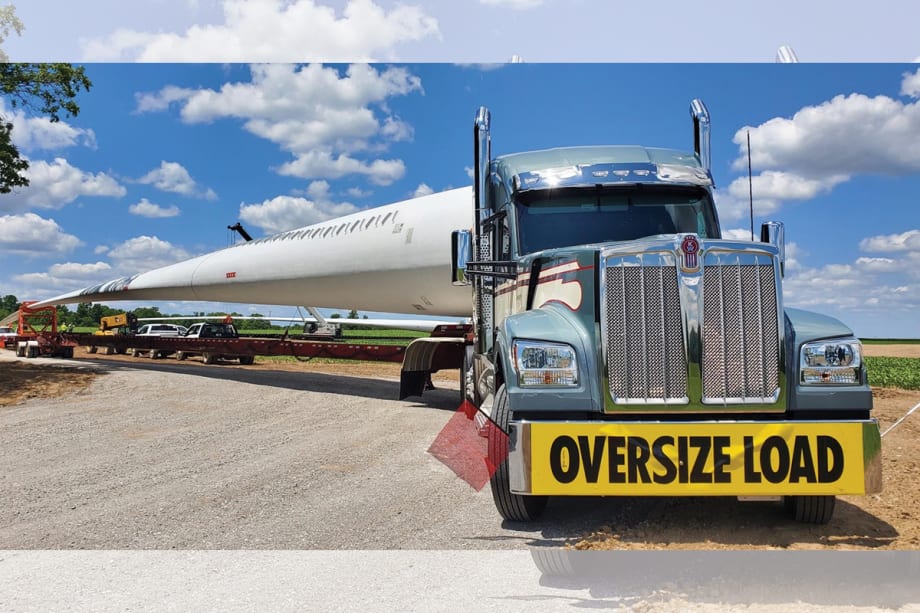
Planning out the right route can be tough for anyone, but add in inclement, sometimes unpredictable weather and loads weighing more than 260,000 pounds, and routing becomes a challenge that takes a whole team to execute.
Photo: Kenworth
Like most carriers, Henderson Heavy Haul Trucking faces three challenges when spec’ing their trucks: dependability, serviceability, and cost. And when you’re moving loads that can be more than 240 feet long and weigh upwards of 160,000 pounds through unpredictable weather, you better be able to depend on each moving part along the way.
“Living in Colorado, they say if you don’t like the weather, wait 15 minutes, so we have to spec the trucks to go from one extreme to the next,” says Mark Weisgerber, operations manager at Henderson Heavy Haul.
After founding the business in Denver, Colorado, about 35 years ago, owner Cliff Henderson moved the operation to Grand junction, Colorado, located about halfway between Denver and Salt Lake City. From the very start, Henderson relied on Kenworths, beginning with a fleet of Kenworth W900B trucks. Currently, Weisgerber runs a fleet of 38 Kenworth trucks, most of them four-axle tractors.
While Weisgerber and the Henderson crew specialize in transporting heavy equipment, its mainstay business is hauling oversized components used to construct wind turbines throughout U.S. and around the world. This type of cargo calls for the right planning, preparing, and execution, considering that the blades for the windmills can be as long as 240 feet, with the total length of the truck, trailer, and load at 270 feet. The tower sections measure 90-plus-feet-long and weigh 160,000 pounds each — a load that is altogether 200-feet-long and weighs about 260,000 pounds.
“Probably the most impressive load that we have moved to date is a Sky Pool that was manufactured in Grand Junction and moved into the United Kingdom,” says Weisgerber. “It was 20 feet wide, 165 feet long, 16 feet tall, and was 270,000 pounds total gross.”
During the move from Grand Junction to Houston, Texas, wildfires were raging and changed Weisgerber’s plan, forcing his team to reroute the entire load at the last minute to make it in time for the ship bound for the U.K.
“The challenges are similar on all loads, but the time of year has a lot to do how hard it could be to get something moved, from construction, to weather, to the total unforeseen fires,” adds Weisgerber, “but weight, width, and height are factors all year round.”
But, as in many cases, it comes down to the drivers who move the loads, and ensuring they are comfortable and able to do their jobs as effectively as possible, which can reduce operational costs.
“Operating newer equipment does not only lower the cost of operation, but it also gives off a sense of pride with the drivers that computes into more and better production. The real cost that a company has is not only the breakdown, but more to the downtime of the truck being in the shop and the loss of revenue while the truck is being worked on,” says Weisgerber.
More Equipment

How Volvo Updated Its D13 for EPA 2027 [Watch]
Volvo’s updated D13 promises lower emissions without sacrificing performance or fuel economy. Take a closer look at what changed inside the engine in this HDT Spotlight video.
Read More →
Michelin Tire Improves Efficiency and Durability for Regional Fleets
The Michelin X Multi Energy D2 is a regional haul drive tire engineered to help fleets improve fuel efficiency, durability and traction in demanding stop-and-go operations.
Read More →
ZF Expands Commercial Vehicle Push in North America
ZF is expanding its North American commercial-vehicle presence with new transmission applications, electrification, trailer technology and autonomous-driving systems.
Read More →
Tesla Wants a Self-Driving Semi. Are Cameras Enough?
Could Tesla’s camera-only autonomous driving technology work on an 80,000-pound Semi? In this commentary, HDT's Deborah Lockridge takes a look at Tesla, Cybercab, and how autonomous trucks see the road.
Read More →
Kodiak: Driverless Long-Haul Truck Launch on Track for 2026
Kodiak AI says its driverless long-haul safety case is 93% complete and it remains on track to begin commercial operations by year-end 2026.
Read More →
What DOT’s Automated Vehicle Strategy Means for Trucking
The U.S. Department of Transportation issued a new automated-vehicle strategy that outlines plans for driverless-truck regulations, cross-state freight corridors, and federal safety standards.
Read More →
East Coast Port Launches $45M Electric Truck Push
The Port Authority of New York and New Jersey announced millions in incentives for zero-emission drayage trucks, yard tractors, and new charging hubs near the port.
Read More →
PlusAI Going Public to Fund Autonomous Truck Launch
A SPAC deal could provide PlusAI with up to $300 million as it works toward a 2027 commercial launch of factory-built autonomous trucks.
Read More →
NHTSA Moves to Rewrite Truck Fuel-Economy Rules
The National Highway Traffic Safety Administration says it lacks authority to regulate medium- and heavy-duty truck engines separately from complete vehicles, but the existing standards have not yet been eliminated.
Read More →
Detroit Opens Orders for EPA 2027 Engines
Detroit isn’t starting from scratch to meet EPA 2027 diesel emissions standards. Its Gen 6 DD13 and DD15 engines keep much of today’s platform while updating the fuel and aftertreatment systems.
Read More →