




HDT’s Innovators Reflect on Pandemic Year
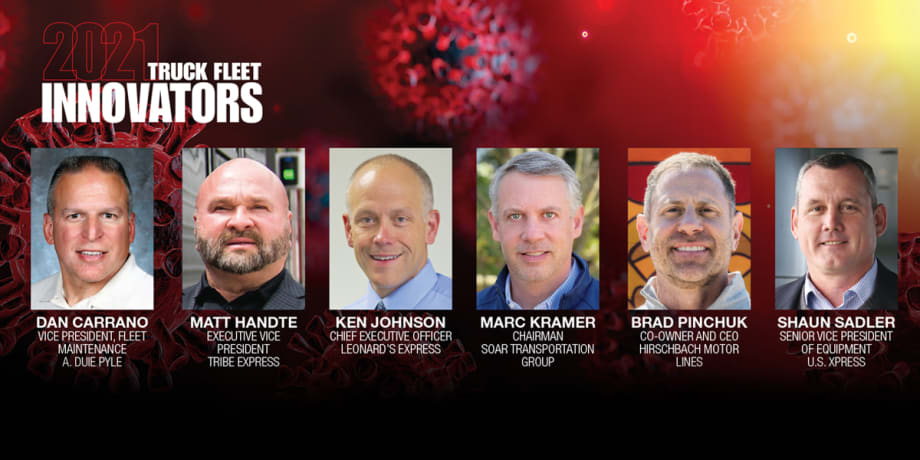
HDT's 2021 Truck Fleet Innovators talk about how the COVID-19 pandemic has affected them and their companies, and if there are lessons learned, technologies or practices adopted as a result of the pandemic that they believe will make for long-term changes.

When 2020 dawned, Ken Johnson was looking forward to a new year, a new decade, and had big plans.

Ken Johnson, Leonard's Express
“Within three months, I was spending most of my time trying to find places to secure hand sanitizer and disinfectant wipes and face masks,” says the chief executive officer of Leonard's Express, Farmington, New York, one of HDT’s 2021 Truck Fleet Innovators.
While that wasn’t how he expected to be spending his time last year, he says, “our drivers are out in the public and using public facilities and having to interact. It's not a job they can do from home, you know. I felt it was my responsibility to make sure they had all the resources they needed to feel safe in the truck and interacting with our customers.”
We spoke with Johnson and our other five Innovators about how the COVID-19 pandemic has affected them and their companies, and if there are lessons learned, technologies or practices adopted as a result of the pandemic that they believe will make for long-term changes.
The Initial Impact of the Pandemic
Ken Johnson: Because the majority of Leonard’s Express customers were grocery chains or suppliers to grocery chains, demand did not drop – in fact, it was up a bit.
“The rest of the year became somewhat of a roller coaster,” he said, as other fleets pivoted from freight that was no longer in demand and turned into competitors for that freight.
By late summer, he says, things were picking back up and demand has remained fairly high. “We're managing through it, and I still have an office full of hand sanitizer and disinfectant wipes.”
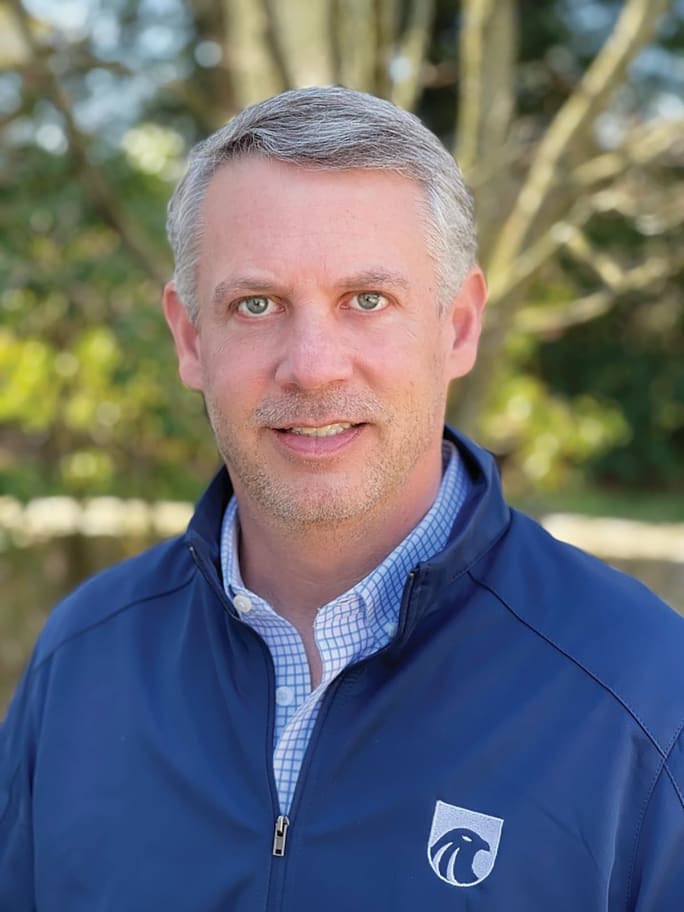
Marc Kramer, Soar Transportation
Marc Kramer, chairman of Soar Transportation Group, West Valley City, Utah, lives in New York, just a couple miles from one of the earliest COVID-19 hot spots in the U.S. – New Rochelle, New York. In early March, Gov. Andrew Cuomo announced the state’s first so-called containment zone in this New York City suburb.
“So the awareness and sensitivity to what was going on in March of 2020 where I live, versus out in Texas, or Utah, or Tennessee [where Soar has operations] was very different.”
That early experience allowed him to get ahead of issues such as how to keep the business functioning while keeping employees safe, whether they were coming into an office or driving a truck into a customer distribution center.
“So we were very aggressive on that at the outset,” getting the businesses ready to push functions that could be done virtually into a remote format.
Soar experienced early disruption to its business when food service and restaurants were shut down but was able to shift more to retail grocery business.
“Where we saw the greatest disruption was in that April-May timeframe like everybody else, but we saw things coming back in the May-June timeframe.”
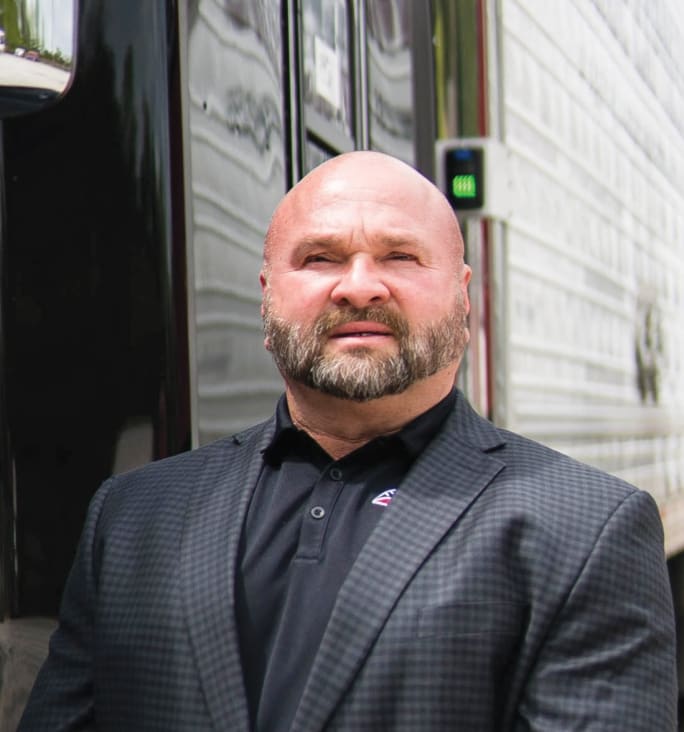
Matt Handte, Tribe Express
Matt Handte: For Gainesville, Georgia-based temperature-controlled carrier Tribe Express, the first months of the pandemic were like night and day depending on which parts of its operation you look at.
“It kind of was twofold,” says Handte, Tribe executive vice president. “If you put food and beverage in one category, and then food service in another category, the food and beverage was outstanding. You had a lot more people eating at home, more people shopping from the grocery stores, and all that volume was way up. All the consumer care products was probably up 60%.
“And then the food service, all our restaurants and fast food type chains, you had a category of them that were way down.”
However, he said, a couple of food-service customers did very well, those that figured out contactless delivery and curbside options early on.
Refrigerated freight services were in demand for pharmaceuticals, too, he said, and more recently the company has been transporting COVID-19 vaccines.
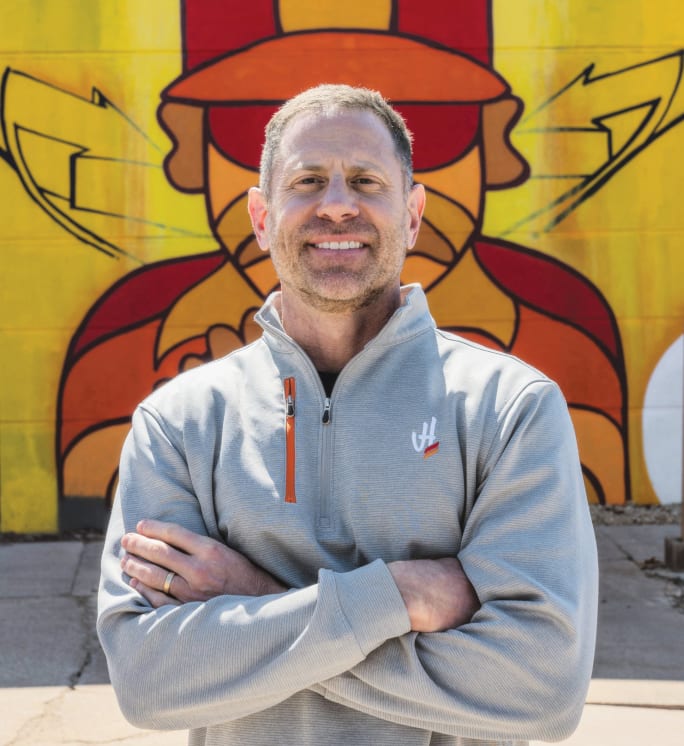
Brad Pinchuk, Hirschbach Motor Lines
Brad Pinchuk: Hirschbach Motor Lines had a challenging first few months of the pandemic, says the co-owner and CEO of the Dubuque, Iowa-based carrier. The temperature-controlled fleet hauls a lot of protein products.
“In April and May, in particular, as our customers were struggling with COVID going through some of their plants and having to shut their plants down and regroup on protecting their employees, we ended up with a real challenging situation,” he says.
That also meant a lot of the company’s owner-operators were hurting, as well, so Hirschbach put together a team to help its independent contractors get PPP loans. For those who weren’t able to get loans, the company took steps such as forgiving truck payments and insurance payments for those who were on a lease-purchase agreement.
Drivers and COVID-19
Marc Kramer: In the early days of the pandemic, Kramer says he laid awake at night worrying about whether the company would still have enough drivers willing to take the risks involved.
“What I found was – and I think it's just a core of who the people are in this industry – our drivers wanted to drive. They wanted to be part of the solution to help, in our case, deliver groceries and to help keep the supply chain moving. And so what we saw was more drivers raising hands to say, ‘What can we do to help right now?’”
Soar put decals on trucks to emphasize “they were part of the mission of keeping America moving,” he says. “And I think we did a very good job on communicating with our customers to ensure that the environments that we were sending them into were safe.”
Soar extended telehealth services to all employees, whether they were part of the company’s health care program or not, so that they had immediate resources.
Driver recruiting and onboarding also had to change due to the pandemic, Kramer says.
“People were afraid to get on a plane. How are you going to do recruiting and orientation if you can't get people to come to orientation?”
While technology allowed some functions to be done virtually, “we operate best, especially if you're doing different types of tests and driver tests, to have them be there in person. And so we did create an alternative program to allow people to come by car, as opposed to by plane, which has been our historic mode. And we changed up some of our advertising and some of our screening and advance work so that we could really ensure that the people that were coming through were the high-potential people that would actually make it through the program.”
Brad Pinchuk: “As far as keeping our drivers safe out there from COVID, we basically made our own soap and got it deployed to all of our drivers at our terminals. We couldn't get ahold of masks early on, so we had an army of people making homemade masks to be able to hand out to our drivers.”
Hirschbach, like many companies, also went to a hybrid virtual and in-person onboarding process for new drivers.
“We went from an orientation of three days for an experienced driver down to three hours,” Pinchuk explains. “During COVID, we moved 100% of our classroom to be online remote from their homes. Then we'd schedule a three-hour time slot for them to come in at one of our terminals, which was basically a road test and familiarization with the equipment.”
Since then, the company has returned to more in-person orientation, “but we've cut the time in half at this point for the in-person training from where we were before. We felt some of the training, in particular safety training, we really wanted that to be face-to-face. And we want the drivers to meet us and feel more a part of the organization and understand who we are and what the culture is. Doing all that remotely and coming in for a three-hour session, we didn't think quite got that done for us as effectively as we wanted.”
One thing that the pandemic made some fleets aware of is that they could be doing a much better job of cleaning truck interiors in between drivers – something that drivers appreciate and can help with retention.
Ken Johnson: “If we lose a driver or we put a driver in a new truck, when we’re getting the old truck ready, we used to clean it – and now we really clean it. Sanitizing and replacing a lot of the soft material and mattresses, where before if it looked like it was in pretty good shape we may not have.”
Shaun Sadler, U.S. Xpress
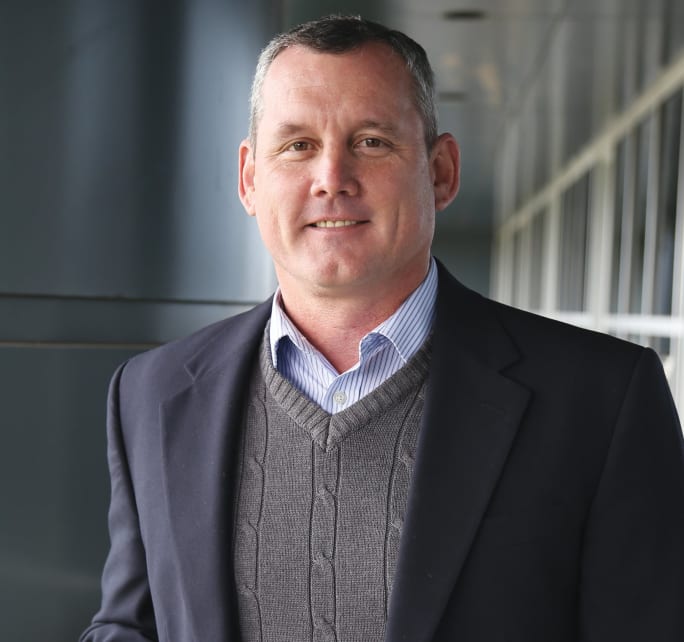
Shaun Sadler: Sadler, senior vice president of equipment at U.S. Xpress, views drivers as another type of customer and cleaner trucks as another way to take care of them.
“We've taken a little bit more care and understanding of how clean that vehicle is, how we take care of that vehicle," he says. "We give a lot more better customer service today than we did yesterday. When you start talking about some of the things we may have taken for granted before; just a pet in a vehicle can create some sort of additional worry, right? Pet hair is one of those just proliferates through vehicle and it's hard to get clean. Today it's more important. We want to make sure that we don't leave any stone unturned – or mat unturned in this case – and make sure we clean the vehicle to standards that we probably didn't expect in the past.”
Managing the shop during a pandemic
Dan Carrano, A. Duie Pyle
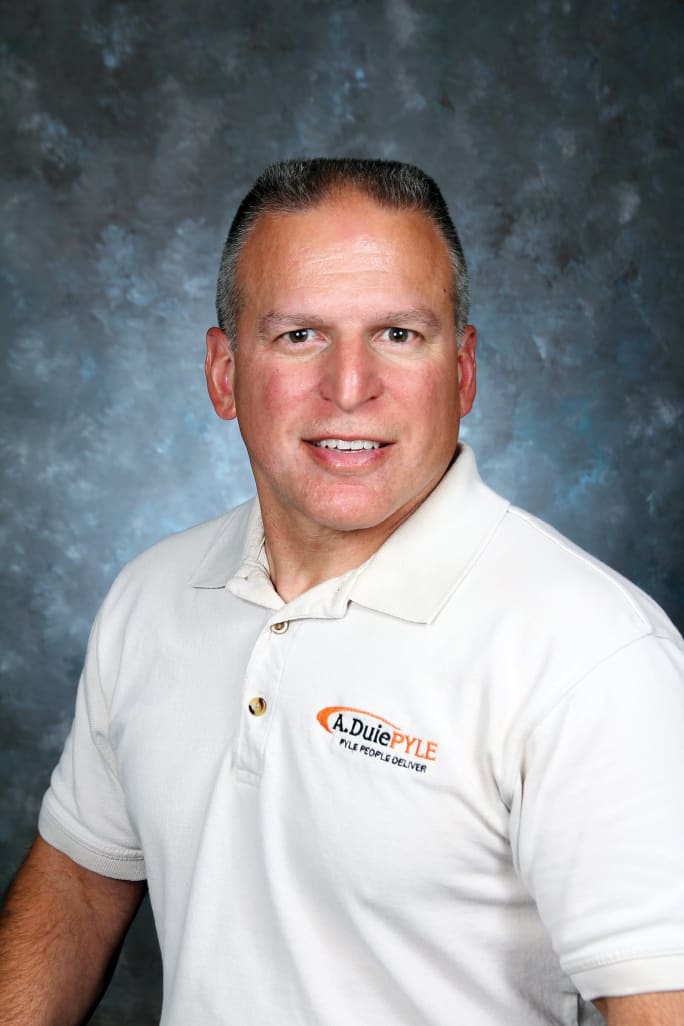
Dan Carrano: For the vice president of fleet maintenance for Pennsylvania-based less-than-truckload carrier A. Duie Pyle, the challenges of the pandemic came in making changes in its shops to protect technicians.
For technicians working by themselves in their workstations, he says, face masks are not required, but anytime they were working together more closely, face masks are required.
In normal times, he says, “A whole shift would take lunch at the same time. That's no longer the case anymore – it’s one fleet tech per table.”
In larger shops where that social distancing isn’t enough, Pyle divided the staff into several different shifts for lunch.
“I think overall, we've been pretty successful at working with, and dealing with, the COVID situation,” Carrano says. “If you do everything that's really asked of you, it really minimizes the risk. And that's really what we've done.”
Shaun Sadler: “In the shop environment, I think we instituted COVID protocols very efficiently. And quite frankly, I think we did an extraordinary job doing that,” he says. “I haven't seen a widespread case of COVID at any of my shops. We've had onesies and twosies. We’ve maybe seen a driver coming to a facility that had COVID, so we cleaned the facility, we may close it for a day.
“But the ramifications of the sickness just haven't taken a widespread effect on our company. We've been very proud of our employees and the way that they take the disease very seriously. They make sure that they follow those protocols.”
The Virtual Office
Our innovators had mixed feelings on whether working from home would be a strategy they would continue.
Ken Johnson: Working from home “just never has been our way of doing business. But we rallied and adapted quickly. I think at the high point, we may have had 60-65% of our non-driving workforce working from home. I think we still have about 30-35% of our people working from home.”
Even after the pandemic, he says, he believes Leonard's Express will be more likely to consider people wanting to work from home if they're in the right position.
“I certainly wouldn’t want to own office space in New York City anymore. I think people have learned that you can be a lot more productive at home, or as productive at home, and not have the need for a large office space. There’s certainly functions that can work remotely, and still be as productive and contribute to our company.”
Matt Handte: Although Tribe tried some remote work, Handte says it’s just not the way they like to operate.
“Our operations is in one big room, and there’s too much information that’s happening on an hourly basis that’s not in the system. It’s very difficult if we're disconnected in operations to understand and process that information. There’s a lot of conversation, direction, planning, problem-solving, that are outside the system.”
For Tribe, he said, they have discovered that working in-person but social distancing allows them to “still have the conversations that are needed to provide the solutions to our customers and our drivers each and every day.”
Marc Kramer: Soar recently decided to bring most of its employees back to the office.
“I think the extreme focus on the health and safety and having that be a priority that everyone can feel comfortable.”
Brad Pinchuk: “I think like anything, you can go too far in one direction, or too far in another direction. For our office team members, we did work from home for a long period of time. And that really forced us to be able to, from a technology standpoint, make sure people were able to connect to the system and work efficiently from home.”
However, he says, “a lot of collaboration that needs to happen in the office, and does that collaboration happen as well when everyone's working from their home? No.
“I just think everyone working from home is not going to work for our business. And speaking with other business owners or CEOs in our industry or others, I think most would agree that it's pretty tough to create a real dynamic culture, having everyone working from their home.”
Where the lessons learned from virtual work could be a long-term benefit for Hirschbach and other companies, he says, is in allowing employees to occasionally work from home when it’s necessary.
“We now have the confidence in the technology to be able to work from home. Our preference is still that they're in the office, [but] I think we'll show more flexibility, whether it be from an illness or some family situation.”
More Fleet Management

How Telematics Improves Visibility, Control, and Performance in Refrigerated Fleets
Explore how telematics help refrigerated fleets improve visibility, uptime, efficiency, compliance, and cargo protection across connected cold chain operations.
Read More →
What the U.S.-Canada Trade War Means for Trucking
Escalating U.S.-Canada tariffs could disrupt cross-border freight, reduce truck volumes, raise costs, and create new uncertainty for carriers on both sides of the border.
Read More →
What Are Trucking’s Top Concerns for 2026?
The American Transportation Research Institute wants to know what's worrying trucking fleet managers, drivers, and other stakeholders in its annual Industry Issues survey.
Read More →

American Trucking Associations Looks for a New Leader
ATA President and CEO Chris Spear abruptly left his job at the association on August 21, at a pivotal time for the trucking industry.
Read More →
Public Wi-Fi Cybersecurity Risks: How Truck Drivers and Fleets Can Protect Their Data
Public Wi-Fi can expose truck drivers and fleets to credential theft, malware, and other cyber threats. Here’s how to reduce the risk on the road.
Read More →
For Nicky Cupp, Fleet Innovation Starts With Frustration
HDT Truck Fleet Innovator Nicky Cupp turns everyday pain points at Fraley & Schilling into opportunities for better technology and smarter processes.
Read More →
Adam Buttgenbach’s Approach to Electric Trucks: Start With Where They Fit
HDT Truck Fleet Innovator Adam Buttgenbach helped PepsiCo build one of North America’s largest EV fleets by focusing on where electric trucks make operational sense.
Read More →
Deen Albert: Let Automation Do the Math, People Make the Decisions
HDT Truck Fleet Innovator Deen Albert makes sure people are still at the heart of operations at Grand Island Express, even while adopting artificial intelligence tools. AI-assisted dispatch helped boost revenue 25% with the same number of trucks.
Read More →
Trimble’s New AI Agent Takes Aim at Fleet Back-Office Busywork
Arc Agent works across Trimble TMS products to automate repetitive tasks such as freight orders, maintenance, invoices, fuel costs and more.
Read More →
How HDT’s 2026 Truck Fleet Innovators Are Rethinking Fleet Operations
Meet five trucking leaders who are challenging assumptions, solving operational problems, and putting innovative ideas to work.
Read More →