




Great American Trucks: The Jeep
It began life as a tiny little scout car. And it became one of the most famous trucks, ever -- the rolling personification of American can-do spirit.

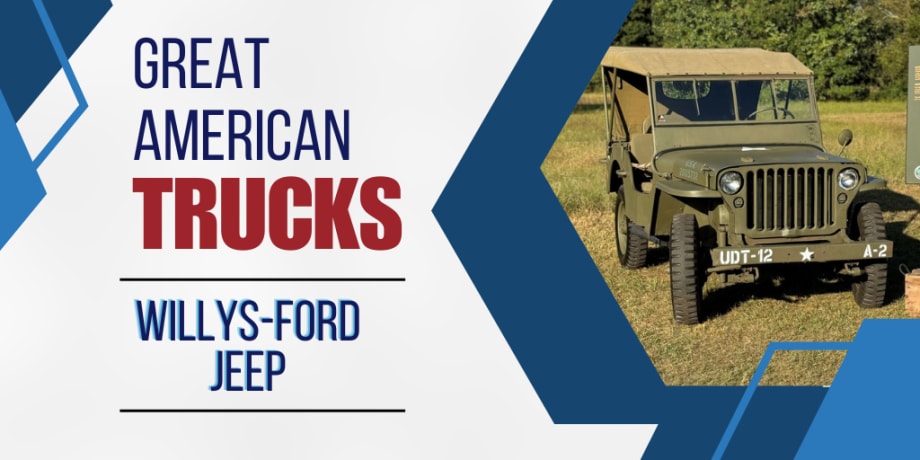
From its humble beginning as a small scout car, the Jeep went on to symbolize American manufacturing and design excellence.
Photo: Michael Newman -- Canva
Technically speaking, the world-famous Jeep isn’t a truck, exactly. Although it does have a small bed. And it’s worth noting that the original U.S. Army development contract for the scrappy little vehicle laid out its desired specifications for a new “four-wheel drive reconnaissance car.”
But the vehicle that eventually became known as “The Jeep,” proved to be so capable and such a highpoint of American ingenuity, design and manufacturing prowess that it became the most famous light-duty truck in history.
A Three-Company Design
In 1940, World War II had been raging in Europe for almost a year. And it was becoming increasingly obvious to objective observers that sooner or later, the United States would enter the war against Nazi Germany.
In a belated attempt to prepare for war, the U.S. Army sent a specification request to 135 automative companies.
The spec sheet requested the development of a four-wheel drive reconnaissance car that could carry at least two soldiers and their equipment cross country to scout enemy positions.
Only two car companies bothered to respond to the request: The tiny American Bantam Car Company – best known as an early pioneer of what eventually became known as “compact cars” – and the Willys-Overland Company.
Willys-Overland was actually a large and well-established car-builder at the time. Based in Toledo, Ohio, the company had a reputation for dependable, stylish, family cars. And, in recent years, Willys-Overland had come in second only to Ford in terms of sales volumes coming out of the Depression – a point that would soon become important in the Jeep’s history.
With the threat of war growing daily, the Army issued an expediated deadline of just 49 days for the new scout car.
And despite its size and resources, Willys asked for more time to perfect its design – which the Army refused.
Bantam, on the other hand, didn’t have the design staff on hand to focus on the Army contract. So, it hired a freelance automotive designer named Karl Probst to take on the job – with the understanding that he would only get paid if Bantam won the contract.
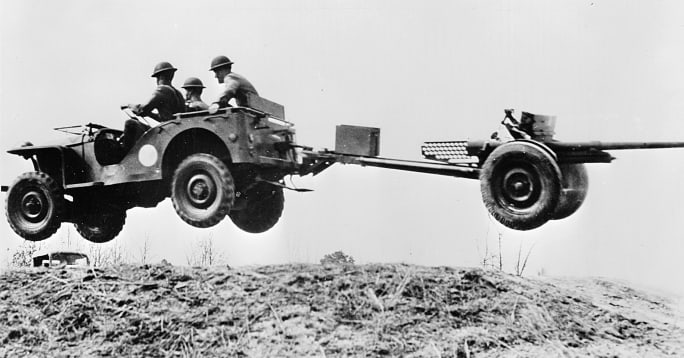
The U.S. Army was impressed by the Jeep's capabilities in early testing. The little truck was fast, agile and could go almost anywhere.
Photo: U.S. Army Signal Corps
In just four days, Probst completed his design and submitted it to the Army – complete with blueprints.
Most of the little truck could be built from standard, off-the-shelf automotive components. And its robust, proprietary four-wheel system would be manufactured by the reliable Spicer Corporation.
Bantam quickly hand-bult a prototype vehicle at its facility in Butler, Pennsylvania. Company employees then drove the new vehicle directly to the Army testing grounds in Camp Holabird, Maryland, to demonstrate its capabilities.
Army evaluators were impressed. In fact, they determined that the Bantam Reconnaissance Car, as the vehicle was called at the time, met the specifications in every metric except engine torque.
Ford and Willys Step Up
Bantam had clearly won the design competition for the new scout car.
But there was just one problem: It was obvious the tiny car company had nowhere near the production capacity needed to produce the new vehicle in the numbers the Army needed.
And so the Army provided both Willys and the Ford Motor Company with Bantam’s plans, and asked if they would be interested in manufacturing the new truck.
What followed was a bit of an ad hoc design period for the new truck.
For some unfortunate reason, Ford decided to call the little truck “The Pygmy.”
Meanwhile, Willys decided it should be called “The Quad.”
Regardless of what it was called, Willys and Ford – deciding that they knew more about automotive design than Bantam ever would – set about tweaking the specifications for the little truck. Which lead to Spicer providing similar – yet different – drivetrain components to all three companies.
There were some positive developments, too, however.
It was Ford that actually finalized the little truck’s pressed-metal front grille design. It was an inspired design that would soon become world famous. And one that remains Jeep’s calling card to this day.
As importantly, Willys designers turned their attention to the little truck’s under-powered engine. They replaced the Bantam powerplant with their own Willys L134 “Go Devil” four-cylinder flathead engine. The new engine was heavier than Bantam’s. But it produced 60 horsepower. Which was more than enough for the new truck’s base weight of only 2,450 lbs. The Go Devil engine would go on to power the vast majority of Jeeps produced during World War II.
What’s in a Name?
From the get-go, it was obvious the Army’s new car-truck was a hit. Within weeks, the Navy, Marine Corps and Coast Guard were submitting production orders for the capable little vehicle.
And this led to something of a war for bragging rights between Ford and Willys.
Ford, which was churning out the new trucks for $782.59 per vehicle, dubbed its design the GPW. And it began stamping parts with an “F” on them. And some early Jeep models even have the famous “Ford” script emblazoned on their tailgates.

Michael Newman's Jeep is an early 1942 Ford model -- with the highly desirable "Ford Script" stamp on the tailgate.
Photo: Michael Newman
Willys, meanwhile, called the vehicle the “MB Model,” and charged the government $648.74 for every unit it produced. And it began stamping “Willys” onto various vehicle parts until the Army finally put a stop to the little branding war in 1942.
But where did the world famous “Jeep” name come from?
No one knows for sure. It seems to have sprung up organically as Americans moved out all over the globe fighting World War II.
But there are a few theories.
For starters, American GIs called the new truck a “GP,” based on the Ford name for the model.
At the same time, a “jeep” was soldier’s slang for a brand-new recruit, who didn’t know anything. The term was probably based on the innocent-sounding “jeepers” epithet in common use then.
And there was also a popular cartoon character in the “Popeye” comic strip in widespread syndication at the time. “Eugene the Jeep” was an odd, sort of dog, sort of bear, creature endowed with magical powers who showed up to create all sorts of problems the spinach-eating sailorman.
A Mission-Focused Design
Like Eugene the Jeep, the Army’s new light truck was small, seemingly able to move into places other vehicles couldn’t go, and was capable of solving any problem its driver and passengers were presented with.
There is no way to know for sure how the name came about. But, by 1942, GIs around the world were commonly referring to the tough little truck as “The Jeep.”
And thus was born the name of an automotive giant known around the globe – and still in business today.
Speaking of today’s Jeeps, it’s important to note that they certainly share a family resemblance to World War II Jeeps. It’s a look that has endured for more than 80 years now and has defined multiple generations of both military and civilian cars and trucks.
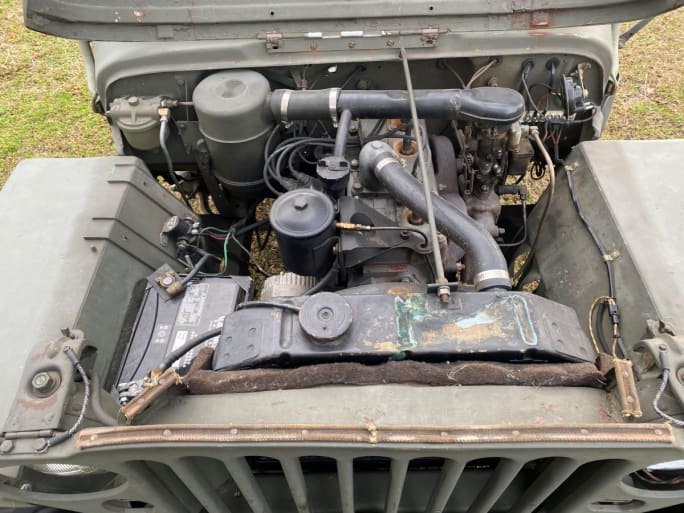
Above all else, Jeeps were practical. They were easy to work on. And every major component could be easily reached by mechanics in the field.
Photo: Michael Newman.
But today’s Jeeps are designed to carry multiple passengers comfortably in luxurious interiors that would have gob-smacked World War II GIs. Because of these, today’s Jeeps are much larger than the original models were.
In fact, one of the original design specifications for the Jeep was that it be small enough to be concealed behind a small bush.
It was a reconnaissance vehicle, after all.
Which is why if you ever ridden in a World War II vintage Jeep, or see pictures of them, you know that they are extremely cramped. Leg room is practically nonexistent. As are any semblance of creature comforts. Windshield wipers, for example, were operated manually via a small handles mounted at the top of the fold-down front windscreen.
The Jeep was also brutally utilitarian in its overall design. For example, its front headlights could be rotated up and backwards to shine on the engine bay, to facilitate repairs at night. And there was no ignition key. Because what would you do if the driver put it in his pocket and then got shot and you couldn’t reach him?
Honoring Navy Underwater Demolition Teams
A high school classmate of the author, Michael Newman, has a lovingly restored 1941 Ford GPW that he has treasured for years.
Newman is himself a U.S. Navy veteran who served with the branch’s Underwater Demolition Teams. And he proudly preserves this rare, and important piece of American history as a tribute to all U.S. military veterans.
“My jeep is a 1942 Ford GPW and was delivered to the military just 4 months after the attack on Pearl Harbor,” Newman said. “The date of delivery is April 29, 1942. It is considered a very early production jeep.”
Like most World War II survivors, Newman’s Jeep never went overseas. This jeep, like most here in the US, was never sent overseas and it served on Fort Benning, Georgia, (now Ft Moore) during the war.
“This early jeep is called a ‘Script Ford’ model because of the Ford stamped in the rear panel,” Newman continues. “Both Willys and Ford did that until early 1942, when the Army had them stop. The Army flatly stated that they were ‘Army Jeeps, not Ford or Willys Jeeps’.”
That simple stamped panel adds about 20% to the value of the Jeep on the collector’s market today, Newman adds.
Interestingly, Newman notes that regardless of who manufactured a Jeep, all the parts were interchangeable. But every model produced was under warranty. And Henry Ford did not want to pay for any Willys parts that were returned. To deal with this problem, Ford had his engineers stamp or cast a script "F" on each and every part of the Ford jeeps.
“You can find tiny ‘F’ stamps on gears, shafts, windshield glass and even every bolt head on Ford Jeeps,” Newman says. “And while both Ford and Willys used the Willys L134, also known as the Go Devil engine, all Willys engines were painted OD green. And all Ford engines were painted Ford tractor grey.”
Newman just completed a frame-off restoration of his Jeep – doing all the work himself.
Prior to the restoration, the Jeep was marked in basic U.S. Army colors. Now, the vehicle is in Underwater Demolition Team (UDT) 12 livery.

Michael Newman's newly restored Ford Jeep pays tribute to U.S. Navy Underwater Demolition Teams in World War II.
Photo: Michael Newman
The Navy created UDT units to clear beaches and act as combat swimmers for amphibious invasions in all theaters of the war. Many years later this unit was converted into a SEAL Team and was renamed SEAL Delivery Vehicle Team 1 – the unit Newman served with when he was in the U.S. Navy. And, as a result, Newman’s Jeep is now dedicated to all of the Navy Frogmen, Naval Combat Demolition Units and Underwater Demolition Teams that served in World War II.
World War II – as seismic an event as it was – was just the beginning for the mighty Jeep.
The little truck went all over the world, winning admirers everywhere it went.
“Good lord,” famed American war correspondent Ernie Pyle said of the little truck, “I don’t think we could continue the war with the Jeep. It goes everywhere. It’s faithful as a dog. Strong as a mule. And as agile as a goat.”
Today, the Jeep brand remains strong as a passenger car brand. And Jeeps can be seen on- and off-roads all over the world. It’s ruggedness and adaptability made it a symbol of American manufacturing and design excellence – earning it a spot as one of the most iconic trucks ever created.
More Equipment

How Volvo Updated Its D13 for EPA 2027 [Watch]
Volvo’s updated D13 promises lower emissions without sacrificing performance or fuel economy. Take a closer look at what changed inside the engine in this HDT Spotlight video.
Read More →
Michelin Tire Improves Efficiency and Durability for Regional Fleets
The Michelin X Multi Energy D2 is a regional haul drive tire engineered to help fleets improve fuel efficiency, durability and traction in demanding stop-and-go operations.
Read More →
ZF Expands Commercial Vehicle Push in North America
ZF is expanding its North American commercial-vehicle presence with new transmission applications, electrification, trailer technology and autonomous-driving systems.
Read More →
Tesla Wants a Self-Driving Semi. Are Cameras Enough?
Could Tesla’s camera-only autonomous driving technology work on an 80,000-pound Semi? In this commentary, HDT's Deborah Lockridge takes a look at Tesla, Cybercab, and how autonomous trucks see the road.
Read More →
Kodiak: Driverless Long-Haul Truck Launch on Track for 2026
Kodiak AI says its driverless long-haul safety case is 93% complete and it remains on track to begin commercial operations by year-end 2026.
Read More →
What DOT’s Automated Vehicle Strategy Means for Trucking
The U.S. Department of Transportation issued a new automated-vehicle strategy that outlines plans for driverless-truck regulations, cross-state freight corridors, and federal safety standards.
Read More →
East Coast Port Launches $45M Electric Truck Push
The Port Authority of New York and New Jersey announced millions in incentives for zero-emission drayage trucks, yard tractors, and new charging hubs near the port.
Read More →
PlusAI Going Public to Fund Autonomous Truck Launch
A SPAC deal could provide PlusAI with up to $300 million as it works toward a 2027 commercial launch of factory-built autonomous trucks.
Read More →
NHTSA Moves to Rewrite Truck Fuel-Economy Rules
The National Highway Traffic Safety Administration says it lacks authority to regulate medium- and heavy-duty truck engines separately from complete vehicles, but the existing standards have not yet been eliminated.
Read More →
Detroit Opens Orders for EPA 2027 Engines
Detroit isn’t starting from scratch to meet EPA 2027 diesel emissions standards. Its Gen 6 DD13 and DD15 engines keep much of today’s platform while updating the fuel and aftertreatment systems.
Read More →