





More Great American Trucks:Mack AC
Great American Trucks: The GMC DUKW
It wasn’t pretty. But the GMC DUKW took the war to the Axis Powers during World War II — over both water and land.
July 4, 2023

The GMC DUKW is our next featured vehicle in our Great American Truck series.
Photo: National Archives/Canva
5 min to read
A quick glance at a map in early January 1942 made things obvious: The Japanese Empire threw America into World War II with its sneak-attack on Pearl Harbor the month before. Germany and Italy quickly followed up and declared war on the United States.
Taking the fight to any of those enemies was going to require the ability to land troops by sea on hostile shores. But landing troops wasn’t enough. Once they were ashore, America’s fighting men would need supplies. Lots of them. And getting supplies ashore, under fire, on unimproved, hostile beaches, was a serious logistical problem.
Two yacht designers, a British naval expert named Dennis Puleston, and an America engineer at the Massachusetts Institute of Technology thought they had a solution. Why not take an existing truck design, add a waterproof, ship-like, hull and a rear-mounted propeller, and give the army a truck that could move materials both on the water, and over land?
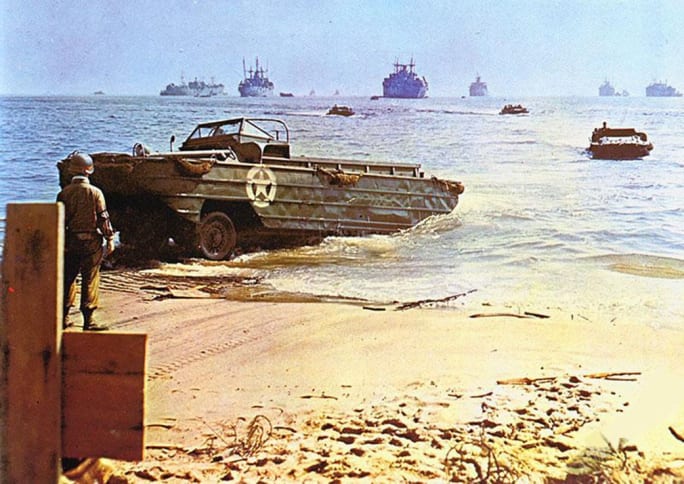
A GMC DUKW wades ashore during Operation Dragoon in Southern France in the summer of 1944.
Photo: National Archives
The Ugly Duckling is Hatched
A production team at the General Motors Pontiac plant and GMC Truck and Coach Division in St. Louis went to work on the project and soon cobbled together an odd-looking hybrid boat-truck that seemed to be just what the military needed.
The new amphibious truck was based on the GMC CCKW. This was a six-wheel drive cargo truck with a 2.5 ton cargo capacity. Most CCKWs were conventional configured trucks. But the new amphibious project truck was based on the cabover version of the CCKW.
The project engineers added a watertight hull to the base vehicle. A four-liter GMC Model 270 straight-six gasoline engine provided power to a five-speed overdrive manual transmission. There was a modified transfer case which allowed the driver to switch between engaging a rear-mounted propeller or the front drive axle in off-road conditions. A PTO drove an auxiliary air compressor and a winch, both valuable features in a war zone. A high-capacity bilge pump was added to keep the truck afloat if the hull were breeched — a very real possibility on a hostile beach under heavy fire.
And the new truck was the first vehicle that gave the driver the ability to adjust tire pressure from inside the cab, thanks to the PTO-driven air compressor. The driver could fully inflate the truck’s tires for operation on paved roads. Or they could deflate them to gain traction on loose, sandy beaches. Today, this capabilty is standard on all U.S. military trucks.
The resulting design proved to be extremely capable. It could manage 5.5 knots (6 mph) over open water, and 50 mp- on paved roads and manage to cross over even tough, muddy or sandy off-road areas.
A Fortuitous Rescue
The GMC development team thought they had a winning design on their hands. But there was one small problem: The new truck was decidedly weird looking. Its watertight hull gave it a deceptively squat appearance that totally belied how capable the design actually was. At first, the U.S. military rejected the design.
But then, fate intervened. The new truck had been taken to the rough seas off the coast of Provincetown, Massachusetts, for sea trials. One winter day, a storm blew in and swamped a U.S. Coast Guard vessel, causing it to run aground. The Coast Guard crew was trapped, and no ship in the area could weather the rough seas to rescue them.
Confident in their design, the new GMC amphibious truck crew decided to try a rescue while Navy and Coast Guard officers looked on from the shore. The funny-looking truck had no problem dealing with the 60-knot winds, rain and high waves and swiftly took the stranded Coast Guardsmen to safety. (The design would eventually end all debate regarding its seaworthiness by easily crossing the English Channel.)
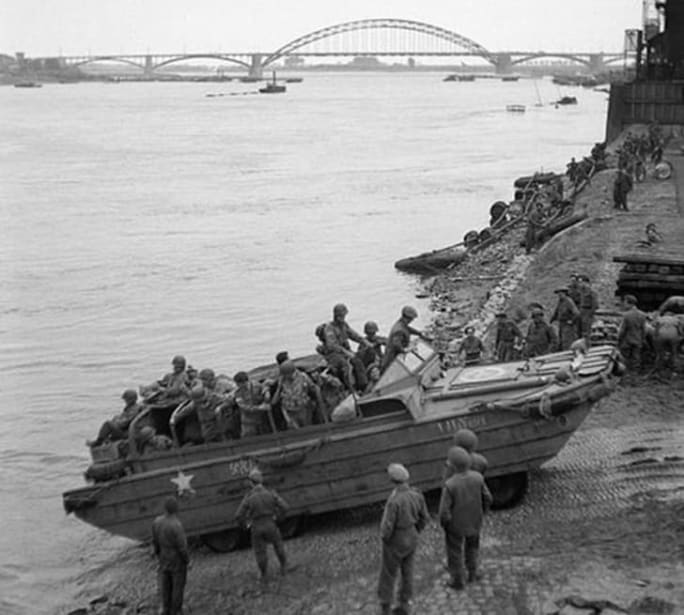
A DUKW brings supplies across the Waal River in Holland durng Operation Market Garden in 1944.
Photo: National Archives
As a result of the rescue, the U.S. military approved the new truck right away and mass production began at once.
The Army dubbed its new hybrid-truck vehicle the DUKW based on GM’s model nomenclature system:
D – 1942 production series
U – Utility truck
K – All-wheel drive capability
W – tandem, dual-drive, rear axles.
American GIs quickly dubbed the funny-looking truck “the Duck.” It was the perfect name for the highly capably hybrid truck -- and one that is still universally used to this day.
The Duck Goes to War
The Duck first saw combat when the U.S. Marines invaded Guadalcanal in August of 1942 – a testament to just how fast GM was able to design, test and produce the new design. Its European baptism of fire came during the Invasion of Sicily the following year.
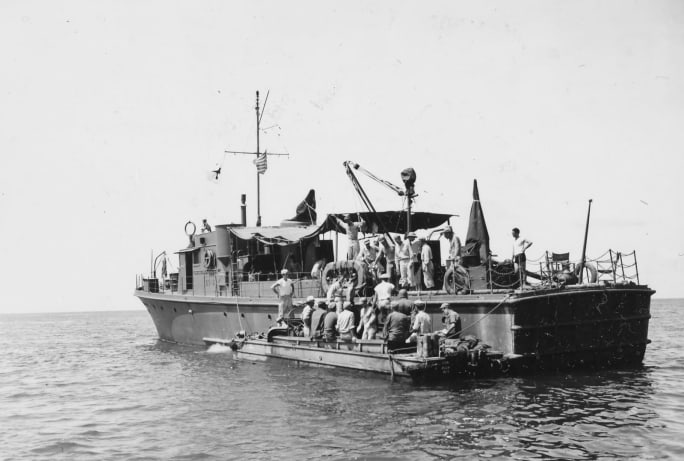
Wounded GIs being transferred to a waiting ship from a DUKW during the Battle for Mindinao during the Phillippines Campaign in 1945.
Photo: National Archives
Eventually Ducks would see combat all around the globe. They waddled ashore at Normandy on D-Day. And they were used extensively in the island-hopping campaign in the Pacific against Japan. And it wasn’t hard to see why the design proved so popular. A single DUKW could carry 25 soldiers and their equipment while towing an artillery piece. Or it could be used to haul in up to 5,000 lbs. of general cargo.
And Ducks weren't limited to sea actions. Europe is crisscrossed with rivers and lakes. The truck hauled men and materials across Dutch rivers during Operation Market Garden and even helped cross the Rhine River to take the war into the heart of Germany. The U.S. Army 10th Mountain Division used Ducks to attack German forces across massive Lake Garda in northern Italy.
According to the Encyclopedia Brittanica, GM produced 20,000 DUKWs during the war. The bulk went to the U.S. armed forces. Around 2,000 went to Great Britain. And another 586 were sent to Australia.
The Duck’s story didn’t end with the close of World War II. The truck saw combat during the Korean War. The British Royal Marines used DUKWs for amphibious training exercises into the 1990s. Today, Ducks are still in service as civilian tourist guide truck-boats in seaside cities all over the globe.
The GMC DUKW started life as an ugly duckling rejected by the U.S. military. But it ended up being one of the most innovative military vehicles in history. It proved itself under fire countless times and helped rid the world of fascism. It was an incredible, inspired design that was perfect for its time.
Subscribe to Our Newsletter
More Equipment

How Volvo Updated Its D13 for EPA 2027 [Watch]
Volvo’s updated D13 promises lower emissions without sacrificing performance or fuel economy. Take a closer look at what changed inside the engine in this HDT Spotlight video.
Read More →
Michelin Tire Improves Efficiency and Durability for Regional Fleets
The Michelin X Multi Energy D2 is a regional haul drive tire engineered to help fleets improve fuel efficiency, durability and traction in demanding stop-and-go operations.
Read More →
ZF Expands Commercial Vehicle Push in North America
ZF is expanding its North American commercial-vehicle presence with new transmission applications, electrification, trailer technology and autonomous-driving systems.
Read More →
Tesla Wants a Self-Driving Semi. Are Cameras Enough?
Could Tesla’s camera-only autonomous driving technology work on an 80,000-pound Semi? In this commentary, HDT's Deborah Lockridge takes a look at Tesla, Cybercab, and how autonomous trucks see the road.
Read More →
Kodiak: Driverless Long-Haul Truck Launch on Track for 2026
Kodiak AI says its driverless long-haul safety case is 93% complete and it remains on track to begin commercial operations by year-end 2026.
Read More →
What DOT’s Automated Vehicle Strategy Means for Trucking
The U.S. Department of Transportation issued a new automated-vehicle strategy that outlines plans for driverless-truck regulations, cross-state freight corridors, and federal safety standards.
Read More →
East Coast Port Launches $45M Electric Truck Push
The Port Authority of New York and New Jersey announced millions in incentives for zero-emission drayage trucks, yard tractors, and new charging hubs near the port.
Read More →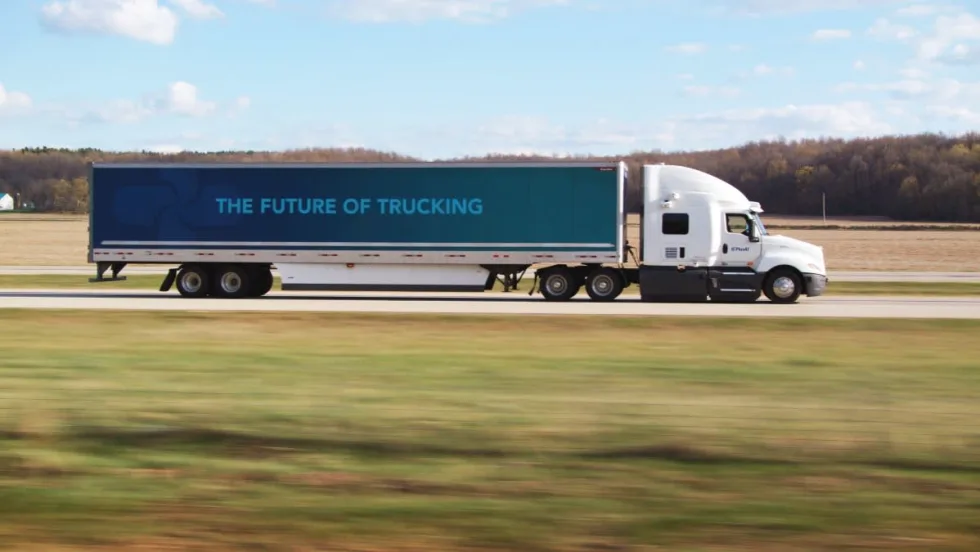
PlusAI Going Public to Fund Autonomous Truck Launch
A SPAC deal could provide PlusAI with up to $300 million as it works toward a 2027 commercial launch of factory-built autonomous trucks.
Read More →
NHTSA Moves to Rewrite Truck Fuel-Economy Rules
The National Highway Traffic Safety Administration says it lacks authority to regulate medium- and heavy-duty truck engines separately from complete vehicles, but the existing standards have not yet been eliminated.
Read More →
Detroit Opens Orders for EPA 2027 Engines
Detroit isn’t starting from scratch to meet EPA 2027 diesel emissions standards. Its Gen 6 DD13 and DD15 engines keep much of today’s platform while updating the fuel and aftertreatment systems.
Read More →