




Great American Trucks: The GMC Crackerbox
It was ugly, disproportioned, loud and uncomfortable. But somehow, this gawky, weird-looking rig found a soft spot in the hearts of American truckers.
October 3, 2023

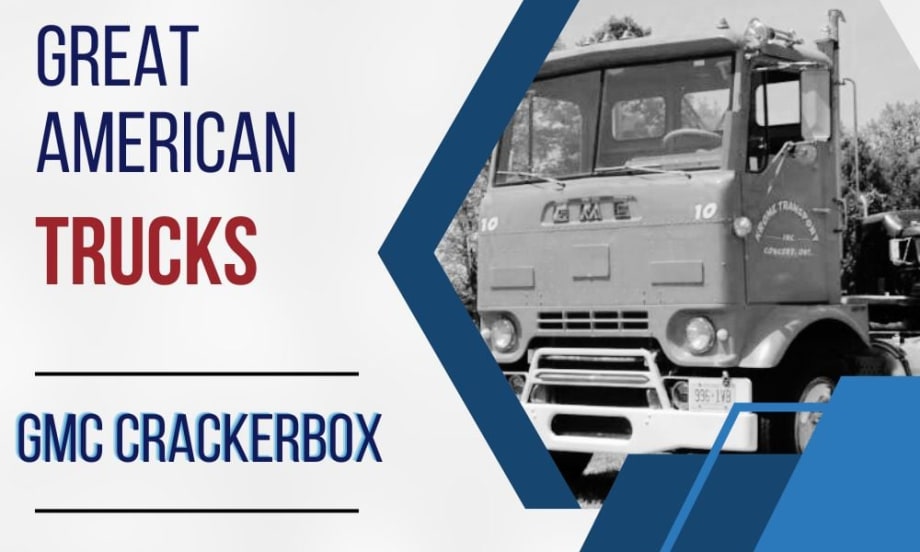
The GMC F-Series, a Class 8, tilted-cabover design, was best known as the “Crackerbox” by truck drivers.
Source: Jim Park/Canva
4 min to read
Officially, it was called the GMC F-Series, a Class 8, tilted-cabover design. But almost immediately it was dubbed the “Crackerbox” by American truckers — a nod to its uncanny resemblance to a metal cracker can stood on its end.
But, as much as any other truck, the Crackerbox came to define American trucking in the 1960s during its production run from 1959 to 1968.
Graceful, refined, elegant, agile and nimble were all words that had nothing to do with the GMC Crackerbox. It was an odd-looking truck, to put it mildly. It was designed from the ground up to be as lightweight, maneuverable and efficient as possible.
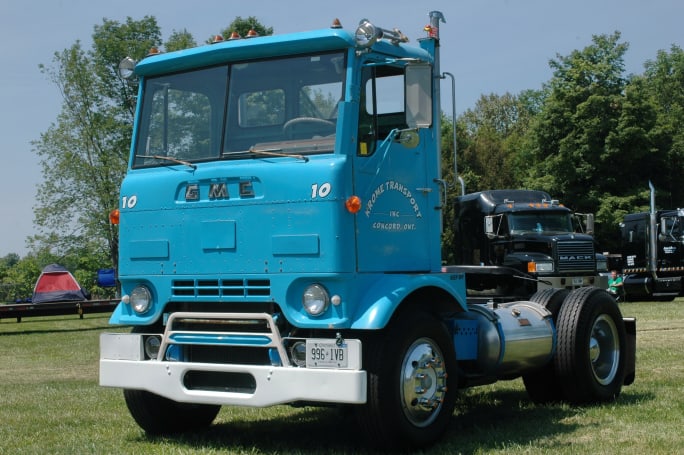
This 1961 GMC 8000 Series "Crackerbox" started life as a showroom queen and featured advanced options like power steering and four-wheel independent air suspension.
Photo: Jim Park
GMC’s engineering staff took those guidelines seriously. The lightweight aluminum cab was all of 48 inches long from nose to tail, although you could spec a 24-inch-wide sleeper berth behind the seats if you wanted one for long-haul routes. The wheelbase on the F-Series was a measly 108 inches, although there was a longer, 130-inch option.
The result was a narrow, top-heavy stance that looked like it was always on the verge of toppling over. A slab-faced front end, set off by a rectangular grille and squared-off bumper, made the truck look something like a bewildered jack-o-lantern.
Driver comfort features, sound insulation and anything approaching the safety standards or features we know today were basically nonexistent.
An Advanced Design — For a Time
GMC intended for its F-Series trucks to be the most advanced Class 8 commercial vehicle in the world at the time. As a result, the design featured some interesting specs for the time, including an independent front suspension, air ride, power steering, and a complex frame that was 50% lighter than GMC’s previous “Cannonball” generation of Class 8 trucks.
Other lightweight touches included fiberglass fenders and front grille. According to press releases from the time, GMC claimed the super-lightweight F-Series design could haul up to a ton more than its predecessor.
Many of these advanced features would fade away as maintenance demands and the desire for more basic, stripped-down designs took root in the commerical vehicle market of the time. GMC responded by offering a more basic version of the truck with fewer options that eventually became the most popular version of the series.
GMC offered single- or tandem-axle configurations for the trucks. You could spec a 702 cubic-inch GMC V112 gasoline engine, or your choice of Detroit Diesel 6V71 and 8V71 engines. Caterpillar and Cummins options became available later on in the truck’s production run. The standard transmission was a five-speed Spicer manual “synchromesh overdrive” gearbox teamed with a two-speed Eaton rear axle.
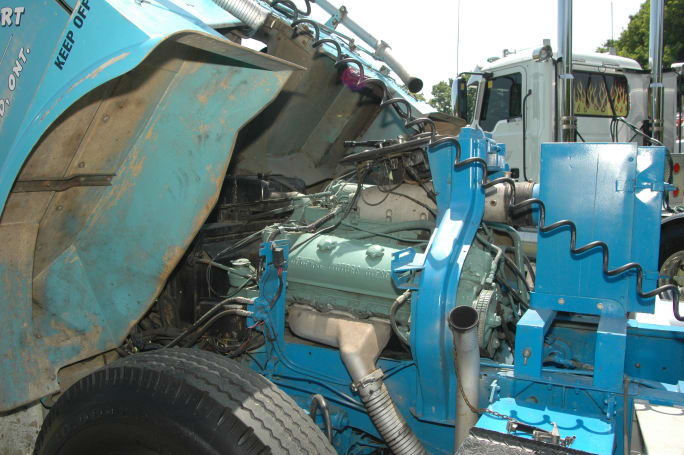
The tilt-forward cab reveals this Crackerbox's 6V-71 naturally aspirated Detroit Diesel engine.
Photo: Jim Park
GMC Crackerbox trucks weren’t pretty. They weren’t comfortable. And they weren’t quiet. The ride was something akin to a pogo stick. But they were tough. They were durable and easy to repair.
And they could haul.
As noted, GMC ads touted the trucks’ ability to haul up to an extra ton of payload per trip — a feat that would earn fleets and owner-operators an extra $2,000 in profit a year, the OEM boasted. By all accounts, Crackerboxes were as powerful and fast as any truck on the road during the 1960s.
And that was good – because things weren’t so great for the driver, shaking and rattling along with massive amounts of engine noise and heat blasting upward through the thin aluminum skin into the cab.
A Backward-Running Engine
HDT Senior Editor Jim Park actually drove one of these trucks early in his career as a driver. (Check out his blog, "Were Those Old Trucks Really as Good as We Remember?") And it’s not an experience he looks back on fondly:
These trucks were not fun to drive. I first ran into one in 1978 or '79 as my career was just getting started. Being the junior man at this particular company, I had my choice of the trucks parked in the back row of the lot. I picked a 6x2 axle model, with an air-lift pusher axle. No AC, no power steering, and all the noise and heat you could handle coming up through the floor.
The truck had a 238-hp 6-cylinder two-stroke Detroit 6V-71 diesel engine. Being a two-cycle engine, it had one unique attribute: When backing under a trailer to hook up, you had to hit it pretty hard sometimes to ensure you got under it on the first shot. I learned the hard way that if the trailer pushed the tractor out as you were trying to pick it up, it would spin the engine backwards, and the darned thing kept running — but backwards, sucking air in through the exhaust stack and exhausting through the air cleaner. It was pretty strange putting the transmission in first gear and taking off in the wrong direction!
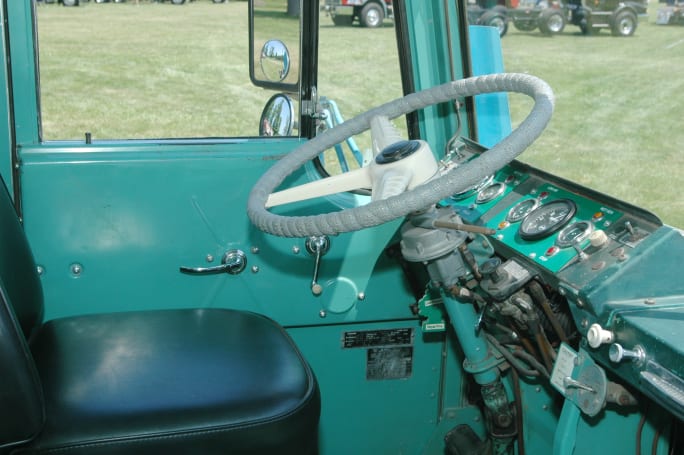
The interior on the GMC Crackerbox was about as spartan as you can get. Driver comfort simply wasn't an important consideration at the time.
Photo: Jim Park
It may have been ugly. And uncomfortable. But the GMC Crackerbox was a tough workhorse that fit the trucking industry perfectly during the freewheeling sixties. It was a truck made for a time in which everything was secondary to getting a load to its destination on time. And it filled that role wonderfully, until time and more modern designs finally caught up with it at the end of the decade.
Subscribe to Our Newsletter
More Equipment

How Volvo Updated Its D13 for EPA 2027 [Watch]
Volvo’s updated D13 promises lower emissions without sacrificing performance or fuel economy. Take a closer look at what changed inside the engine in this HDT Spotlight video.
Read More →
Michelin Tire Improves Efficiency and Durability for Regional Fleets
The Michelin X Multi Energy D2 is a regional haul drive tire engineered to help fleets improve fuel efficiency, durability and traction in demanding stop-and-go operations.
Read More →
ZF Expands Commercial Vehicle Push in North America
ZF is expanding its North American commercial-vehicle presence with new transmission applications, electrification, trailer technology and autonomous-driving systems.
Read More →
Tesla Wants a Self-Driving Semi. Are Cameras Enough?
Could Tesla’s camera-only autonomous driving technology work on an 80,000-pound Semi? In this commentary, HDT's Deborah Lockridge takes a look at Tesla, Cybercab, and how autonomous trucks see the road.
Read More →
Kodiak: Driverless Long-Haul Truck Launch on Track for 2026
Kodiak AI says its driverless long-haul safety case is 93% complete and it remains on track to begin commercial operations by year-end 2026.
Read More →
What DOT’s Automated Vehicle Strategy Means for Trucking
The U.S. Department of Transportation issued a new automated-vehicle strategy that outlines plans for driverless-truck regulations, cross-state freight corridors, and federal safety standards.
Read More →
East Coast Port Launches $45M Electric Truck Push
The Port Authority of New York and New Jersey announced millions in incentives for zero-emission drayage trucks, yard tractors, and new charging hubs near the port.
Read More →
PlusAI Going Public to Fund Autonomous Truck Launch
A SPAC deal could provide PlusAI with up to $300 million as it works toward a 2027 commercial launch of factory-built autonomous trucks.
Read More →
NHTSA Moves to Rewrite Truck Fuel-Economy Rules
The National Highway Traffic Safety Administration says it lacks authority to regulate medium- and heavy-duty truck engines separately from complete vehicles, but the existing standards have not yet been eliminated.
Read More →
Detroit Opens Orders for EPA 2027 Engines
Detroit isn’t starting from scratch to meet EPA 2027 diesel emissions standards. Its Gen 6 DD13 and DD15 engines keep much of today’s platform while updating the fuel and aftertreatment systems.
Read More →