





Classic Iron Rolls During the Annual Kenworth Truck Parade in Chillicothe, Ohio
Great American Trucks: Kenworth's W900 Series
It was 1956. Elvis was about to break big. And Kenworth was about to unveil a new truck that would endure for six decades – and become an American icon in the process.
November 13, 2024
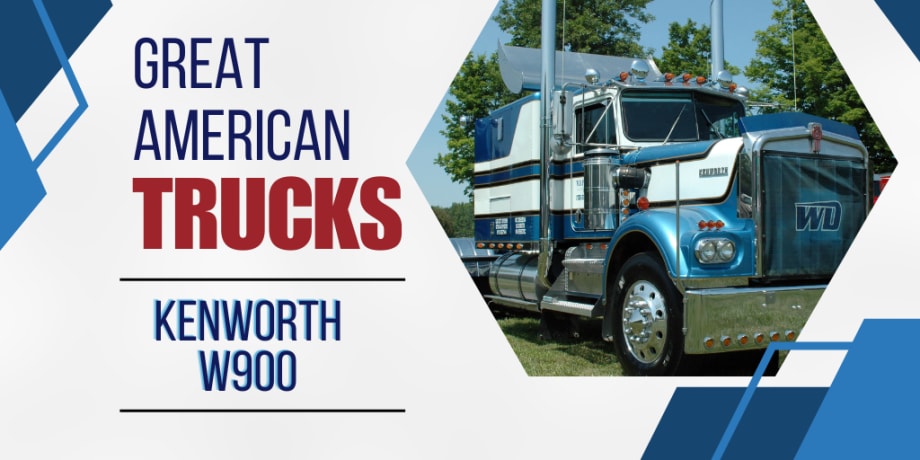
The Kenworth W900 has been running North American highways for over six decades now -- and shows no signs of letting up any time soon.
Photo: Jim Park/Canva
6 min to read
Mention “American big rigs” to someone not associated with the trucking industry, and odds are an image of the Kenworth W900 is going to pop into their heads.
And why not?
The truck is a cultural icon and movie star in its own right. Who can forget Jerry Reed’s Snowman, gear-jamming a trailer full of Coors beer over to Atlanta while Burt Reynolds’ Bandit ran interceptor in his black Trans Am?
And we can’t forget about Claude Akins' green 1974 model in the TV series “Movin’ On,” can we?
A big part of this truck’s presence in American popular culture stems from its broad-shouldered, rugged good looks. Without a doubt, Kenworth designers nailed the truck’s aesthetics from the jump. And it remains a popular, aspirational truck for fleets and drivers to this day. And that’s a remarkable achievement considering the truck has been on the market for more than 50 years, now.
A New Truck for New Times
That’s right. Kenworth debuted the W900 in 1956 – the same year a young rockabilly singer from Mississippi named Elvis Presley was starting to break out nationally.
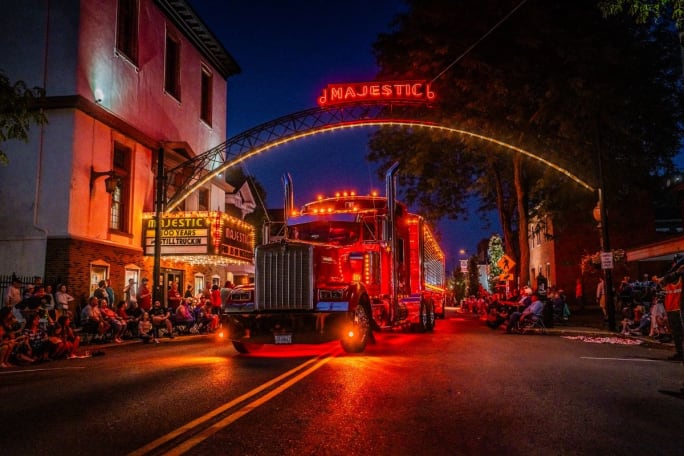
A W900 lights up the night in Chillicothe, Ohio during a truck parade celebrating Kenworth's long history in the city.
Photo: Kenworth Motor Company
And although it’s considered a “classic” design today. The W900 was actually a modern, even cutting-edge truck when it first appeared.
The American heavy truck market was of two minds about truck designs in the 1950s.
Cabover models emerged as the dominant heavy design after World War II. These trucks offered drivers exceptional maneuverability and visibility. And their shorter cab lengths (a function of tractor-trailer length laws at the time) meant they could pull longer trailers and carry more payload.
But as the American highway network expanded and improved, longer and longer haul routes were becoming routine. And cabovers obviously lacked the room and comfort desirable on multiple day runs. Moreover, the driver sat directly over both the engine and front axle. Which meant that cabovers were generally loud and rode like hell.
The answer was “conventional” truck designs. These are front-engine models that have longer, more spacious interiors that allow for a much larger sleeper berth. These models generally ride smoother and are quieter, too. That’s because both the engine and the front axle are out in front of the driver. This dampens in-cab noise levels and smooths out the ride considerably.
And it was this unique design environment that saw Kenworth bring the W900 into the world.
By the mid-‘50s, Kenworth’s premier Class 8 truck model was the “bullnose” K100 cabover. Kenworth’s new conventional model – then simply dubbed the “900 Model” -- shared the same chassis and as the K100. But Kenworth designers had nailed an iconic look that drew on styling cues from the 1930s while delivering a fresh, bold image that would come to define American long-haul trucking.
It was all there: A tall, gleaming, chrome grille out in front of a long nose, set off by a wide, no-nonsense stance, stout fenders with quad headlamps – all topped off by a commanding, high-rise cab. Chrome exhaust stacks, roof-mounted air horns and shining, cab-mounted air cannisters rounded out the new truck’s look.
Kenworth has tweaked the design over the decades. Smoothing out some lines. Sharpening others. Modernizing when appropriate. But all in all, today’s W900 models remain faithful to the vision first laid out by Kenworth designs more than six decades ago.
Engine options were standard for the time. Cummins, Caterpillar and Detroit Diesel options offered. Although the W900’s larger engine bay meant that higher-horsepower options than offered on cabover models were generally available.
An Instant Classic
The new truck proved popular. And by 1961, Kenworth decided to improve upon the original design. The new version of the truck, designed the W900 to distinguish it from the earlier model, featured a host of new features and improvements. Among these were a raised roofline and taller windows and the now iconic two-piece front windshield. Up front, a wider, redesigned grill enhanced airflow into the engine bay. And the quad headlamps were integrated into the fenders.
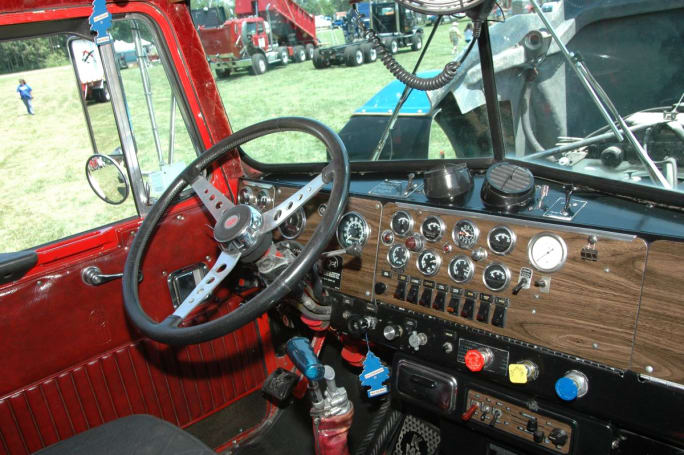
Truck dashboards were fairly sparse until the W900 came along. Kenworth designers introduced banks of dials and gauges that remained the industry standard for decades.
Photo: Jim Park
1965 saw additional upgrades and the introduction of the W900A model. The trend was definitely toward higher horsepower in conventional models. So Kenworth designers lengthened the truck’s nose and increased its radiator size to accommodate larger diesel engines.
These upgrades were followed by new, more ergonomic door designs in 1972. And in 1973 the Kenworth badge was redesigned, resulting in a restyled grille and hood badge. 1976 saw the introduction of the iconic Aerodyne sleeper with its twin skylight windows in the roof.
In 1982, Kenworth rolled out the W900B, introducing rectangular headlights and a higher hood. The OEM also updated the engine bay with more modern cooling and exhaust systems. And the first hint of modular electronic components appeared.
Since 1982, Kenworth has offered the W900 in three basic models:
The base W900B model
The W900S is a severe-duty model
The W900L is a high-power/longer-nosed variant – This truck eventually became the most popular W900 variant.
Behind the Wheel of a Classic
Is the W900 entering into its twilight years? Probably. Sixty-plus years is a phenomenal run for any vehicle. And there are signs that Kenworth will wind down W900 production at some point.
In 2020, the OEM ended production of the W900S model. Currently, Kenworth still builds the W900B and the W900L.
In 2018, Kenworth also introduced the W990 model. This is a distinct, all-new design that shares many of the same components as modern Kenworth trucks – but with styling cues that clearly evoke the iconic W900 Series. The assumption is that at some point, the W990 will assume the role the W900 enjoys as Kenworth’s classic conventional truck design.
If you’ve never driven a W900, you’re missing out. I’ve had the opportunity to drive several models on visits to Kenworth’s home turf in Renton, Washington, during my career. And it’s always been a treat to climb up into the cab of one of these incredible trucks.
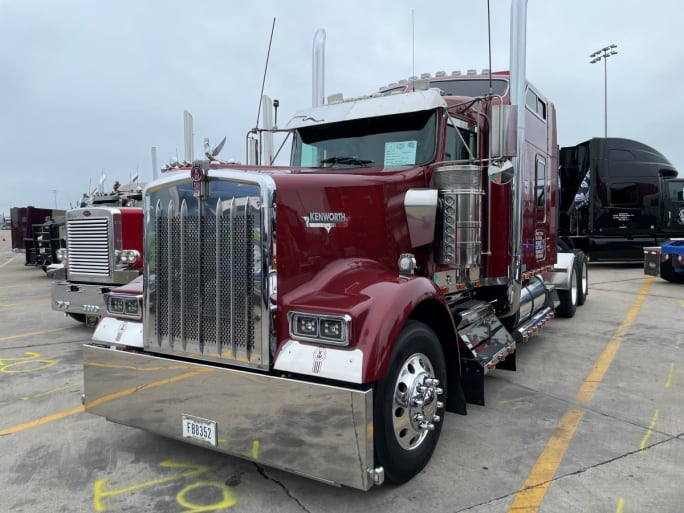
Kenworth W900s remain popular draws at truck shows. This head-turner, seen at the Walcott Truck Jamboree in 2023 is owned by Kenneth Liddle.
Photo: Walcott Truck Jamboree
Usually these drives take place in the stunning Cascade Mountain range outside of the Seattle metropolitan area. And let me tell you -- those twisting, winding, narrow, mountain roads can be pretty interesting in a truck as broad-shouldered as the W900 is!
But there’s really nothing like driving a W900. Just looking out over that long, narrow, hood, while perched up high in the cab, is an incredible experience. There is an undeniable connection to generations of drivers who first embraced and then fell in love with this truck. And it’s easy to see why sitting high up in a W900 cab.
I often comment on how many of the modern trucks I test drive have a distinct passenger car-like feel in terms of comfort, ride and handling. When you’re behind the wheel of a W900, there’s no mistaking the fact that you’re in an old school truck.
This is not to say the W900 is uncomfortable. It’s not. They ride great. Their handling is exceptional. But taken as a whole, the throwback dashboard with its row upon row of dials and gauges, the bounce of the air-ride seat, the two-pane windshield and – of course – the manual gearbox, gives you a bit of swagger that you just don’t feel settling in behind the wheel of many modern Class 8 trucks.
That’s because the W900 has 60-plus years of history behind it. The truck is an American icon. But it’s also a design that has weathered a stunning array of changes over its long life. It has proven to be incredibly adaptable to new technology. And it continues to deliver high levels of driver comfort and productivity combined with a distinct sense of style and flair that turns heads everywhere these trucks go.
Subscribe to Our Newsletter
More Equipment

How Volvo Updated Its D13 for EPA 2027 [Watch]
Volvo’s updated D13 promises lower emissions without sacrificing performance or fuel economy. Take a closer look at what changed inside the engine in this HDT Spotlight video.
Read More →
Michelin Tire Improves Efficiency and Durability for Regional Fleets
The Michelin X Multi Energy D2 is a regional haul drive tire engineered to help fleets improve fuel efficiency, durability and traction in demanding stop-and-go operations.
Read More →
ZF Expands Commercial Vehicle Push in North America
ZF is expanding its North American commercial-vehicle presence with new transmission applications, electrification, trailer technology and autonomous-driving systems.
Read More →
Tesla Wants a Self-Driving Semi. Are Cameras Enough?
Could Tesla’s camera-only autonomous driving technology work on an 80,000-pound Semi? In this commentary, HDT's Deborah Lockridge takes a look at Tesla, Cybercab, and how autonomous trucks see the road.
Read More →
Kodiak: Driverless Long-Haul Truck Launch on Track for 2026
Kodiak AI says its driverless long-haul safety case is 93% complete and it remains on track to begin commercial operations by year-end 2026.
Read More →
What DOT’s Automated Vehicle Strategy Means for Trucking
The U.S. Department of Transportation issued a new automated-vehicle strategy that outlines plans for driverless-truck regulations, cross-state freight corridors, and federal safety standards.
Read More →
East Coast Port Launches $45M Electric Truck Push
The Port Authority of New York and New Jersey announced millions in incentives for zero-emission drayage trucks, yard tractors, and new charging hubs near the port.
Read More →
PlusAI Going Public to Fund Autonomous Truck Launch
A SPAC deal could provide PlusAI with up to $300 million as it works toward a 2027 commercial launch of factory-built autonomous trucks.
Read More →
NHTSA Moves to Rewrite Truck Fuel-Economy Rules
The National Highway Traffic Safety Administration says it lacks authority to regulate medium- and heavy-duty truck engines separately from complete vehicles, but the existing standards have not yet been eliminated.
Read More →
Detroit Opens Orders for EPA 2027 Engines
Detroit isn’t starting from scratch to meet EPA 2027 diesel emissions standards. Its Gen 6 DD13 and DD15 engines keep much of today’s platform while updating the fuel and aftertreatment systems.
Read More →