




Grace Under Pressure
Under-inflated tires and improper tread patterns conspire to rob you of fuel economy.

Try walking in deep sand on your favorite beach and you'll have an inkling how under-inflated tires affect fuel economy. It's easy going when you're down near the water and the sand is hard. Go further inland where the Frisbee players and the seagulls hang out and you can feel the difference.
The analogy holds if you flip it upside down - it's not soft, squishy roads we're talking about, but tires. Think of the extra effort required to propel a 200-pound biped through deep sand. Out on the road, the extra energy required to overcome rolling resistance on a 40-ton semi running on soft tires comes straight out of your fuel tank.
While tires can affect fuel economy in a number of ways, inflation seems to have the most dramatic impact. We'll get to inflation, but first, let's look at a tire's contribution to the overall efficiency of the truck.
It's a tire's job to hold the truck on the road, so there's some built-in inefficiency in the tire - it's called friction. Trucks would score higher in fuel economy if they had steel wheels, but they'd be skating all over the place. Talk about hell on wheels.
Truck tire design parameters include traction, life-before-replacement, rolling resistance, and ability to resist damage. If rolling resistance were the only consideration, we'd get better mileage, but be replacing the darned things on a monthly basis. As in much of life, tire design is a series of compromises.
Rolling resistance derives from three factors: the rubber compound used to make the tire, the amount of flex in the sidewall, and the pattern and thickness of the tread. A lot has changed in the rubber compound world. Twenty years ago, you might have expected to give up economy and tire life for better traction, or vice versa. That's no longer the case today. Advanced formulations in tread rubber mean longer life, better economy, and good traction. But we can go overboard on traction if we're not careful.
True off-road tires, with their deep lugs, won't last long in over-the-road service. But even some lug-style highway drive tires offer more traction that might be needed. According to Goodyear's marketing communication manager, Tim Miller, companies would benefit from a fuel cost savings standpoint by going with a less aggressive, more fuel-efficient drive tire, but they choose to go with the more traditional drive tire because that's what drivers like to see on the back of their trucks.
"An aggressive pattern may look good to a driver, and give him a sense of security knowing he'll be able to pull out of a yard that's covered with snow," Miller says, "But frankly, you don't need that much aggressiveness in the tread pattern to make it work."
Anything trucking companies can do to keep drivers happy with their equipment will pay dividends in some respects, but they come at a cost in other respects.
A thorough evaluation of where the truck runs could change your tire spec'ing decision. Why run lug-type treads in the deep south? And do you need a really aggressive lug even in the north? Chances are you'd get by with a rib-lug combination pattern, which improves rolling resistance with only a minimal traction sacrifice.
Look around at some of the big fleets that run continent-wide - like Schneider National. They run a tire custom-designed for that operation, but it looks a lot like Goodyear's new Fuel Max tread design -not what you'd describe as an aggressive tread pattern.
Lugs tend to be deeper, too, which comes at a cost to fuel economy. As tires wear down, the fuel economy gets better and better. Research done by Bridgestone found that the tread accounts for between 60 and 70 percent of a tire's rolling resistance. A typical new rib tire will have a tread depth of about 18/32 to 22/32. A lug tire offers something like 26/32 to 30/32 of an inch of rubber. Bridgestone found a 7/32 reduction in tread depth produces a 10 percent improvement in rolling resistance.
Bridgestone claims that a new rib tire is about 6 percent more efficient than a new lug tire, and well-worn rib tire (4/32 inch) is about 7 percent more efficient than a new rib tire.
"There are losses in energy as the tread pattern squirms as it goes through its footprint. Energy is required to work the tire like that, and that energy comes from the fuel tank," Miller says. "Thinner tread takes less energy to roll."
In addition to tread depth, there's also a relationship between sidewall flex and rolling resistance. It takes energy to bend the stiff sidewall of a tire casing. That energy comes from the fuel tank as well.
FUEL ECONOMY UNDER PRESSURE
It's accepted, understood, and agreed that under-inflated tires are a fuel economy liability, but the extent - and the cost - of under-inflation is staggering. In a study published in July 2005 titled, "Tech Brief: Commercial Motor Vehicle Tire Pressure Sensor," the Federal Motor Carrier Safety Administration concluded only 44 percent of all commercial vehicle tires were within 5 percent of their target inflation pressures, with as many as 7 percent out by 20 psi or more. That suggests a significant amount is fuel is wasted every day overcoming unnecessary rolling resistance.
The rule of thumb is 1 percent degradation in fuel economy for every 10 psi under optimum pressure across the vehicle, but as maintenance items go, keeping tires properly inflated is like herding cats. They don't stay where you want 'em for long.
"Even if tire pressures are checked once a month, in the interval between checks, they'll naturally lose some pressure. Tires that haven't been checked in a while are going to be down. That's a given," says Goodyear's Tim Miller.
When Miller was a fleet sales rep, he'd often conduct inflation audits when he visited his customers.
"I can tell you that some fleets do a very good job of chasing tire inflation pressure and some just don't. I found very few over-inflated tires, but a lot of them in the 90-95 psi ranges."
Data compiled by FMCSA suggests for-hire carriers and owner-operators generally do a better job at managing tire inflation than private fleets, and it was noted that fleet size had a direct bearing on inflation management. For tractors, fleets with 50 power units or less have 19 percent of their tires under-inflated by 20 psi or more, while fleets of more than 3,000 power units have only 2 percent of their tires under-inflated by 20 psi or more, the agency concluded.
In addition, mismatched pressure between dual tires was found to be a significant contributor to poor fuel economy and tire maintenance costs. Approximately 20 percent of all tractor dual tire assemblies have tires that differ in pressure by more than 5 psi, FMCSA notes, while one out of four trailer dual assemblies (25 percent) have tires that differ in pressure by more than 5 psi.
A recent case study by Bridgestone found that a mere 5-psi difference in pressure between the dual tires creates a differential in the circumference of two tires of as much as 5/16 inch. Even that small a difference will cause drag on the larger (higher pressure) tire equal to about 13 feet per mile, or 86 miles of drag for every 35,000 miles of operation.
Try dragging a tire down the road sideways and see how much effort that takes.
A SINGLE SOLUTION?
Much has been made of the fuel economy gains available with wide-base single tires, and it's incontrovertible. The savings are there. Bruce Stockton, vice president of maintenance and asset management at Con-way Truckload in Joplin, Mo. (formerly CFI), notes he's seeing 2/10 of a mile per gallon on tractor-trailer units with wide-base singles on the drives only, and another 3/10 mpg from similarly equipped trailers.
"That's a solid half a mile per gallon for the truck, and it's all to do with rolling resistance," he says.
Con-way Truckload is now 100 percent wide-base singles on tractors. They're at 33 percent on trailers. Stockton notes that it can take several years to convert the whole fleet if you're doing it at trade time.
"You need new wheels as well as the tires," he explains. "It makes more sense to convert as you trade, unless you want to make a huge investment in that area."
Still, the fear of blowing a wide-base single tire on the road remains a barrier to wider acceptance. Blow one of those and you're down until it's fixed, no ifs, ands, or buts. Interestingly, Stockton reports fewer blowouts and fewer failures than he had when he was running duals. It's much easier for the driver to physically see if he has a low tire, he says.
"It's easier to check the tire pressure because you've got only one valve stem, you're not fishing for the second one," he says. "We know drivers are checking the pressure more often because they can easily see if the tire is down."
And maybe the threat of a long wait at roadside for a service call prompts drivers to be a little more vigilant with the singles than with dual tires. Whatever the reason, Stockton says the benefits are there, right on the bottom line.
KEEPING THE PRESSURE UP
The Federal Motor Carrier Safety Administration, in its tech brief called "Commercial Motor Vehicle Tire Pressure Sensors," estimates it takes 30 minutes to check and maintain tire pressure on an 18-wheeled vehicle. The number of man-hours required to maintain tire pressure on every truck in the land would be beyond imagination - assuming you could convince drivers to embrace the task. Since mostly they don't, what alternatives exist to monitor and maintain tire pressure?
On the low-tech end of the scale, we have tire pressure equalizers such as Cat's Eye from Link Manufacturing and Crossfire from Dual Dynamics. These provide a visual indication of tire pressure while equalizing the pressure between dual tires. For about $250 for a tandem grouping, they're an inexpensive option, but they still require monitoring and driver intervention if there's a pressure drop. Tirogage's tire pressure monitors install at the valve stem, providing visual confirmation of tire pressure. Pre-calibrated gauges are available in common pressure gradients, and are claimed to be accurate for the life of the product. At about $25 per wheel, you're not going to break the bank keeping your tires properly inflated.
Several medium-tech solutions exist to monitor tire pressure electronically, such as the Doran 360HD from Doran Mfg., and Pressure Pro from L&S Safety Solutions, or SmarTire, Tire Sentry, SecuTire, and others. Each offers at least a low pressure alert for individual tires. Some have visual pressure displays, all are wireless, and some require additional antennae for trailer service. They cost from $700 to $1200 and are compatible with most trucks.
At the higher end of the tech spectrum, we find Dana Spicer's SmartWave TPMS (Tire Pressure Monitoring System). It's currently available for power units only, but the company will be rolling out a trailer system shortly, we're told. SmartWave collects pressure and temperature data from inside the tire, and transmits to a chassis-mounted receiver connected to an external display or through an OEM smart dash. It will display actual psi or just deviation value.
"It's hard to tell if a tire is going down with today's steering and suspension systems. The feel of the vehicle doesn't change significantly, even on steer tires," says Dana Spicer's product manager for tire management and wheel-end systems, Jon Intagliata. "Studies have shown that you can take tire pressure down to 20-30 psi on steer tires and drivers could not tell the difference from inside the cab while driving."
The key, he says, is to alert the driver before the pressure loss becomes critical. "If the driver is aware of a problem, he can take steps to correct it."
They'll be available as factory installed options through at least one OE beginning in June of this year.
It's also possible to maintain tire pressure while on the road automatically with Meritor's Tire Inflation System (MTIS) by PSI. It's a trailer-only system that uses trailer brake reservoirs to top up under-inflated tires when the need exists. Surveys show that trailer tires are more consistently under-inflated than tractor tires, so a little help from MTIS can save a fleet thousands in tire costs annually.
More Fleet Management
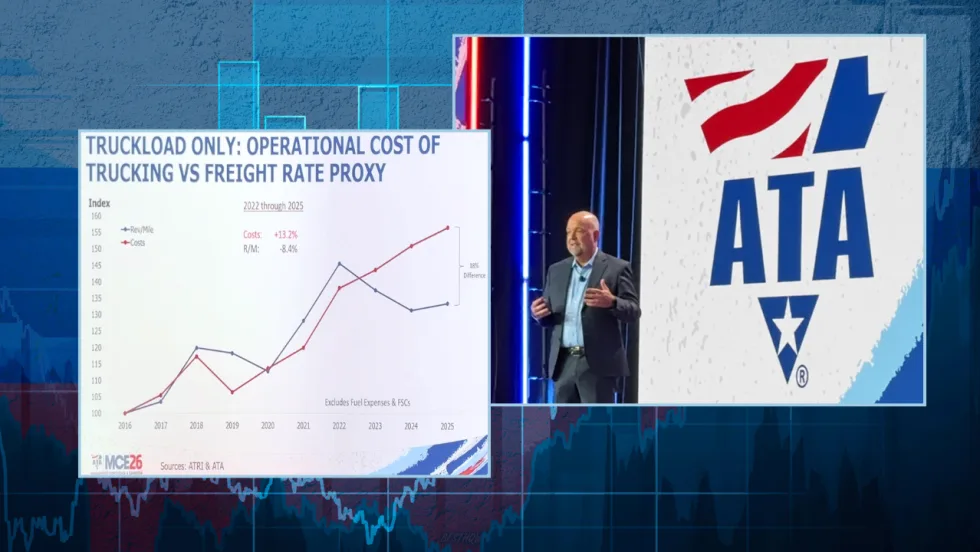
Why This Trucking Recovery Is Different
Freight demand remains sluggish, but rising costs and tougher enforcement have taken enough capacity out of the market to change the outlook for motor carriers.
Read More →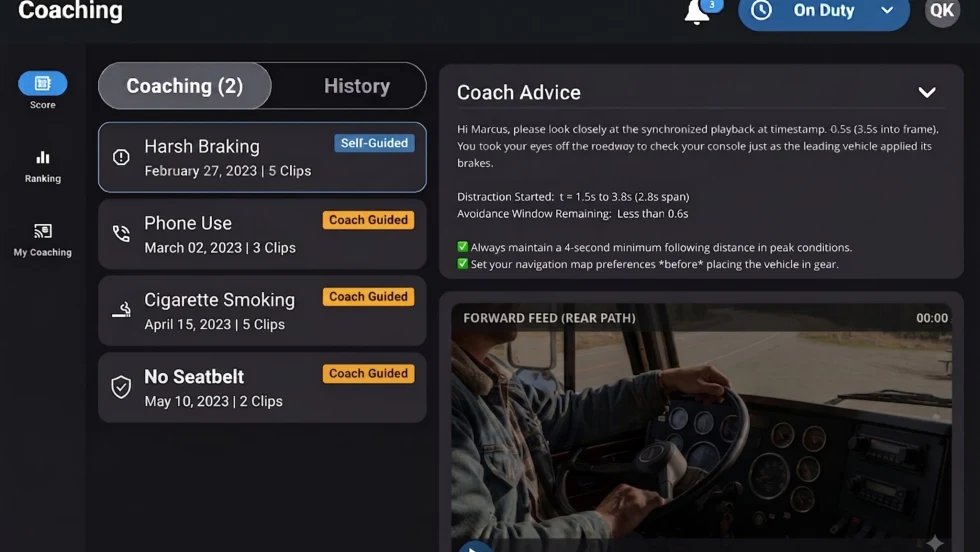
Platform Science Adds Dispatch and Safety Tools
Four additions to PS Fleet help fleets monitor loads, manage driver coaching, share truck locations and adjust video system settings.
Read More →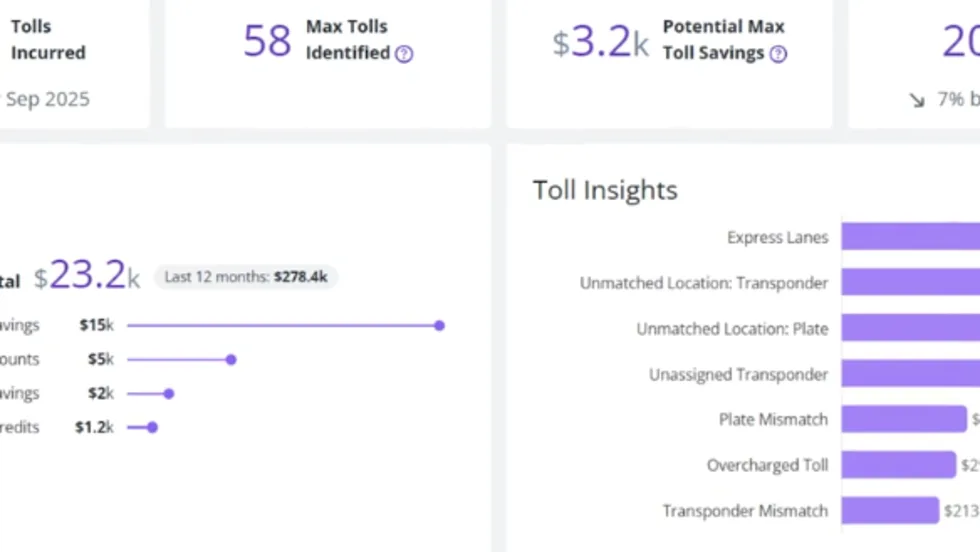
PrePass Intelligence Mines Fleet Bypass, Toll and Safety Data
PrePass Intelligence helps fleets measure bypass savings, flag potential toll overcharges, and spot suspicious transactions by combining data from separate systems.
Read More →
Motive Adds AI Agents for Fleet Operations
New tools automate follow-up on fleet data, from maintenance work orders to driver alerts, with two-way voice conversations planned for later this year.
Read More →
Can You Beat Our Trucking Trivia Challenge?
Test your truck knowledge with 19 trivia questions from Heavy Duty Trucking Exchange. Can you keep up with the fleet pros?
Read More →
BeyondTrucks Adds Rules Checks to Dispatch
New Compatibility Engine checks driver qualifications, equipment requirements and fleet policies before loads are dispatched.
Read More →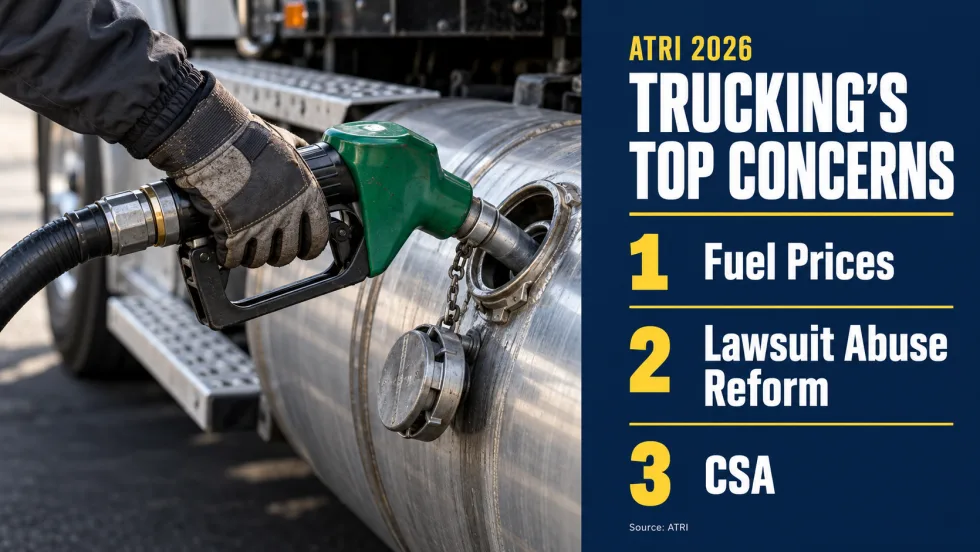
Diesel Prices Hijack Trucking’s Worry List
ATRI’s annual survey finds cautious optimism about freight, but diesel costs, litigation, and insurance continue to squeeze fleets. Drivers have different priorities on several issues.
Read More →
Nomination Deadline Extended for HDT Emerging Leaders
Just a few more days to nominate accomplished trucking fleet professionals under 40 who are making an impact and helping lead the industry forward for the HDT Emerging Leaders award. Deadline extended to October 20!
Read More →
What Will ATA’s New Leader Bring to Trucking's Table?
Incoming President and CEO Mark Colson’s record in Alabama offers clues about his priorities and approach following Chris Spear’s abrupt departure as the head of the American Trucking Associations.
Read More →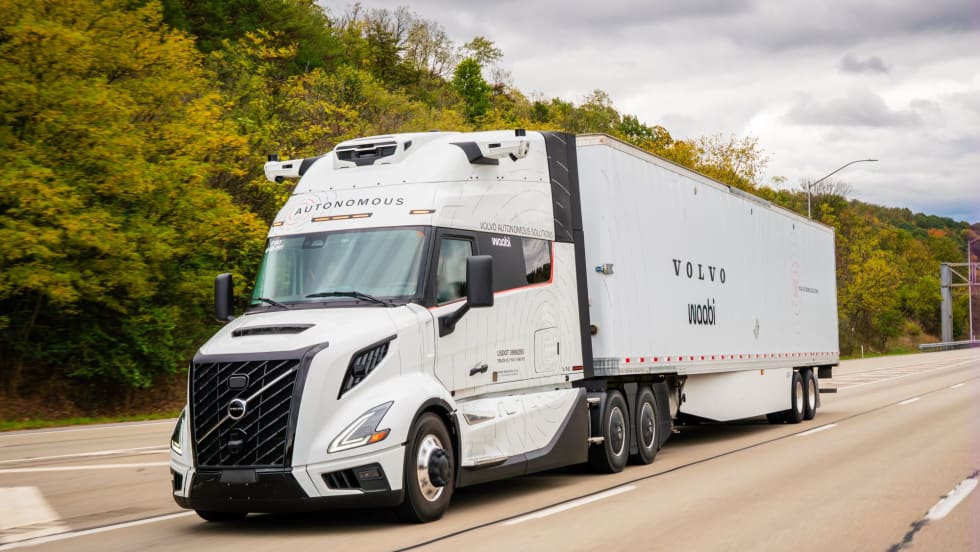
Volvo, Waabi Start Commercial Autonomous Operations in Texas
Volvo VNL Autonomous trucks, powered by the Waabi Driver, are hauling freight directly to third-party facilities for a customer in Texas.
Read More →