





Global News Roundup: Autonomous Truck Market Heats Up in Asia
Global News Roundup: HD Truck Manufacturers Team Up For Electric Charging
ICYMI: A roundup of trucking industry news from Daimler, Traton, Volvo, MAN, Mercedes, FedEx, Delihvery, Volkswagen, Britain and more.
July 26, 2021
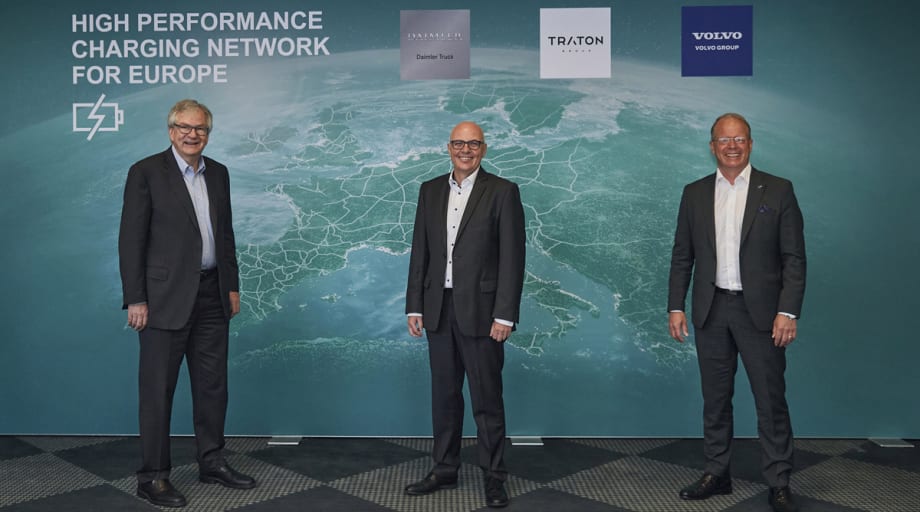
Europe's leading commercial vehicle manufacturers will form a joint venture to develop a public charging network for battery-electric heavy-duty trucks by 2026.
Photo: Traton
3 min to read
Daimler Truck, Traton Group, and Volvo Group are teaming up to develop a public charging network for battery-electric heavy-duty trucks in Europe.
The three commercial vehicle manufacturers signed an agreement to install and operate at least 1,700 high-capacity charging points near highways and logistic points within five years. The infrastructure will be compatible with vehicles of all brands.
The companies intend to invest about $591 million into the development, which will support the European Union’s Green Deal for a carbon-neutral freight transportation by 2050. The number of charging points is intended to be increased significantly by seeking additional partners as well as public funding, company officials said.
Battery-electric vehicle fleet operators will be able to use both fast charging tailored to the 45-minute mandatory rest period in Europe and also charge overnight.
The three companies will own equal shares in the planned joint venture but continue to be competitors in all other areas.
Autonomous Truck Trial at German Container Port
A pilot project at a German container terminal tested an autonomous MAN prototype truck.
A 40-foot container was transported about 70 kilometers to the container terminal in the Port of Hamburg by a regular truck driver in a prototype truck equipped with electronic automation systems.
After going through the terminal check gate, the driver switched to the passenger seat and a safety driver climbed in, who had to be on board for legal and safety reasons. The truck then drove autonomously across the terminal site to its correct position in the block storage lane and also maneuvered autonomously backwards into the correct parking position. After container handling, the return trip to the check gate was also autonomous. Beyond the terminal site, the regular driver again took full command.
New Briefs from Around the World
At the 2021 World Artificial Intelligence Conference in Shanghai, China, Inceptio Technology exhibited what it called the world’s first two models of mass-produced autonomous-driving heavy-duty trucks. They were developed in cooperation with Chinese truck makers Dongfeng Commercial Vehicle and Sinotruk.
This summer saw the premiere of the Mercedes battery-powered eActros for heavy-duty distribution. Prototypes have been in customer testing since 2018, and series production is scheduled to begin in the second half of this year.
FedEx will invest $100 million in Mumbai-based Delhivery and will transfer “certain assets” to the Indian express delivery giant, combining the FedEx global network with Delhivery’s extensive pan-India network.
Volkswagen Caminhões e Ônibus in Brazil is launching an electric delivery truck. The first vehicle developed within the framework of the e-Consortium VW established in 2019, this e-Delivery is aimed at the light truck segment with the capacity to transport up to 14 tonnes. The truck has a range of 200 kilometers and brakes that charge the batteries while driving.
Britain faces a shortage of 100,000 truck drivers, thanks to “Brexit,” the country’s withdrawal from the European Union, with the industry saying truck drivers don’t want to come to Britain with new regulations making border crossings difficult. The shortage was made worse when many European drivers returned to their home countries during the COVID-19 lockdown. The construction sector has reported widespread disruption and delays due to the shortfall of truck drivers. The government, however, says employers should focus on investing in the domestic workforce rather than relying on drivers from abroad.
This news first appeared in the July 2021 issue of Heavy Duty Trucking.
Subscribe to Our Newsletter
More Fuel Smarts

How Volvo Updated Its D13 for EPA 2027 [Watch]
Volvo’s updated D13 promises lower emissions without sacrificing performance or fuel economy. Take a closer look at what changed inside the engine in this HDT Spotlight video.
Read More →
Diesel Price Spike Shortens Payback for Natural Gas Trucks, Report Says
Energy Vision estimates fleets could recover the higher purchase price of an RNG-fueled Class 8 tractor in 1.3 to 2.8 years under current fuel-price scenarios.
Read More →
Calstart Becomes Catalyst Mobility, Reflecting Broader Focus
Calstart is now Catalyst Mobility, reflecting the nonprofit’s growing national role in clean transportation, including zero-emission trucks, infrastructure and incentive programs.
Read More →

Record Diesel Prices Squeeze Trucking Fleets
Average U.S. diesel prices have climbed to nearly $6 a gallon, surpassing the 2022 record as tight refinery capacity and Middle East disruptions keep fuel costs elevated.
Read More →
Sponsored•September 9, 2026
How Fuel Delivery Shapes Engine Performance
Fuel delivery depends on more than what happens at the injector. For fleet, maintenance and technical professionals, looking at the full path from pump to injector can provide useful context for understanding engine performance.
Read More →
East Coast Port Launches $45M Electric Truck Push
The Port Authority of New York and New Jersey announced millions in incentives for zero-emission drayage trucks, yard tractors, and new charging hubs near the port.
Read More →
California Bill Could Shed Light on Electric Truck Prices
Why do battery-electric Class 8 trucks remain so expensive? A California bill headed to Gov. Gavin Newsom would give fleets and state agencies more visibility into what manufacturers charge.
Read More →
Detroit Opens Orders for EPA 2027 Engines
Detroit isn’t starting from scratch to meet EPA 2027 diesel emissions standards. Its Gen 6 DD13 and DD15 engines keep much of today’s platform while updating the fuel and aftertreatment systems.
Read More →
Zero-Emission Truck Corridor Planned for West Coast
California, Oregon, Washington, British Columbia and Baja California are coordinating plans for truck charging and hydrogen fueling from Canada to Mexico.
Read More →
A Closer Look at Kenworth’s Electric T880E Vocational Truck [Video]
Learn more about Kenworth's T880E battery-electric vocational truck at the Paccar Technical Center, including its range, applications, upfitting considerations, and PTO options, in this HDT Spotlight video.
Read More →