




Fair Credit Reporting Act Affects Driver Hiring
Last May, the Federal Motor Carrier Safety Administration began its pre-employment screening program service, or PSP. The PSP service compiles information regarding driving records of commercial drivers for use by motor carriers in making employment decisions
Last May, the Federal Motor Carrier Safety Administration began its pre-employment screening program service, or PSP. The PSP service compiles information regarding driving records of commercial drivers for use by motor carriers in making employment decisions.
Operated by National Information Consortium Technologies, the PSP gives carriers a glimpse into a driver's roadside inspection history, specifically hours of service violations, overweight violations and equipment violations.
However, motor carriers should develop processes and procedures to ensure that obtaining and using this information to make hiring and training decisions that are consistent with the Fair Credit Reporting Act.
FCRA should be nothing new to motor carriers, as many current databases and reports are subject to this law, such as most MVRs. FCRA applies to "consumer reports" generated by a "consumer reporting agency." The FCRA does not require employers to conduct background checks, but it does set authorization and disclosure requirements for obtaining the records.
Under the FCRA, before obtaining a consumer report like the PSP, a motor carrier must first make a written disclosure to the driver that the carrier intends to obtain a consumer report, and must obtain written authorization from the prospective driver to do so. This disclosure and authorization must be clear and conspicuous, and must be on its own separate document - not part of the employment application. The form provided by PSP for this purpose should be sufficient.
The motor carrier also must certify to the consumer reporting agency that the motor carrier will comply with the FCRA. The FMCSA does this using the Monthly Account Holder FCRA Employer Certification form included in the PSP application.
Interestingly, the trucking industry obtained an exemption from the requirement that the disclosure and the authorization have to be written when a driver applies for a job. Rather, the disclosure and authorization could be by oral or electronic means. The exemption applies to applications for positions "over which the secretary of transportation has the power to establish qualifications and maximum hours of service pursuant to the provisions of section 31502 of title 49, or a position subject to safety regulation by a state transportation agency," and only if the driver applies by some means other than in person. This exception would appear to cover reports under the PSP system, as almost all such reports would be on driver applicants who are governed by the secretary of transportation. Presumably, this exemption was in recognition of the fact that truck drivers are often on the road and have limited access to mail or fax machines.
However, even more interesting is that the FMCSA unilaterally dispensed with the statutory exemption by contractually requiring that the motor carrier obtain a written authorization from the driver to obtain a PSP report. Therefore, even if a motor carrier previously relied on oral authorization to pull a driver's MVR, in order to obtain a PSP report, motor carriers must get written consent. Furthermore, pursuant to the same contract, the written consents must be kept on file and are subject to audit by the FMCSA (or its designees) at any time.
Generally, prior to taking any adverse action against the driver (for instance, deciding not to hire the driver, or assigning the driver for remedial training in orientation) that is based in whole or in part on information obtained from the consumer report, a motor carrier must first provide a "pre-adverse action" notice to the driver. This notice must provide a copy of the consumer report and a description of the driver's rights under the FCRA in a form promulgated by the Federal Trade Commission. This notice allows time for the driver to challenge or correct any errors in the consumer report before final adverse action is taken.
If after providing the pre-adverse action notice, the motor carrier does, in fact, take adverse action against the driver based on the consumer report, then the motor carrier must provide notice of the adverse action within three business days of taking such action. This notice must contain the following:
* The name, address and telephone number of the consumer reporting agency;
* A statement that the agency did not make any decision and cannot provide any reasons why the adverse action was taken;
* Provide notice of the driver's right to obtain a free copy of the consumer report; and
* Provide notice of the driver's right to dispute the accuracy or completeness of the information in the report.
Although the adverse action notice can be oral, written or electronic, it is recommended that a written notice be used to document that all necessary information was conveyed.
As with the written consent requirement, the trucking industry obtained a special exemption for taking adverse action. Motor carriers may dispense with the pre-adverse action requirement if the driver applies by means other than in person. Instead, the motor carrier can simply proceed with the adverse action and send the adverse action notice. If the driver requests a copy of the consumer report from the motor carrier, however, the motor carrier must comply with the request within three business days, as well as provide a copy of the FTC's notice of consumer rights form (which should be provided by the agency when the report is sent.)
Unlike the written consent requirement, FMCSA does not require motor carriers to contract out of the adverse action statutory exemption in order to participate in the PSP program. Therefore, if the driver does not apply in person, the pre-adverse action notice is not required when taking the adverse action (such as not hiring the applicant) based on the PSP report. If the driver does apply in person, the pre-adverse action notice is required, including a copy of the PSP report and a copy of the FTC notice of rights. And if adverse action is taken, the same notice is required, along with an extra requirement that the driver be informed of their right to obtain a copy of the PSP report from the FCMSA as well.
What about independent contractors? Independent contractors are included in the federal definition of "employee" under 49 CFR 390.5. Because motor carriers, generally, are responsible for safety compliance of independent contractors, we recommend using PSP to screen contractor applicants but changing the authorization and notices to delete references to "employee" to eliminate confusion.
In conclusion, in obtaining access to the PSP database, a motor carrier must have authorization from the driver. We suggest using the authorization provided by PSP. If the motor carrier is using the PSP to take a negative action against the applicant, then the pre-adverse action must be given, but only if the driver applied in person. Finally, after the adverse action is taken, the motor carrier must provide an adverse action notice. PSP does not provide forms for the pre-adverse action notice nor the adverse action notice. Therefore, motor carriers should work with counsel to develop these along with policies and procedures for FCRA compliance.
From the April 2011 issue of HDT.
More Safety & Compliance
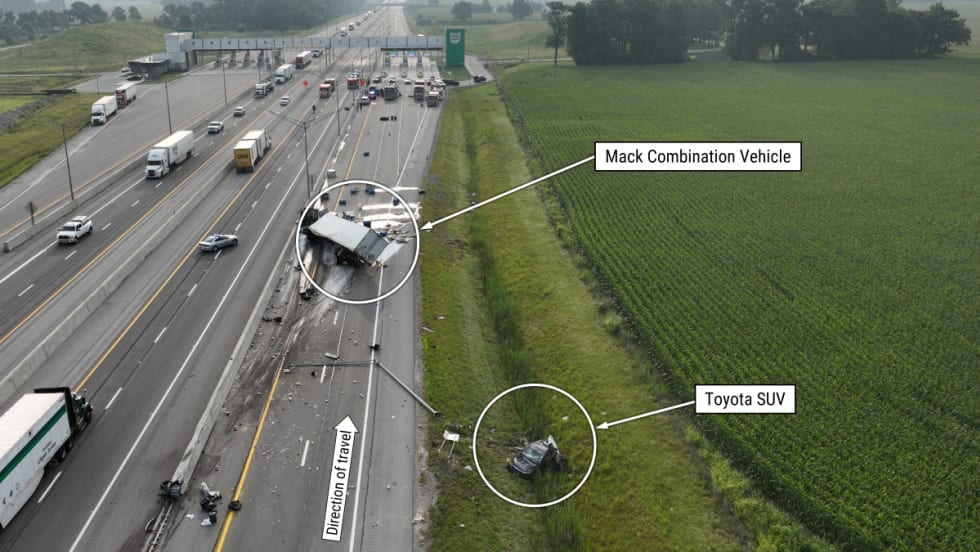
Fatal Crash Exposes Toll Plaza Risks
An NTSB investigation found that last-minute lane changes and large speed differences at an Ohio toll plaza created a hazard the truck driver couldn't avoid in time.
Read More →
When Language Stops the Truck: The Return of ELP Out-of-Service Orders
English language proficiency rules for commercial drivers aren’t new, but renewed out-of-service enforcement has raised the stakes. Here’s what carriers need to know before a driver reaches a roadside inspection.
Read More →
A Camera Isn't a Safety Program. Here's What Brokers Are Screening for Now
Footage alone may not be enough to pass broker vetting processes. Here's what counts as a defensible safety program now.
Read More →

Marijuana and Trucking’s Drug-Testing Dilemma
Marijuana is getting stronger, laws are changing, and drug tests still can’t reliably establish impairment. What does that mean for truck drivers and the fleets that employ them?
Read More →
PrePass, Kodiak Connect Driverless Trucks to Roadside Enforcement
The system will allow enforcement agencies to verify Enhanced Inspection information and decide whether Kodiak’s autonomous trucks can bypass roadside screening sites.
Read More →
From One Generation to the Next: How Mentorship Builds Safer Truck Drivers
After three decades in trucking, Harold Perry shares what he's learned about driver safety, mentorship, and helping the next generation build confidence behind the wheel.
Read More →
FMCSA Pauses Biennial-Update Enforcement Amid Motus Transition
Carriers whose updates were due on or after June 1 have more time, while FMCSA works to stabilize its new registration system and warns of phishing sites impersonating its new carrier registration system, Motus.
Read More →
ZF Expands Commercial Vehicle Push in North America
ZF is expanding its North American commercial-vehicle presence with new transmission applications, electrification, trailer technology and autonomous-driving systems.
Read More →
Truck Drivers Need More Than Another Alert
Fleets have more visibility into truck health, safety events, and driver activity than ever. The next challenge is turning all that information into useful guidance for the person who has to decide what to do next.
Read More →
Tesla Wants a Self-Driving Semi. Are Cameras Enough?
Could Tesla’s camera-only autonomous driving technology work on an 80,000-pound Semi? In this commentary, HDT's Deborah Lockridge takes a look at Tesla, Cybercab, and how autonomous trucks see the road.
Read More →