




How One Fleet Faces Maintenance Tech Shortages Head-On
Paul Cupka, maintenance facility superintendent for Fairfax County’s Department of Vehicle Services in Virginia, talks maintenance technician shortages.

Paul Cupka chats with technician Scott Duvall about tire repair issues. Cupka is Fairfax County’s Department of Vehicle Services West Ox Maintenance Facility superintendent.
Photos by Rachel Graber Akpotu, TMC
Paul Cupka is alarmed that the trucking industry is behind a looming eight ball when it comes to filling the many vacancies for skilled maintenance technicians. “We’re already behind, but in 10 or 15 years we’re going to be in a lot of trouble,” said the West Ox Maintenance Facility superintendent for Fairfax County’s Department of Vehicle Services in Virginia.
Cupka is not waiting for others to take action in his universe. He scouts local vocational schools and actively encourages his 60 technicians and six supervisors to constantly train and stay abreast of rapidly changing technology. Fairfax County’s four maintenance facilities —all of which are ASE Blue Seal Certified —are responsible for 6,000 pieces of equipment. Cupka’s shop works on 1,400 of those vehicles, ranging from school buses and fire pumpers to mowers and rolling sign boards. The Fairfax County fleet also ranked 15th in Government Fleet Magazine’s 50 Leading Fleets across the U.S. and Canada.
“Technicians at West Ox alone hold 46 ASE Master Certifications, which means about 75% of our technicians have at least one ASE certification,” Cupka crows. “It’s tough getting and keeping good people, but the results are worth the effort. We aren’t as concerned about numbers as the quality of repairs.”
Making a Difference
Cupka taught truck technicians for a year and sits on the board of advisors at the Northern Virginia Community College (NOVA). He also volunteers for outreach to potential technicians at area high schools and welcomes students to his shop as apprentices.
"Our industry needs more people like Paul, who get involved and try to make a difference. He’s not sitting on the sidelines and waiting for someone else to do it. Paul clearly leads by example,” said George Arrants, automotive education consultant, specializing in ASE accreditation and a familiar face around the TMCSuperTech competitions put on by the American Trucking Associations' Technology & Maintenance Council.
“Paul is a great example of someone who really believes in his industry and wants to get involve and make a difference in his community,” Arrants said. “Through his efforts, he will in turn change the lives of those that go through that program in the future.”
Cupka, who in his youth began but wasn’t able to complete the NOVA automotive program, took his first job as a mechanic in 1978 for the Washington Post’s Robinson Terminal Warehouse & Trucking Company, a fleet that delivered news print. “Then we were known as mechanics or grease monkeys. There were no computers,” he said, adding that the current job title of maintenance technician better describes the more advanced systems of today’s working fleets.
He labored for 32 years with Robinson before starting with Fairfax County as a technical trainer. After spending four years as supervisor of training, safety and quality assurance with the Fairfax County Government Center, he was promoted to his current position, but training still gets him out of bed each morning.
“I realized when I started teaching how satisfying it is. I wasn’t born knowing this, but it’s icing on the cake when after a brake class, a student walks up to me — he’s been a technician for years — and thanks me for taking the time to pass on what I’ve learned. (The attendees) say that if they’d known some of what I covered in the class, it would’ve made their jobs easier,” Cupka said.

John Wingard (left) and Paul Cupka at the dynamics station, where they put school buses in gear on a treadmill to test engine functions.
Regular training is held at the West Ox facility by Cupka and others to ensure technicians are familiar with all systems of the vehicles.
“Paul taught an air brake class that I attended when I first started with the county,” said Matt Cekala, currently the West Ox facility’s night supervisor. “Not long after that air brake class, there was a fuel tanker truck whose rear brakes were locking up, and it had to be towed to my facility to see what was going on. He gave me ideas on what to check and he let me do the work. Turned out to be a sticky valve on the air brake relay. At that time, I wouldn’t have been able to diagnose and make the repair without his instruction.”
Cekala, who holds five ASE master certifications, supervises 19 technicians in his section which focuses on maintaining the 699 school buses serviced by the shop. And he knows how to break it down by the numbers. “We perform preventive maintenance (PM) inspections on each bus every 45 days so that means we have to check 16 to 18 buses every shift.”
Cekala, who attended Lincoln Tech in Landover, Maryland, has been a technician for 22 years, but continues to be impressed with Cupka’s level of experience.
“There are days Paul hangs around into the evening to give feedback or brainstorm about what to do about a computer control issue or mechanical issue. He loves sharing his knowledge,” Cekala said. “We do a lot of diagnosis before we replace a component because it can get really expensive and we don’t want to guess.”
Cekala explained that today’s vehicles include two to eight different computers and some might have 10 modules. All this technology requires more diagnostics than in the past. “Gone are the days you could just guess and throw some part on,” he said. “The computer codes might identify the system that is ailing, but it doesn’t tell you what to do to fix it. We have to check all steps and depending on where the problem comes up, we use volt meters or oscilloscopes. It’s really a comprehensive process.”
“Paul doesn’t just talk a good game, he’s done the work,” said Bobby Iames, 28 and a Technician 3 who also holds ASE Masters Certification in five categories. “He has a lot of experience working on different equipment and provides training in electrical, air conditioning, brakes, after treatment systems, tires…every piece of equipment.”
Iames graduated in 2008 from Universal Technical Institute in Exton, Pennsylvania, and first worked with an international school bus supply company. He completed the five ASE certification tests in a year and a half and aims to be a shop supervisor someday.
“Paul has been on the floor, so he understands. When we needed a laptop that hooks up to school buses to diagnose issues, he went before the county and convinced them to purchase the computer,” said Iames.
The shop staff do all they can to keep repairs in-house. “Our labor rate is cheaper and when we have sent equipment out for repair, we never know when we’ll get it back,” Iames explained.
Cupka insists that technicians remain flexible to work on mission critical vehicles – such as fire trucks and medical ambulances. They have to be on call during the weekends and weather emergencies too, but overall he feels working for a government fleet is less stressful than a dealership where there is increased pressure to return a vehicle to service in less time.
Trucking Will Always Need Technicians
TMC also benefits from Cupka’s training prowess. For the last four years, he has been one of the trainers for the North American Transportation Management Institute (NATMI) Certified Director/ Supervisor of Maintenance Certification courses. Cupka holds the NATMI director of safety certification. He is also involved with the Educator Committee and the S.3 Engines Study Group, focusing on aftertreatment systems.
Stepping around some ongoing construction in his facility, Cupka acknowledges that the trucking industry is experiencing a driver shortage, but feels the technician shortage doesn’t receive the attention it deserves. “Even if we fill the driver seats, we’ll still need trained technicians to keep the trucks working properly,” he said. “Even if the industry goes toward autonomous/automated vehicles, trained technicians will be needed to keep the vehicles running.”
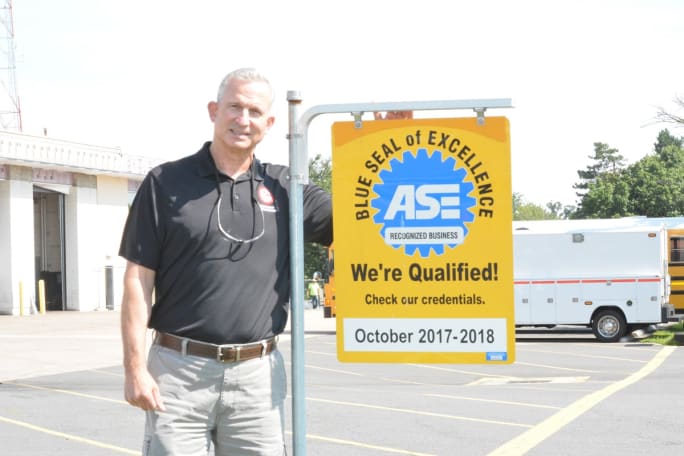
Paul Cupka stands proudly in front of the ASE Blue Seal of Excellence at the Fairfax County facility, which is also currently under construction.
Every action always comes back to training for Cupka. “One of my pet peeves is the lack of federal and state funding for vocational training and community colleges. To work on today’s heavy duty equipment, these people need to master highly technical material. The government and states should seriously support trade schools,” he said.
However, book learning doesn’t always translate to mastery of any trade.
"Schools gives you theory but when you are shown how something works – like tying your shoe — then it really takes hold and makes sense,” Cekala said. “I do a lot of hands-on training with new technicians, and we put them with more experienced techs to learn some of the more difficult diagnostics of the job.”
When the current $4 million renovation to the West Ox facility is complete, Cupka said there will be 29 working bays, including a machine shop, parts department, body shop and tire bay. He continues to keep an eye out for sharp technicians and realizes that a happy technician will be a long-term employee.
Cupka encouraged his technicians to use their mechanical abilities to build a race car and participate in Fairfax County’s Employee Appreciation Day this past June. The techs enthusiastically built their entry out of 55-gallon plastic barrels, scrap metal and components from the landfill, such as bike wheels. Gravity and luck were on their side, and Cupka’s Crew won the downhill race, beating out three other cars.
Janet Howells Tierney is the American Trucking Associations' Technology & Maintenance Council director of council development. This article originally appeared in TMC's Fleet Maintenance and Technology and was used with permission, edited according to the standards of HDT to provide useful information to our readers.
More Maintenance
Mack Expands Extended Coverage With Four Chassis System Plans
Mack Trucks' new system-specific coverage options allow heavy-duty fleets to select protection for driveline, cab, HVAC, electronics, and advanced safety components.
Read More →
What an Out-of-Service Order Really Costs, and How to Plan for One
The repair invoice is the first number you see — and often one of the smallest. Here’s what else an out-of-service order can cost a fleet, and how planning can reduce the damage.
Read More →
International Launches Online Truck Parts Store
Fleetrite.com lets fleets and repair shops find OEM and all-makes parts, check prices and availability, and order without calling a parts counter.
Read More →

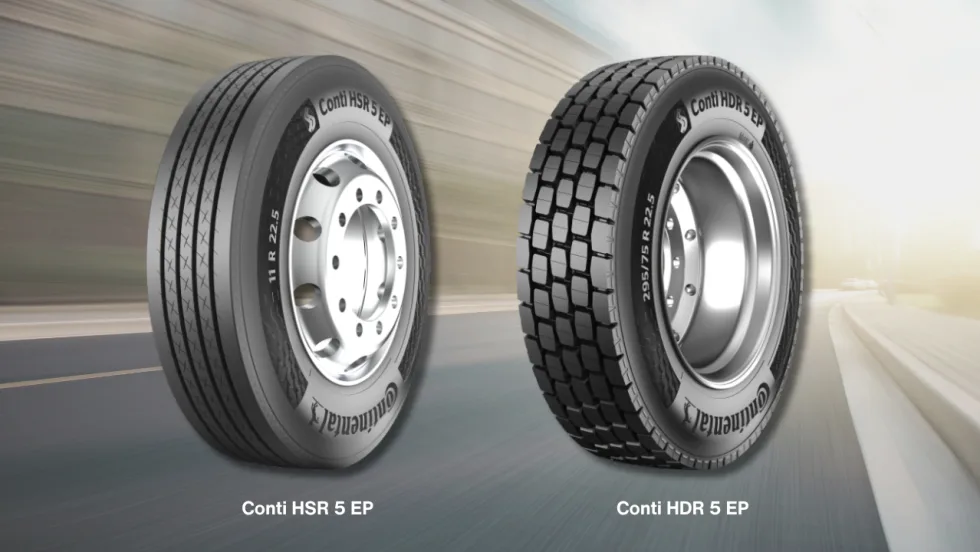
Continental Introduces New Regional Truck Tires
Continental says its new Generation 5 steer and drive tires for regional operations offer longer tread life, with estimated mileage gains of 22% and 19%, respectively.
Read More →
How AI Can Help Your Techs’ Efficiency
The technician shortage isn't going away, and no single fix can close the gap on its own. Trent Broberg makes the case that AI's real job in the shop is protecting the billable hours and job satisfaction of the techs you already have, not asking them to work faster.
Read More →
Color Match Smarter: Tools That Restore & Perform
For fleet managers and collision repair professionals keeping heavy-duty trucks on the road, getting the color right the first time isn't just about appearance — it's about efficiency, turnaround time, and bottom-line results. Discover how today's digital color tools are transforming the repair process from guesswork to precision.
Read More →
Wrong Repair Prompts Recall of Freightliner, Western Star 4x2 Trucks
DTNA is recalling more than 2,400 trucks that received an incompatible software fix instead of the hardware repair required to address brake valve corrosion.
Read More →
Truck Drivers Need More Than Another Alert
Fleets have more visibility into truck health, safety events, and driver activity than ever. The next challenge is turning all that information into useful guidance for the person who has to decide what to do next.
Read More →
The Maintenance Checks Trucking Fleets Should Prioritize Before Fall Freight Picks Up
Making it through August isn’t the same as being ready for the next several months of operation. Find out what systems may have suffered from summer heat and need to be checked out before fall.
Read More →
What Three Fleets Are Doing Differently When Buying Truck Parts in 2026
With freight improving but costs still climbing, fleet maintenance executives explain how they're balancing price, quality, and supplier relationships.
Read More →