





Related: Integrated Powertrain Project in the Works from TomTom, Daimler, Bosch
Engines Are Smarter Than You Think
Smart powertrains have made possible incredible gains in fuel efficiency, performance and safety.
March 16, 2020
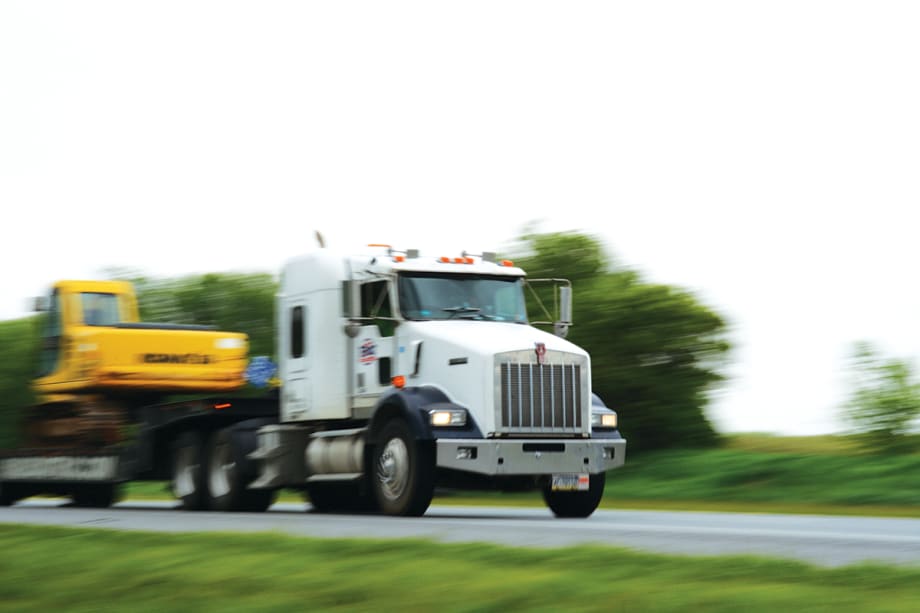
Smart powertrains build on how good drivers used to operate their trucks, but improvements made possible with technology have left even the best drivers in the dust.
Photo: Jim Park
7 min to read
Smart powertrains are nothing more than modern extensions of what the best drivers did back in the day, when everything was mechanical and electronics were limited to CB radios. I have to say, in all modesty as a former driver myself, it has taken a long time for the technology to catch up — but it now leaves even the best drivers in the dust. What drivers could do by their own wits is far exceeded by the micro-precise adjustments and finely tuned calibrations electronic controls can deliver. The gains in performance and efficiency are stunning — but they are still based in good old-fashioned sound driving principles.
Back in my driving days, when travelling over the Three Sisters on I-80 in Wyoming, or nearly any other significant hill in the country, drivers with fleets that had locked-down speed limits of 55 would descend the hills with the brakes on all the way down, not daring to exceed 55 by even 1 mph. They burned their brakes all the way down and created traffic mayhem as their under-powered trucks crawled up the other side.
Meanwhile, drivers who weren’t living under the speed-limited sword of Damocles let the trucks roll out a little to preserve momentum and reduce brake wear (OK, and to make a little time). That’s exactly what the predictive cruise control and neutral-coast features do for drivers today — with the added advantage of some electronic oversight.
Features such as cruise-brake overspeed allows customers to control runout speeds on negative grades, notes John Moore, Volvo Trucks’ powertrain marketing manager. “The customer can set the runout speed a little higher than cruise speed to take advantage of the momentum coming off a hill without the driver letting it run way over the set speed. Also, predictive cruise works in conjunction with Eco-Roll to disengage the drivelines faster when no driveline load is experienced, again, to take advantage of momentum with the parasitic engine drag.”
Features such as predictive cruise control use GPS and terrain maps to read the road ahead and plan acceleration, gear shifts, and engine-brake applications to keep the truck rolling as efficiently as possible without unnecessarily extending trip times. On an uphill grade, for example, the GPS will tell the engine it’s approaching a 1-mile-long 3% grade. Based on the weight of the truck, the engine may calculate it can climb that hill without a downshift. But on a 1.5-mile hill, if the engine determines it might need a downshift midway up, it may instead make the downshift before it hits the hill to avoid shifting on the hill and losing momentum in the process.
The various algorithms built into the ECMs favor fuel efficiency in many cases, but they can be programmed to lean toward performance if that’s what the operator wants. In the old days, a fleet might give a driver a high-powered truck and hope they would use the power responsibly. While a driver can still override some of today’s programmed shifting and acceleration parameters, they usually don’t. It’s not worth the effort. It’s simply easier to let the computers do the thinking.
“When I think of smart powertrains like Cummins Adept, we have provided customers the ability to customize their powertrain for its particular use,” says RaNae Isaak, Cummins’ powertrain total cost of ownership and consultancy leader. “Adept can provide electronic decisions to the powertrain that can at times make better decisions regarding efficiency than the operator can.”
Better Torque Management
Perhaps one of the most beneficial examples of smart powertrain thinking is downspeeding — running at very low engine rpm at cruise speed to reduce fuel consumption. It would not have worked back in the days of mechanical engines and manual transmissions, even though some variation on the gear-fast/run-slow concept was popular. Drivers would have been intensely unhappy with the feel of the engine at very low rpm, so they would have likely run a gear or two back or cruised at 80 mph or more as the gear sets allowed. Either way, the fuel savings would have been negated.
When cruising at 1,100 rpm, the question of whether or not to downshift on an uphill grade is a delicate one. Drop too low in the torque band and it feels like someone turned off the key. But letting the engine pull down to 1,000 or even 900 is fine if the engine knows that relief is just ahead. Good drivers would watch the road ahead and predict if a shift was needed; predictive cruise does that now, adding GPS eyes to the powertrain that enable it to hold a gear as long as possible — or to know when to give up and downshift earlier.
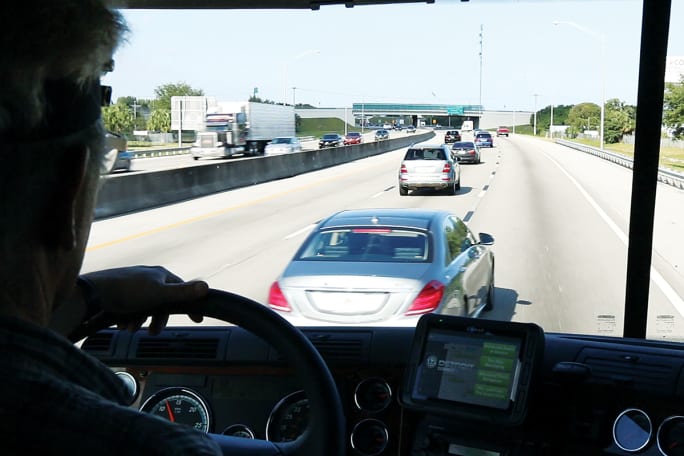
Integrating the powertrain with various proximity sensors allows the computer to intervene with braking, deceleration, and possibly steering to minimize the potential for collisions.
Photo: Jim Park
Options like Volvo’s Dynamic Torque can manage torque under different load conditions. When lightly loaded, below 65,000 pounds, torque is reduced on acceleration to reduce fuel consumption and driveline wear when extra power isn’t needed, such as when bobtailing or empty. For heavier-haul applications, programming allows the transmission to lock out overdrive and keep it in direct. This enhances performance when heavy with a minimal fuel penalty. In effect, a single engine can be programmed to perform at its best under quite different load conditions.
“Customers can tailor the drive mode software to match their fuel economy or performance requirements,” says Moore.
Most engine makers offer dual-torque configurations, too. The lower torque setting is active in the lower gears where high torque output isn’t needed and can be damaging to driveline components, but available in the higher gears. This eliminates the need to over-spec the driveline, which keeps down cost and weight.
The Safety Card
Adaptive cruise control is now a popular option not only for its fuel-saving potential but also for its safety benefits. Using radar- and/or camera-based forward object detection, adaptive cruise control sets a minimum following distance (sometimes adjustable by the driver, sometimes not) to help prevent rear-end collisions. It’s also useful for minimizing fuel-stealing brake applications by drivers who do get in too close to the preceding vehicle.
“Detroit’s Intelligent Powertrain Management (IPM) knows the route ahead and will accelerate, preselect gears, eCoast and brake the engine to maximize efficiency,” says Kelly Gedert, director of product marketing at Freightliner and Detroit. “Using preloaded terrain maps, IPM will adjust the following distance to ensure the truck is carrying the most efficient momentum into road conditions ahead.”
Adaptive cruise control throttles up or down and coasts in an effort to maintain a steady road speed and avoid abrupt changes in power demand. When coupled with an advanced driver assistance systems such as Detroit Assurance 5.0, the engine and transmission can control vehicle speed, following distance, and the application of service brakes when necessary, even down to a full stop.
Programming Parameters
Smart powertrains have opened a number of doors to fleets and drivers that improve just about everything: fuel efficiency, performance, safety, and operating costs. In effect, a fleet can buy a single make and model of engine (which is good for serviceability, parts inventory and technician familiarity), but program them for different applications, capitalizing on different performance parameters as required. In addition to the high-level options, there are dozens of individual parameters than can be adjusted to suit the fleet’s needs. These are often overlooked in favor of the default settings, says fuel economy whiz-kid, Joel Morrow of Ohio-based fleet Ploger Transportation.
“It can take a while to go through them all, and the dealer can really help with that,” he says. “Once you dial in a setting for a particular application, you can save the setting and import them to other trucks as well. But beware, sometimes a factory update can wipe the changes and restore the defaults. You have to watch for that.”
Truck and engine makers are always updating the technology and adding new features.
“In order to keep offering industry-leading fuel economy to International’s customers, advanced engineering teams identify which technologies can provide fuel economy improvements, with the right tradeoffs in terms of uptime, weight, serviceability, cost and more,” notes Jim Nachtman, heavy duty marketing director at Navistar. “There are many areas of innovation and continued optimization. Reducing drag on the engine with variable size pumps, further downspeeding of engines, improved optimization with the transmission, and aftertreatment operation refinements are just some of the areas where fuel efficiency gains come from.”
None of that was possible with mechanical engines and manual transmissions. It’s fair to say that smart powertrain programming has made possible the near doubling of engine fuel efficiency over the past two decades, and all indicators suggest even more gains are on the horizon.
Subscribe to Our Newsletter
More Equipment

How Volvo Updated Its D13 for EPA 2027 [Watch]
Volvo’s updated D13 promises lower emissions without sacrificing performance or fuel economy. Take a closer look at what changed inside the engine in this HDT Spotlight video.
Read More →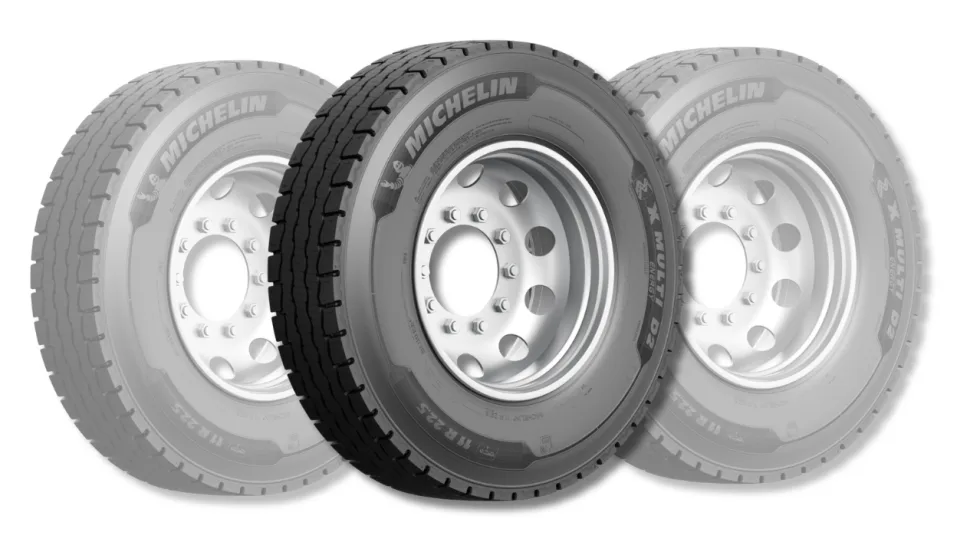
Michelin Tire Improves Efficiency and Durability for Regional Fleets
The Michelin X Multi Energy D2 is a regional haul drive tire engineered to help fleets improve fuel efficiency, durability and traction in demanding stop-and-go operations.
Read More →
ZF Expands Commercial Vehicle Push in North America
ZF is expanding its North American commercial-vehicle presence with new transmission applications, electrification, trailer technology and autonomous-driving systems.
Read More →
Tesla Wants a Self-Driving Semi. Are Cameras Enough?
Could Tesla’s camera-only autonomous driving technology work on an 80,000-pound Semi? In this commentary, HDT's Deborah Lockridge takes a look at Tesla, Cybercab, and how autonomous trucks see the road.
Read More →
Kodiak: Driverless Long-Haul Truck Launch on Track for 2026
Kodiak AI says its driverless long-haul safety case is 93% complete and it remains on track to begin commercial operations by year-end 2026.
Read More →
What DOT’s Automated Vehicle Strategy Means for Trucking
The U.S. Department of Transportation issued a new automated-vehicle strategy that outlines plans for driverless-truck regulations, cross-state freight corridors, and federal safety standards.
Read More →
East Coast Port Launches $45M Electric Truck Push
The Port Authority of New York and New Jersey announced millions in incentives for zero-emission drayage trucks, yard tractors, and new charging hubs near the port.
Read More →
PlusAI Going Public to Fund Autonomous Truck Launch
A SPAC deal could provide PlusAI with up to $300 million as it works toward a 2027 commercial launch of factory-built autonomous trucks.
Read More →
NHTSA Moves to Rewrite Truck Fuel-Economy Rules
The National Highway Traffic Safety Administration says it lacks authority to regulate medium- and heavy-duty truck engines separately from complete vehicles, but the existing standards have not yet been eliminated.
Read More →
Detroit Opens Orders for EPA 2027 Engines
Detroit isn’t starting from scratch to meet EPA 2027 diesel emissions standards. Its Gen 6 DD13 and DD15 engines keep much of today’s platform while updating the fuel and aftertreatment systems.
Read More →