





To learn more about how engine brakes work, see the companion article, What Fleets Need to Know About Engine Brakes.
How Truck Drivers Can Effectively Use an Engine Brake
To drivers with less than five years of experience, it probably feels heretical to operate a diesel engine at 2,100 rpm. But if you want great performance from your engine brake, that’s where it needs to operate.
July 24, 2023
Make sure your drivers know how to properly use engine brakes.
Photo: Canva
8 min to read
- Drivers with less than five years of experience may find it unusual to operate a diesel engine at 2,100 rpm.
- Achieving optimum engine brake performance requires operating at this higher rpm level.
- Understanding proper rpm usage is crucial for new drivers to efficiently use an engine brake.
*Summarized by AI
Modern diesel engines perform exceptionally well at 1,100 to 1,200 rpm. They deliver peak torque just a few hundred rpm above idle, and peak horsepower somewhere around 1,500 or 1,600 rpm. But what happens if the engine runs faster than that? Well, your engine brake will work a lot better.
A lot of drivers don’t realize that engine brakes are designed to operate at or above 2,000 rpm.
Fleets really emphasize fuel economy these days. Most have invested in gear-fast/run-slow downsped drivelines to take full advantage of the fuel savings associated with low engine speed. Unfortunately, low engine speed doesn’t help engine brakes do their job very effectively. At speeds around 1,200 rpm, the engine brake delivers about half the retarding power it’s capable of.
It’s not surprising that drivers often complain about “weak engine brakes.” Compounding the problem of the ineffective feel of the engine brake at low rpm is the lack of feedback that it’s working. Today’s exhaust aftertreatment systems do a very good job at killing engine noise — including the bark from the engine brake. It’s barely a low rumble anymore.
So, for drivers unfamiliar with the correct operation of an engine brake, here’s a primer on how to get top performance from your engine brake.
Using the Engine Brake
Engine brake controls include an on/off switch and a three-position power selector:
- Position 1 is the low setting, with the engine brake function activated on two of the engine’s six cylinders.
- Position 2 has four cylinders activated.
- Position 3 is all six cylinders functioning.
Position 1 and 2 are useful for modulating the engine brake performance when less retarding power is needed but upshifting would cause the truck to accelerate. Think of driving down a hill that alternates from steep to less steep in different places. You might use position 3 on the steep section to maintain a steady descent speed but flip to position 2 or position 1 on the less steep sections when less retarding power is needed to maintain the same speed.
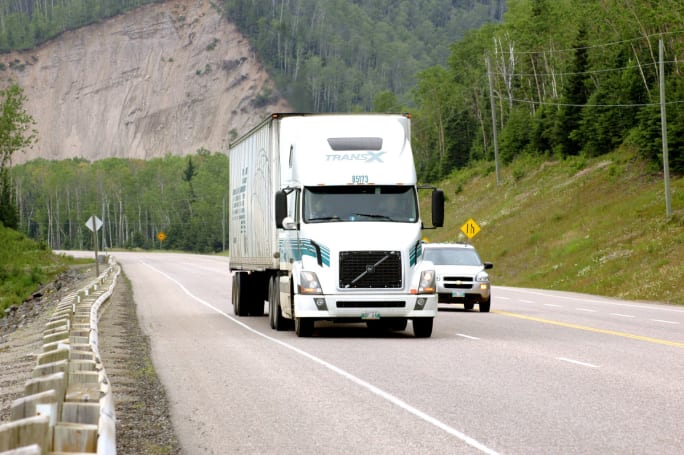
Long grades can put heavy demands on the brakes if the drivers aren’t using the engine brake properly. Any load can descend any hill with no service brake application at all using proper driving technique.
Photo: Jim Park
This is pretty straightforward with a manual transmission. Pick the gear you want to use to descend the hill and engage the engine brake. Let the engine run up into the higher rpm range where the retarder is most effective, and control the vehicle speed using the engine brake power selector rather than applying the service brakes.
A word of advice here: If the engine brake won’t hold the truck at a steady speed in position 3 at 2,000 or 2,100 rpm, you’re descending the hill too fast. While you still can, apply the brakes to slow the truck, make a downshift and re-engage the engine brake.
If you’re in the correct gear for the hill you’re descending, you will never have to touch the service brakes.
Automated Transmissions
The seemingly simple process described above can get really muddy in trucks with automated transmissions and cruise control.
Setting cruise speed is easy. Get the truck to a certain speed and press the set button. If the truck slows while climbing a hill, the cruise control will increase power to maintain speed. If the truck exceeds the set speed, cruise control will cut the power and allow the truck to coast. Sometimes the engine brake engages, sometimes not.
When fleets program their engines and transmissions, they can set what is called a “droop” into the “engine brake-on” set speed. This could be 2 to 5 mph above the cruise set speed to allow the truck to run out a little on a slight grade.
For example, if cruise control is set to 65, with a 3-mph droop the truck will run up to 68 mph before the engine brake comes on. Some trucks are programmed with a “soft droop.” This will engage the engine brake on position 1 at just above the cruise set speed and gradually roll it up it to position 3 if speed continues to increase.

Drivers are often taught about truck technology on a need-to-know basis. Basic driver training probably doesn’t include full instruction on how engine brakes work.
Photo: Jim Park
On most makes and models, if speed continues to increase while descending a grade, the cruise control will command a downshift to raise the engine rpm in order to increase the retarding power.
But here’s the potential problem: If cruise control is set to 65, the transmission might not get around to downshifting until the truck reaches 68 mph — and that’s much too fast for hills like Fancy Gap or Cabbage Hill, or some of those long grades in Colorado.
In that case, the driver would have to switch off cruise control and then manually downshift to a lower gear to get the engine revs up. Once in a suitable gear, the transmission can be placed in “hold” mode so that it will not automatically upshift as road speed increases with the downhill momentum.
A savvy driver might get the speed down to something reasonable, say 45 mph or so on a long grade with a big load, and then set the cruise speed to 45 and let the electronics manage the engine brake power settings.
But a driver less familiar with the correct way to use engine brakes with automated transmissions and cruise control might continue traversing the hill, slowing the truck with the service brakes.

Gentle grades on rolling sections of interstate highway don’t need a lot of help from the engine brake. Lower engine speeds are fine in this case.
Photo: Jim Park
Since all the OEM cruise control settings and parameters — and functionality — tend to be brand-specific, drivers may find it difficult transitioning from one make to another. Different generations of technology may behave differently, too.
From the driver’s seat, there’s no hard and fast universal solution to this situation — except to learn everything you can about the systems and settings for the truck you’re driving.
Cruise Control Off
When cruise control is turned off, the driver must manually turn the engine brake on and select the power settings. On most recent-model trucks, those settings are indicated on the shifter stalk marked “0” for off, and 1, 2, 3, for low, medium and high as described earlier.
On most models, momentarily pulling the shifter stalk all the way back will initiate a downshift, as well. This provides additional retarding power thanks to the higher engine speed. Most AMT models also have a hold mode that will keep the transmission in the selected gear — though this, and the ability to manually shift gears, can be locked out when the equipment is programmed.
On relatively flat ground or rolling terrain, the engine brake will work sufficiently well at low engine speed to keep the truck’s speed in check. On longer and/or steeper grades, the driver will have to determine an appropriate speed for the grade and possibly downshift to get into that gear, and then place the transmission in hold. The amount or retarding (speed control) can be adjusted with engine brake power settings.
As a rule of thumb, the gear you choose to descend the hill should allow the driver to control the speed using only the engine brake power settings. If the driver needs to make a service brake application, either the engine is not running fast enough to provide sufficient retarding power, or the truck is going too fast for the grade.
What’s the Best RPM for Engine Brake Performance?
The short answer is, the higher the better. The engine brake will work at any rpm from 1,000 to 2,200 in most cases.
Jacobs, makers of most of the engine brakes in use today, says the best performance is achieved at about 10% above the engine’s rated rpm.
“When we design a brake, we really want the operator to use it at up to 10% higher than the engine’s rated speed,” says Gabe Roberts, director of product engineering for Valvetrain Technologies with Cummins Engine Components, formerly known as Jacobs Vehicle Systems.
“So, if it’s a 1,900-rpm-rated engine, we want drivers to run the brake up to 2,100 rpm. That's where the peak performance of the brake is.”
The chart below illustrates the power produced by engine brakes at various engine speeds. It’s easy to see the higher output exists at higher engine speeds.
The colored lines represent all the different heavy-duty engines in North America. Shown vertically on the right side of the chart is the retarding power measured in kilowatts per liter of displacement. Along the bottom is engine rpm.
For example, following the redline from bottom left to upper right: At 1,200 rpm this engine produces about 12 kW/L of retarding power. If this was a 15-liter engine, you’d multiply that figure by 15 (or multiply by 13 for a 13-liter engine). So, with all cylinders in retarding mode, the engine produces a total of 180 kW of retarding power, or 244 horsepower.
At the point the red line crosses 2,200 rpm, the output jumps to about 31 kW/L, or 630 hp. At what engine speed do you think that engine brake would feel most effective?
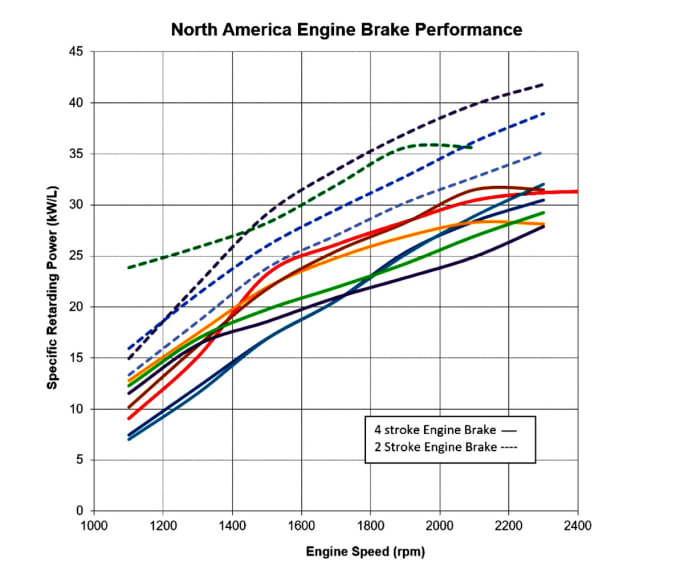
Source: Jacobs
Here’s something important to remember: No fuel is consumed while the engine brake is operating. Zero. Zilch. Nada. The engine brake’s electronic controls shut off fueling to the engine. There is NO fuel economy penalty to running the engine brake at 2,100 or 2,200 rpm.
So, the people who make engine brakes say they should be operated at high rpm — yet some fleets issue overspeed warnings to drivers for exceeding certain engine speed thresholds.
Overspeed warnings when accelerating or cruising are understandable. Fleets want to keep engine speed down to reduce fuel consumption. But no fuel at all is consumed during engine braking. It is possible to distinguish overspeed under positive power from normal high engine speed when under engine braking. Fleets just have to set up the alerts properly.
Drivers should not be afraid of running engine brakes at high rpm. That’s what those things are designed to do.
Roberts says the design criteria demands the engine brake be able to run at much higher rpm (up to 3,000 rpm for some applications) for hundreds of hours under full load. They are tested that way. Running the engine brake at 1,900 to 2,100 rpm is where they work best.
“We design the engine brake so that it won't damage itself even under a maximum overspeed condition. They’ll last forever at normal overspeed condition (2,300 rpm),” he says.
“I think drivers that are used to an operating range of between 1,100 and 1,500 rpm might be a little nervous about taking the revs as high as 2,100 or 2,200. That’s understandable. But there’s nothing to worry about. They can handle that speed and load at that rpm range.”
Subscribe to Our Newsletter
More Equipment

How Volvo Updated Its D13 for EPA 2027 [Watch]
Volvo’s updated D13 promises lower emissions without sacrificing performance or fuel economy. Take a closer look at what changed inside the engine in this HDT Spotlight video.
Read More →
Michelin Tire Improves Efficiency and Durability for Regional Fleets
The Michelin X Multi Energy D2 is a regional haul drive tire engineered to help fleets improve fuel efficiency, durability and traction in demanding stop-and-go operations.
Read More →
ZF Expands Commercial Vehicle Push in North America
ZF is expanding its North American commercial-vehicle presence with new transmission applications, electrification, trailer technology and autonomous-driving systems.
Read More →
Tesla Wants a Self-Driving Semi. Are Cameras Enough?
Could Tesla’s camera-only autonomous driving technology work on an 80,000-pound Semi? In this commentary, HDT's Deborah Lockridge takes a look at Tesla, Cybercab, and how autonomous trucks see the road.
Read More →
Kodiak: Driverless Long-Haul Truck Launch on Track for 2026
Kodiak AI says its driverless long-haul safety case is 93% complete and it remains on track to begin commercial operations by year-end 2026.
Read More →
What DOT’s Automated Vehicle Strategy Means for Trucking
The U.S. Department of Transportation issued a new automated-vehicle strategy that outlines plans for driverless-truck regulations, cross-state freight corridors, and federal safety standards.
Read More →
East Coast Port Launches $45M Electric Truck Push
The Port Authority of New York and New Jersey announced millions in incentives for zero-emission drayage trucks, yard tractors, and new charging hubs near the port.
Read More →
PlusAI Going Public to Fund Autonomous Truck Launch
A SPAC deal could provide PlusAI with up to $300 million as it works toward a 2027 commercial launch of factory-built autonomous trucks.
Read More →
NHTSA Moves to Rewrite Truck Fuel-Economy Rules
The National Highway Traffic Safety Administration says it lacks authority to regulate medium- and heavy-duty truck engines separately from complete vehicles, but the existing standards have not yet been eliminated.
Read More →
Detroit Opens Orders for EPA 2027 Engines
Detroit isn’t starting from scratch to meet EPA 2027 diesel emissions standards. Its Gen 6 DD13 and DD15 engines keep much of today’s platform while updating the fuel and aftertreatment systems.
Read More →