


Part 1: Where We've Been, Part 2: Changing the Focus,
Part 3: Apples and Oranges, Part 4: One Test or Two?
 MENU
MENU SEARCH
Waste heat recovery systems are being developed by engine makers but are they the worth the compromises they bring in the name of more efficiency?
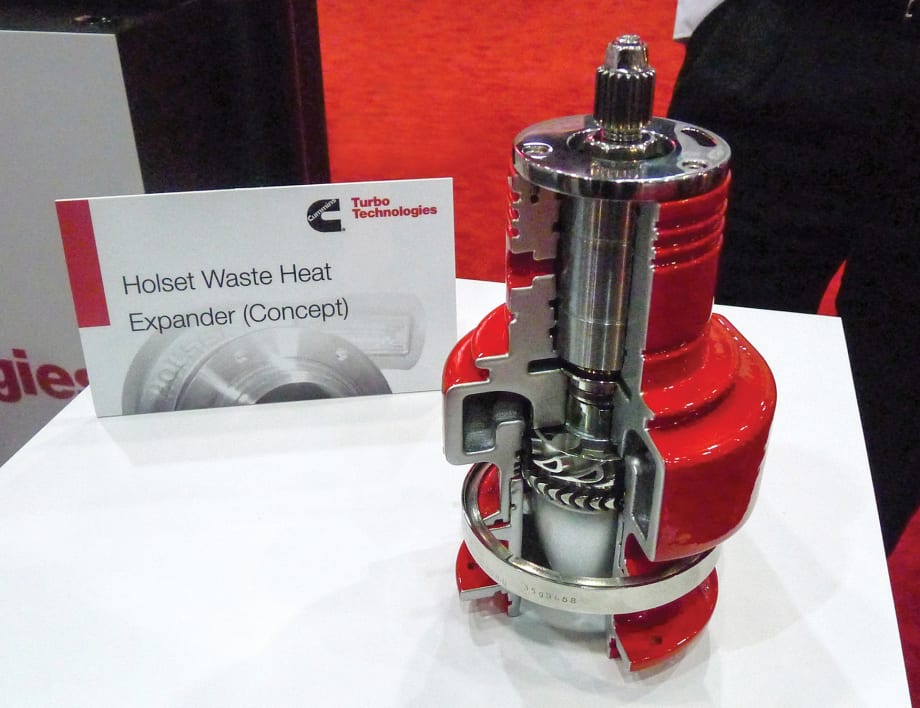
Photo courtesy of Today's Trucking
Photo courtesy of Today's Trucking
Waste heat recovery is a tool that Cummins expects to deploy in 2020 or so, though the company's Brian Mormino says some customers may get field-test units in 2017 or 2018.
In fact, all engine makers are developing it, and a variation is even used in today's Formula One race cars, where they add it to the standard V-6 and call the package a hybrid. It recovers exhaust heat and turns it back into energy.
"It's essentially a second engine," says Volvo Group's Tony Greszler. "And it requires that you run the exhaust heat through a fluid, via a heat exchanger in the exhaust, and run it through an expansion machine to make power, and then condense that fluid again. Which means that you've got a lot more cooling demand. You've now got to cool most of the heat from the exhaust, because the process isn't very efficient, so most of that heat ends up in your condenser.
"And we end up having to add substantial weight, space, and cooling capacity into our trucks," he continues, "which means that we lose aerodynamic performance and we lose freight capacity because of weight. So we add efficiency to the engine but we take it away from the truck. That doesn't make sense.
"Why would you force us to do something like that? Give us the flexibility to look at the truck as a complete entity and make the best, most cost-effective decisions about how to improve the fuel efficiency in a way that meets the target," Greszler urges.
"I think it's also obvious that a system like that adds a lot of components, a lot of sensors, a lot of complexity, and potentially a lot of unreliability. Which customers don't want or need. And if you're not getting the full benefit from it anyway, you're really kidding yourself when you measure the efficiency of the engine in a test cell where weight, space, and cooling demand are not accounted for at all."
Waste heat recovery is just an example, of course, and there might be any number of similar examples that could come up in the future.
"A particular customer could well benefit from efficiency improvements that have nothing to do with the engine and hit the overall targets that EPA will establish," Greszler continues. "Are we going to force him into engine efficiency solutions that don't necessarily match his operational requirements because EPA structured a rule that said X amount had to come from the engine? It just doesn't make sense to us."
Depending on the stringency of the coming rules, and whether or not we have a separate engine test, waste-heat recovery may or may not be needed.
"If we have a fairly stringent engine efficiency requirement measured in a test cell, then WHR may be the only available technology to meet that target," Greszler says. "If it's not applied to the engine but to the truck, we may find quite a few other options.
"We're all developing waste-heat recovery," he adds, "don't get me wrong. I'm not saying it's a technology that shouldn't be explored and exploited when and where it makes sense, but it ought not be forced into production on a time schedule that doesn't allow adequate reliability development and it shouldn't be forced into applications where it doesn't really deliver."
Watch for full coverage of the new GHG regulations when they are unveiled in June.

Volvo’s updated D13 promises lower emissions without sacrificing performance or fuel economy. Take a closer look at what changed inside the engine in this HDT Spotlight video.
Read More →
Energy Vision estimates fleets could recover the higher purchase price of an RNG-fueled Class 8 tractor in 1.3 to 2.8 years under current fuel-price scenarios.
Read More →
Calstart is now Catalyst Mobility, reflecting the nonprofit’s growing national role in clean transportation, including zero-emission trucks, infrastructure and incentive programs.
Read More →
Average U.S. diesel prices have climbed to nearly $6 a gallon, surpassing the 2022 record as tight refinery capacity and Middle East disruptions keep fuel costs elevated.
Read More →
Fuel delivery depends on more than what happens at the injector. For fleet, maintenance and technical professionals, looking at the full path from pump to injector can provide useful context for understanding engine performance.
Read More →
The Port Authority of New York and New Jersey announced millions in incentives for zero-emission drayage trucks, yard tractors, and new charging hubs near the port.
Read More →
Why do battery-electric Class 8 trucks remain so expensive? A California bill headed to Gov. Gavin Newsom would give fleets and state agencies more visibility into what manufacturers charge.
Read More →
Detroit isn’t starting from scratch to meet EPA 2027 diesel emissions standards. Its Gen 6 DD13 and DD15 engines keep much of today’s platform while updating the fuel and aftertreatment systems.
Read More →
California, Oregon, Washington, British Columbia and Baja California are coordinating plans for truck charging and hydrogen fueling from Canada to Mexico.
Read More →
Learn more about Kenworth's T880E battery-electric vocational truck at the Paccar Technical Center, including its range, applications, upfitting considerations, and PTO options, in this HDT Spotlight video.
Read More →