




Emissions Yesterday, Today and Tomorrow: Apples and Oranges
Adjusting to Phase 1 of the fuel economy and greenhouse gas regulations may have eased the coming transition into Phase 2. Part 3 of a webXclusive series.
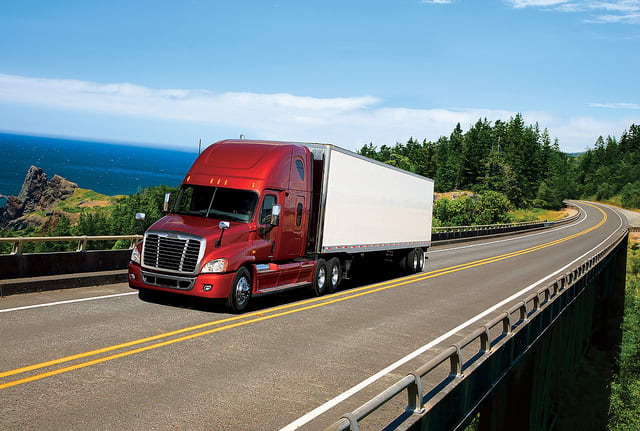
Adjusting to Phase 1 of the fuel economy and greenhouse gas regulations may have eased the coming transition into Phase 2. Photo via Freightliner
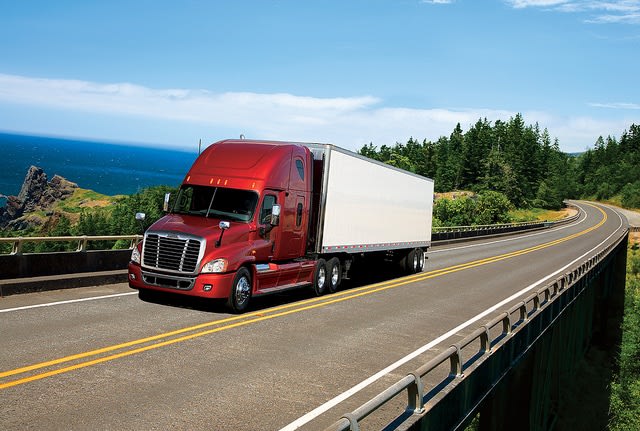
Adjusting to Phase 1 of the fuel economy and greenhouse gas regulations may have eased the coming transition into Phase 2.Photo via Freightliner
Apples and oranges. That's how Brian Mormino describes the difference between the emissions regimes of the previous decade and the one that was launched last year and will enter its second phase in 2020. Executive director, worldwide environmental strategy and compliance at Cummins, he says all the hard work and heartache of dealing with engine emissions from 2002 on to 2010 has left us well equipped for the next steps.
We've already taken the first of those steps, starting a year ago, with Phase 1 of the fuel economy and greenhouse gas regulations as decreed by President Obama. Back in 2010, with so-called "criteria" pollutants like nitrogen oxide (NOx) under control, he ordered the Environmental Protection Agency and the National Highway Traffic Administration to move on. He told them to cut carbon dioxide (CO2) emissions, along with other gases in lesser amounts, while improving fuel economy in medium- and heavy-duty trucks.
The challenge was anything but small, the timeline short, but the 2014 targets were met, largely because so much had already been achieved. And the next target in 2017 will be met as well.
"I'd like to help people understand that the industry is in a great place from the standpoint of technology and the future," Mormino told me in a lengthy recent interview. "What I mean by that is that we now have diesel particulate filters, we have SCR systems, we're taking care of emissions in the exhaust. And we have learned and improved on those systems.
"And so when we look at meeting the first GHG and fuel consumption standard in 2013, a year early, how did Cummins do that? We did it by improving the engine architecture that we already had in place. And what are we going to do for 2017? We're going to improve on the engine architecture that we already have in place. And I would even venture to say that when we look at 2021, we're going to improve on the engine architecture that we already have in place."
The new regime
Phase 1 of the GHG and fuel economy regime does not involve just engines as in the past, but trucks as well, with tires and aerodynamic devices tested and taken into account.
The present 2014-19 rules say that heavy-duty tractors must achieve as much as a 20% reduction in CO2 emissions and fuel consumption by 2017, a little more by 2019. Engines, tested separately, had to improve 3% by 2014, 6% by 2017. Mixers, refuse haulers, and other vocational machines must get to a 10% reduction in fuel consumption by 2017.
None of this change caused a stir last year, and initial targets were met with ordinary improvements of existing hardware and software. Things will get tougher on engines in 2017 but radically new hardware -- like waste-heat recovery -- won't be required.
When these rules were announced it seemed to many observers that, with so many variations in commercial vehicles, it would be near impossible to find a standard that applies to all. But not so, apparently, and for reasons similar to those cited by Mormino.
"It's complicated, but we've been able to manage all the configurations in Phase 1," said Dean Waters, director of compliance and regulatory affairs at Daimler Trucks North America. "Mostly we're able to manage all the differences because we spent a lot of money developing fuel-efficient technologies years ago. All those decisions that have paid off for our business and paid off for our customers, have also paid off in the regulatory world and enabled us to deal with all the different configurations out there."
Phase 2 Tougher
Phase 2 of the fuel-efficiency/greenhouse gas regulations will soon be unveiled. A draft rulemaking proposal was originally due to be released in March, but has been delayed until June. Regardless, the final rule is due some time in 2016, affecting trucks built in 2020 and beyond.
We don't know much about it, and even the people I've talked to lately who keep track of what's going on in Washington can only guess. All we really know is that Phase 2 will demand even tougher, more stringent CO2 and fuel-consumption reductions. Much tougher, it seems. But our firm knowledge stops there.
Will trailers be added to the mix? It's almost certain, it seems, and there are suggestions that it will happen in 2018. At least for dry vans and reefers.
Engines and vehicles are tested separately in Phase 1, but there are those who urge that just one test, with engines rolled into the whole truck like any other component, is the better approach for Phase 2. Both sides are pretty vehement, and we'll look at that in the next instalment.
Part 1: Where We've Been Part 2: Changing the Focus
More Fuel Smarts

New California Law Could Shed Light on Electric Truck Prices
Why do battery-electric Class 8 trucks remain so expensive? A California bill signed by Gov. Gavin Newsom would give fleets and state agencies more visibility into what manufacturers charge.
Read More →
How Volvo Updated Its D13 for EPA 2027 [Watch]
Volvo’s updated D13 promises lower emissions without sacrificing performance or fuel economy. Take a closer look at what changed inside the engine in this HDT Spotlight video.
Read More →
Diesel Price Spike Shortens Payback for Natural Gas Trucks, Report Says
Energy Vision estimates fleets could recover the higher purchase price of an RNG-fueled Class 8 tractor in 1.3 to 2.8 years under current fuel-price scenarios.
Read More →

Calstart Becomes Catalyst Mobility, Reflecting Broader Focus
Calstart is now Catalyst Mobility, reflecting the nonprofit’s growing national role in clean transportation, including zero-emission trucks, infrastructure and incentive programs.
Read More →
Record Diesel Prices Squeeze Trucking Fleets
Average U.S. diesel prices have climbed to nearly $6 a gallon, surpassing the 2022 record as tight refinery capacity and Middle East disruptions keep fuel costs elevated.
Read More →
How Fuel Delivery Shapes Engine Performance
Fuel delivery depends on more than what happens at the injector. For fleet, maintenance and technical professionals, looking at the full path from pump to injector can provide useful context for understanding engine performance.
Read More →
East Coast Port Launches $45M Electric Truck Push
The Port Authority of New York and New Jersey announced millions in incentives for zero-emission drayage trucks, yard tractors, and new charging hubs near the port.
Read More →
Detroit Opens Orders for EPA 2027 Engines
Detroit isn’t starting from scratch to meet EPA 2027 diesel emissions standards. Its Gen 6 DD13 and DD15 engines keep much of today’s platform while updating the fuel and aftertreatment systems.
Read More →
Zero-Emission Truck Corridor Planned for West Coast
California, Oregon, Washington, British Columbia and Baja California are coordinating plans for truck charging and hydrogen fueling from Canada to Mexico.
Read More →
A Closer Look at Kenworth’s Electric T880E Vocational Truck [Video]
Learn more about Kenworth's T880E battery-electric vocational truck at the Paccar Technical Center, including its range, applications, upfitting considerations, and PTO options, in this HDT Spotlight video.
Read More →