




E-Logs: A New Era
The Federal Motor Carrier Safety Administration opted for the strictest approach it could take in its new requirement for electronic onboard recorders, announced last month

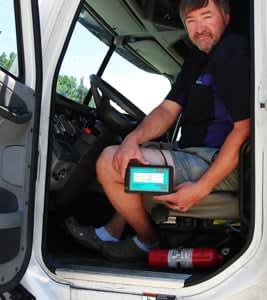
FMCSA chooses strictest option in EOBR rule; industry reaction supportive with reservations. (Photo by Trackwell ADS)
The Federal Motor Carrier Safety Administration opted for the strictest approach it could take in its new requirement for electronic onboard recorders, announced last month.
Reaction from the enforcement and trucking communities has been generally positive, with reservations.
The rule, which will go into effect June 1, 2012, says carriers that violate hours of service rules 10 percent of the time, based on a single compliance review, must use electronic onboard recorders to track driver hours. The lesser option that was considered would have been to target carriers based on two compliance reviews conducted within a two-year period.
The stricter rule will affect close to 5,700 interstate carriers, compared to the approximately 1,000 carriers that would have been targeted under the lesser option.
Both groups of carriers have a crash rate that is significantly higher than the industry average, the agency said. Carriers that violate hours rules 10 percent of the time in two compliance reviews have a crash rate 90 percent higher than the general population. Those that break the 10 percent barrier in just one review have a rate that is 40 percent higher than the general population.
Carriers that violate the standard will have to install recorders on all of their trucks, regardless of when the truck was built, and use the recorders to track driver hours for at least two years. There will be an exception for carriers that install automatic onboard recorders before the compliance review finds them in violation.
Carriers that violate the standard but do not install recorders will not be allowed to operate in interstate commerce. For-hire carriers also risk losing their operating authority.
The agency acknowledged that it is under pressure from Congress, the National Transportation Safety Board and numerous other interests to move to an even stricter mandate. It could not go further in this rule due to procedural limitations, but it is going to start a new rulemaking proceeding to consider a significantly broader mandate, the agency said. As part of that proceeding, the agency will look at how the growth in voluntary adoption of recorders is affecting the cost of the devices.
Meanwhile, the greatest safety benefit comes from mandating recorders for high-risk carriers, the agency said.
"We are committed to cracking down on carriers and drivers who put people on our roads and highways at risk," said Transportation Secretary Ray LaHood in a statement. "This gives us another tool to enforce hours of service restrictions on drivers who attempt to get around the rules."
The details
The rule clarifies a key technical question: EOBRs will have to be integrally synchronized to the truck's engine. In the proposal leading up to this final rule, the agency had considered allowing non-synchronized devices, such as wireless GPS systems and GPS-equipped smart phones, but ultimately decided that synchronization is necessary in order to ensure accuracy.
The rule also sets new performance standards for recorders. Recorders will have to automatically track the truck's location at each change of duty status and while the truck is in motion. They must comply with security requirements. Drivers will be able to add information to the record, but the device must keep the original information as well as the annotations.
Also, the device must provide a digital file for a police officer to read on a computer. It will not have to print out the driver's log. The officer will get the data via a cord that the driver can plug into a Universal Serial Bus (USB) on the recorder, or through a wireless connection.
The information recorded must include the driver's name, duty status including on-duty/not driving, driving time, sleeper berth and off-duty, as well as the date, time, truck location and distance traveled. Recorders will have to use global positioning technology or another tracking system.
The carriers that already use recorders that don't meet these standards will be allowed to keep using them through the life of the truck. Recorders installed in trucks built starting in April 2012 will have to meet the new standards.
As an incentive to promote voluntary use, the agency will no longer require supporting documents related to driving time, such as toll receipts, for carriers that install recorders. Also, carriers that use recorders will get more liberal compliance review procedures.
Enforcement challenges
For the Commercial Vehicle Safety Alliance, which speaks for the police officers who will have to rely on the recorders to enforce hours of service, the rule is a step in the right direction.
It does not go far enough and it has technical shortcomings, says Interim Executive Director Steve Keppler. "But now at least we've got some specifics that we can react to."
CVSA has for some time been pushing for a universal EOBR mandate and is actively working to get one included in the pending federal highway bill. The alliance also is waiting to see what the agency will propose in the next installment of recorder requirements. The agency is working on a proposal to expand the number of carriers required to use recorders and combine that requirement with changes in its supporting documents rules. That proposal is supposed to be published in December.
Keppler says the enforcement community is concerned about a number of the rule's technical requirements. One problem, for example, is that the rule does not require the recorder to have the capability of printing out a driver log.
If an inspector does not have a computer - and not all of them do - "He'll have to have the driver reconstruct the log, or do so himself, by hand," Keppler says. "That will severely lengthen the inspection. Or if the device is not working, the same thing will happen."
The good news for police is that FMCSA will supply software that will convert the recorder's data into a standard format for the police laptop. "From that perspective, we're happy," Keppler says.
Another problem he foresees will be the potential for fraud arising from the rule's method for driver identification. Under the system, the carrier will assign the driver a number; no name will be used.
The agency said it chose this route because privacy rules would require stringent and complex encryption standards if a driver's name is transferred to an officer's computer. Police can use the driver's license or other documents for identification, the agency said.
Another issue is the rule's requirement that vendors and carriers certify that the device meets agency specifications. Keppler wonders if that approach is strong enough. "If we're going to have performance standards rather than explicit design specs, we've got to have a way to oversee that those devices are being built to that standard. You need a strong approach to certification. Otherwise you are going to have people who build stuff that is sub-par, it's just that simple."
But Keppler puts these issues into the category of challenges to be overcome in the next two years, before the rule takes effect. He says the enforcement community expects to work with the safety agency and the states on these details.
Trucking groups react
American Trucking Associations supports the rule because it provides incentives for safe carriers to voluntarily adopt recorders and mandates the devices for severely non-compliant carriers, says Clayton Boyce, vice president of public affairs. "This is a good example of the important role of technology in enhancing driver, vehicle and highway safety," he says.
ATA does have reservations. For one thing, the incentives for voluntary use are weaker than they should be, says Rob Abbott, vice president of safety policy.
In addition to easing supporting documents and compliance review requirements, the agency should have provided EOBR users more flexibility in t
More Fleet Management

Color Match Smarter: Tools That Restore & Perform
For fleet managers and collision repair professionals keeping heavy-duty trucks on the road, getting the color right the first time isn't just about appearance — it's about efficiency, turnaround time, and bottom-line results. Discover how today's digital color tools are transforming the repair process from guesswork to precision.
Read More →
FMCSA Pauses Biennial-Update Enforcement Amid Motus Transition
Carriers whose updates were due on or after June 1 have more time, while FMCSA works to stabilize its new registration system and warns of phishing sites impersonating its new carrier registration system, Motus.
Read More →
2026 Blueprint for Countering Smarter Supply Chain Theft
Cargo theft is no longer just the cost of doing business. It's a multi-billion-dollar criminal enterprise exploiting vulnerabilities across your fleet, drivers, and supply chain.
Read More →


How Telematics Improves Visibility, Control, and Performance in Refrigerated Fleets
Explore how telematics help refrigerated fleets improve visibility, uptime, efficiency, compliance, and cargo protection across connected cold chain operations.
Read More →
What the U.S.-Canada Trade War Means for Trucking
Escalating U.S.-Canada tariffs could disrupt cross-border freight, reduce truck volumes, raise costs, and create new uncertainty for carriers on both sides of the border.
Read More →
What Are Trucking’s Top Concerns for 2026?
The American Transportation Research Institute wants to know what's worrying trucking fleet managers, drivers, and other stakeholders in its annual Industry Issues survey.
Read More →
American Trucking Associations Looks for a New Leader
ATA President and CEO Chris Spear abruptly left his job at the association on August 21, at a pivotal time for the trucking industry.
Read More →
Public Wi-Fi Cybersecurity Risks: How Truck Drivers and Fleets Can Protect Their Data
Public Wi-Fi can expose truck drivers and fleets to credential theft, malware, and other cyber threats. Here’s how to reduce the risk on the road.
Read More →
For Nicky Cupp, Fleet Innovation Starts With Frustration
HDT Truck Fleet Innovator Nicky Cupp turns everyday pain points at Fraley & Schilling into opportunities for better technology and smarter processes.
Read More →
Adam Buttgenbach’s Approach to Electric Trucks: Start With Where They Fit
HDT Truck Fleet Innovator Adam Buttgenbach helped PepsiCo build one of North America’s largest EV fleets by focusing on where electric trucks make operational sense.
Read More →