




E-Logs: 21st Century Timesheets
Refrigerated carrier Pollywog Transportation underwent a safety audit in 2006 after someone made an accusation against the company
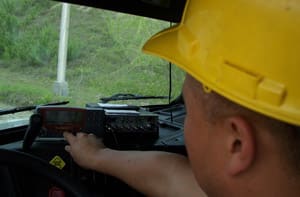
While drivers may be skeptical at first, most find that electric logging technology makes their lives easier, reducing paperwork and increasing their productivity. (Photo by Alamo Cement Co.)
Refrigerated carrier Pollywog Transportation underwent a safety audit in 2006 after someone made an accusation against the company.
While the accusation was found to be false, the audit did find the company had some violations related to driver hours of service reporting.
"We really had to do something at that time, because we didn't want an unsatisfactory rating," says Steve Teeple, president of the Florida-based carrier.
The company decided to install PeopleNet's in-cab electronic logging technology in its three dozen trucks. Before switching over to electronic logs, Pollywog's out-of-service rate was 89 to 90 percent. Now, the company's out-of-service rate is less than 35 percent. Teeple says Pollywog has no more log violations.
"I don't know why we didn't do this sooner," he says.
As a bonus, drivers are more conscious about what they're doing with the equipment. While it took a while to train drivers on the new logging system, Teeple says they're now more efficient, as they have a certain amount of time to get their work done and they're not sitting at the truckstop. One driver with a weekly run to Texas would normally be back every Saturday morning using paper logs. After the switch over to electronic logging, he was back Friday afternoon, Teeple says, with the rest of the weekend free to enjoy with his family. "In the long run, it's going to make [drivers] money."
Eventually, he had drivers coming to work saying, "We wouldn't even want to come to work without it," Teeple recalls.
"If you want to be a profitable business, you've got to use all the tools," he says.
The EOBR rule
Last month, the Federal Motor Carrier Safety Administration passed its new requirement for electronic onboard recorders to track driver hours of service. The new rule, which will affect nearly 5,700 trucking companies, will make EOBRs an even more important tool to stay compliant and keep on top of drivers' hours.
The new requirement includes criteria for the type of electronic logging technology that can be used by carriers. Under the new rule, EOBRs must be able to automatically record the truck's location at each change of duty status and at intervals while the truck is in motion, which can be accomplished using global positioning technology or another tracking system. In addition, the devices must have specific information processing standards, and they must be able to provide enforcement officials with a digital file of hours of service in a specified format. EOBRs are also required to be tied to the engine to ensure accuracy. (See preceding story for more details.)
"Teletrac was prepared for the rule changes, and as such, is fully compliant," says Drew Hamilton, executive vice president of Teletrac, which offers an Hours of Service software module. "Going forward, we see increased demand from not only this marketplace and the subset of the trucking ecosystem with previous violations, but really the industry as a whole."
According to Amy Daley, ASP product manager for J. J. Keller & Associates, up to this point, private fleets have been opting for the technology more than for-hire ones, as they inherently have a lot more at risk. With the new regulation, however, she expects for-hire carriers to show more interest. Daley says as more regulations pop up related to EOBRs, it will require more consistency across the different providers; the government will be looking for commonality in the way the technology looks and feels from an enforcement standpoint.
And that's just what happened with the new rule. Prior to the announcement of the new guideline, Jim Angel, safety and compliance product manager with PeopleNet, told HDT he wouldn't be surprised if the regulation required the display to be viewable outside of the cab in some form. The rule allows for the use of wired communications via a USB cord connection, or wireless transfer of data to the enforcement officer's portable computer.
Some EOBR devices, such as the one made by Trackwell ADS, can be unclipped from the cab to show the inspection officer outside of the truck. Trackwell ADS also offers a USB connection, as the rule requires.
"Carriers using EOBRs are best positioned to manage through all of these regulatory changes with the least disruption to their operations," says Jim Sassen, senior product marketing manager at Qualcomm Enterprise Services. "It will eliminate the concern about using electronic logging when your competitors are not."
How it works
The new FMCSA rule on EOBR use requires the technology to be connected to the engine and include some kind of tracking mechanism, which many technology providers do. Here's a sampling of electronic log technology solutions, and how they work:
* CarrierWeb: The basis of CarrierWeb's electronic logging technology is its hours of service module called LogsManager, which runs on the company's CarrierMate in-cab device with touchscreen technology. The device collects data from the engine on starts and stops, and is also GPS-enabled to send the truck's position to the server every 60 seconds, says Norman Thomas, vice president of consulting services. When the vehicle stops, a drop-down menu allows drivers to choose their duty status. A secured web site with a login provides data management in the back office.
* J. J. Keller & Associates: J. J. Keller's electronic logging technology consists of a black-box recorder mounted inside the cab of the truck, which pulls engine data and interfaces to several types of technology, including smartphones, PDAs and laptop computers. This data from the engine is necessary to accurately and automatically determine when the vehicle is in motion. A GPS device also picks up the vehicle's location. Meanwhile, back office staff can view drivers' hours of service using J. J. Keller encompass, a Web application.
* PeopleNet: PeopleNet eDriver Logs system automatically calculates driving hours of service through a combination of GPS location and PerformX engine diagnostic information. Drivers indicate on-duty/off-duty/sleeper berth/driving status through the message display. The data can be viewed through an LCD-based model, which is text-based, or on PeopleNet's Blu device, which provides a more graphical, color representation. This information is then available to the driver, dispatcher or compliance officer through the PeopleNet Fleet Manager Web-based interface. Drivers can show up-to-date logbook information to law enforcement or DOT officials, which can be viewed from outside the cab.
* Qualcomm Enterprise Services: Qualcomm provides a software-based Hours of Service Application that is an integrated part of its Mobile Computing Platform in-cab devices. The application leverages vehicle information from the engine to determine when the vehicle is moving and automatically transitions the driver between on-duty not driving and driving status, and then back again when the vehicle stops. "The mobile computing platform provides important information about the locations of duty status changes and communicates this and other relevant information required to determine driver compliance status and available hours," says Qualcomm's Sassen.
* Teletrac: Through Teletrac's Fleet Director Hours Of Service software module, fleets can record hours of service data from the cab. The data is recorded, transmitted and displayed via Fleet Director's in-cab Message Display Terminal, the Net 960 CE-X. Drivers use the Fleet Director MDT to enter all relevant HOS information such as Driver ID and Current Status. With the push of a button, the information is sent via a wireless network to a computer for storage and retrieval. The stored data may also be transmitted to drivers as needed. It also features a standard J-bus connection.
* Trackwell ADS: According to Tom Lemke, president and CEO of Trackwell ADS, the company's in-cab device is tied to the engine and prov
More Fleet Management

Color Match Smarter: Tools That Restore & Perform
For fleet managers and collision repair professionals keeping heavy-duty trucks on the road, getting the color right the first time isn't just about appearance — it's about efficiency, turnaround time, and bottom-line results. Discover how today's digital color tools are transforming the repair process from guesswork to precision.
Read More →
FMCSA Pauses Biennial-Update Enforcement Amid Motus Transition
Carriers whose updates were due on or after June 1 have more time, while FMCSA works to stabilize its new registration system and warns of phishing sites impersonating its new carrier registration system, Motus.
Read More →
2026 Blueprint for Countering Smarter Supply Chain Theft
Cargo theft is no longer just the cost of doing business. It's a multi-billion-dollar criminal enterprise exploiting vulnerabilities across your fleet, drivers, and supply chain.
Read More →


How Telematics Improves Visibility, Control, and Performance in Refrigerated Fleets
Explore how telematics help refrigerated fleets improve visibility, uptime, efficiency, compliance, and cargo protection across connected cold chain operations.
Read More →
What the U.S.-Canada Trade War Means for Trucking
Escalating U.S.-Canada tariffs could disrupt cross-border freight, reduce truck volumes, raise costs, and create new uncertainty for carriers on both sides of the border.
Read More →
What Are Trucking’s Top Concerns for 2026?
The American Transportation Research Institute wants to know what's worrying trucking fleet managers, drivers, and other stakeholders in its annual Industry Issues survey.
Read More →
American Trucking Associations Looks for a New Leader
ATA President and CEO Chris Spear abruptly left his job at the association on August 21, at a pivotal time for the trucking industry.
Read More →
Public Wi-Fi Cybersecurity Risks: How Truck Drivers and Fleets Can Protect Their Data
Public Wi-Fi can expose truck drivers and fleets to credential theft, malware, and other cyber threats. Here’s how to reduce the risk on the road.
Read More →
For Nicky Cupp, Fleet Innovation Starts With Frustration
HDT Truck Fleet Innovator Nicky Cupp turns everyday pain points at Fraley & Schilling into opportunities for better technology and smarter processes.
Read More →
Adam Buttgenbach’s Approach to Electric Trucks: Start With Where They Fit
HDT Truck Fleet Innovator Adam Buttgenbach helped PepsiCo build one of North America’s largest EV fleets by focusing on where electric trucks make operational sense.
Read More →