




Dual-Fuel Gliders: A Way to Get Into Natural Gas for Less Money
Dual-fuel glider kits are a relatively new alternative for fleets looking to tap into the benefits of natural gas but at less cost than buying a new, dedicated NG vehicle. A glider is a new truck without some powertrain components. Shops in the field add rebuilt or remanufactured engines, transmissions and rear axles.

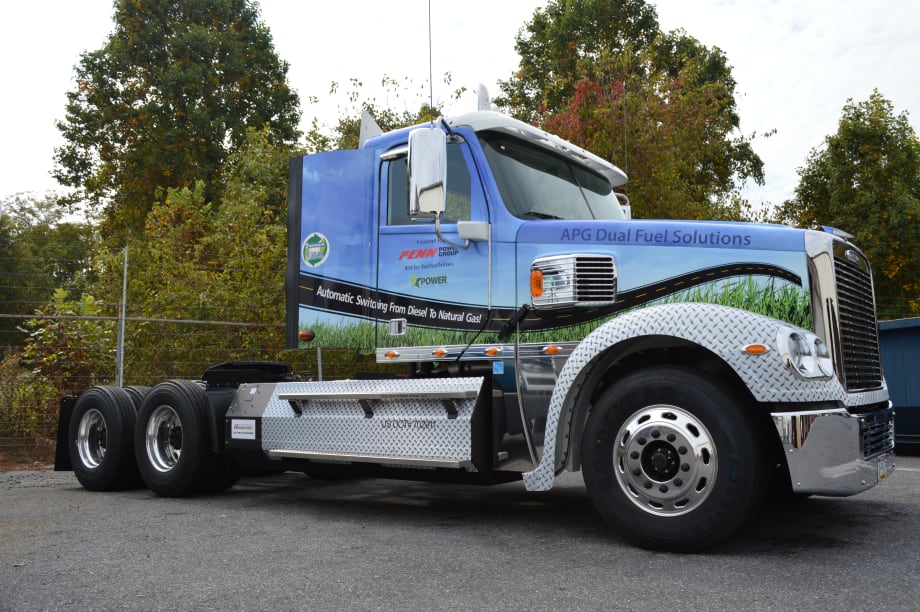
Technicians at Penn Commercial Vehicle, a WheelTime member based in Glenmore, Pa., assembled this
Coronado daycab demo tractor from a Freightliner glider kit. It has an APG dual-fuel diesel-natural gas system and a Webasto coolant heater.
Dual-fuel glider kits are a relatively new alternative for fleets looking to tap into the benefits of natural gas but at less cost than buying a new, dedicated NG vehicle.
A glider is a new truck without some powertrain components. Shops in the field add rebuilt or remanufactured engines, transmissions and rear axles. Freightliner, which makes most glider kits, can also add reman’d engines at the factory, and sometimes reman’d or new axles. Engines are usually straight diesels, but can be fitted with dual-fuel systems.
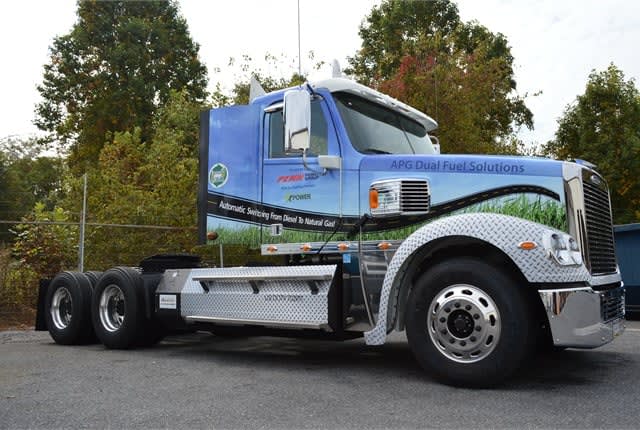
Technicians at Penn Commercial Vehicle, a WheelTime member based in Glenmore, Pa., assembled this
Coronado daycab demo tractor from a Freightliner glider kit. It has an APG dual-fuel diesel-natural gas system and a Webasto coolant heater.
A dual-fuel setup costs $30,000 to $35,000, about half what most new dedicated natural gas systems cost on a new truck. Dual-fuel systems let customers use cheap natural gas along with diesel, and makes the exhaust about 30% cleaner than “pre-emission” diesels. Because the engines can switch back to all-diesel at any time, the still-spotty natural gas fueling infrastructure is less of a problem.
Last year two companies announced dual-fuel glider kits. EcoDual is partnering with Hunter Truck Sales, a Peterbilt dealer with 15 locations throughout Pennsylvania, New Jersey, New York and West Virginia. Hunter will provide custom-configured Peterbilt gliders with EcoDual’s platform, the Max/SR Dual Fuel System.
American Power Group teamed up with the WheelTime network of dealers and repair shops to add APG’s V5000 Turbocharged Natural Gas Dual-Fuel System to gliders from Freightliner.
One WheelTime member is Ervin Equipment in Shreveport, La., where Ken Eggen is director of business development. He says the APG system allows carrying natural gas on the truck in compressed or liquefied form. Dual-fuel equipment, including special gas tanks, pumps and engine parts, are installed as part of the glider assembly process.
“We are slated to build nearly 1,000 glider trucks this year,” Eggen says, “and fully 20% will be dual-fuel.”
Nevertheless, many truck operators still know little about gliders and are suspicious of the idea. Those who have heard about them think of gliders in the traditional sense – a means to rebuild a wrecked truck that has a good powertrain. That’s how gliders originated, but some fleets now substitute gliders for normal new or used trucks.
To help educate fleets about dual-fuel gliders, another WheelTime member, Penn Commercial Vehicle Solutions of Glenmore, Pa., has assembled a demonstrator tractor featuring APG dual-fuel equipment and a Webasto diesel-fueled heater. It will show the advantages of the glider kits that run partly on natural gas, combined with a heater that warms engine coolant for quick starts in cold weather.
The Freightliner Coronado tractor will allow potential customers to try out the concepts in real-world situations before they purchase, said Rick Roger, Penn’s CEO.
“We initially began this project as a way to familiarize our customers with the new dual-fuel technology from APG,” he says, then added the Webasto heater. “People can be reticent to buy into a new technology until they’ve tried it for themselves, and with this new glider they can do just that.”
The Coronado daycab glider has a rebuilt Detroit Diesel Series 60 engine with EPA ’98 specifications, so it has no exhaust-gas recirculation or diesel particulate filter. The APG dual-fuel system offers emissions reduction advantages as well as considerable savings from inexpensive natural gas.
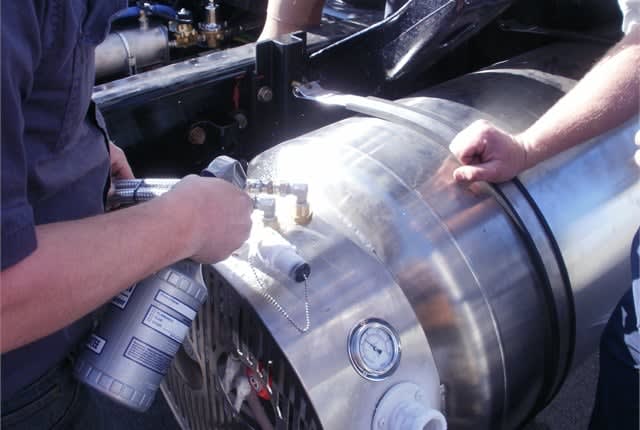
Dual-fuel systems can store gas in compressed or liquefied form. This is an LNG tank being installed by technicians at another WheelTime member, Smith Power in Salt Lake City.
The dual-fuel system displaces up to 80% of the normal diesel fuel consumption, with average displacement ranging from 40% to 65%, APG sources said. The energized fuel balance is maintained with a proprietary read-only electronic controller system, ensuring the engines operate at original equipment manufacturers’ specified temperatures and pressures.
Because cheaper natural gas displaces diesel fuel, the system offers a 15% to 30% net savings in fuel costs. It’s a non-invasive upgrade that boasts a 400- to 800-mile range with no reduction in horsepower, Roger says.
The system thus offers a way for fleets to begin using alternative fuels before or instead of committing to more expensive dedicated natural gas vehicles.
The Webasto coolant heater is approved by California’s Air Resources Board and verified by the Environmental Protection Agency’s SmartWay program as a fuel saver. It can eliminate cold starts and quickly warm a cab’s interior without idling the engine, and gets the vehicle and its driver on the road quickly. The heater’s SmarTemp Control can be programmed to heat automatically at scheduled times, and temperatures can be easily adjusted.
The cost for a Penn-APG dual-fuel glider with Webasto coolant heater and SmarTemp Control is comparable to that of a new tractor that runs only on relatively expensive diesel fuel, Roger says.
More Equipment

How Volvo Updated Its D13 for EPA 2027 [Watch]
Volvo’s updated D13 promises lower emissions without sacrificing performance or fuel economy. Take a closer look at what changed inside the engine in this HDT Spotlight video.
Read More →
Michelin Tire Improves Efficiency and Durability for Regional Fleets
The Michelin X Multi Energy D2 is a regional haul drive tire engineered to help fleets improve fuel efficiency, durability and traction in demanding stop-and-go operations.
Read More →
ZF Expands Commercial Vehicle Push in North America
ZF is expanding its North American commercial-vehicle presence with new transmission applications, electrification, trailer technology and autonomous-driving systems.
Read More →
Tesla Wants a Self-Driving Semi. Are Cameras Enough?
Could Tesla’s camera-only autonomous driving technology work on an 80,000-pound Semi? In this commentary, HDT's Deborah Lockridge takes a look at Tesla, Cybercab, and how autonomous trucks see the road.
Read More →
Kodiak: Driverless Long-Haul Truck Launch on Track for 2026
Kodiak AI says its driverless long-haul safety case is 93% complete and it remains on track to begin commercial operations by year-end 2026.
Read More →
What DOT’s Automated Vehicle Strategy Means for Trucking
The U.S. Department of Transportation issued a new automated-vehicle strategy that outlines plans for driverless-truck regulations, cross-state freight corridors, and federal safety standards.
Read More →
East Coast Port Launches $45M Electric Truck Push
The Port Authority of New York and New Jersey announced millions in incentives for zero-emission drayage trucks, yard tractors, and new charging hubs near the port.
Read More →
PlusAI Going Public to Fund Autonomous Truck Launch
A SPAC deal could provide PlusAI with up to $300 million as it works toward a 2027 commercial launch of factory-built autonomous trucks.
Read More →
NHTSA Moves to Rewrite Truck Fuel-Economy Rules
The National Highway Traffic Safety Administration says it lacks authority to regulate medium- and heavy-duty truck engines separately from complete vehicles, but the existing standards have not yet been eliminated.
Read More →
Detroit Opens Orders for EPA 2027 Engines
Detroit isn’t starting from scratch to meet EPA 2027 diesel emissions standards. Its Gen 6 DD13 and DD15 engines keep much of today’s platform while updating the fuel and aftertreatment systems.
Read More →