Heavy Duty Trucking Logo
MenuMENU
SearchSEARCH

Driving to Get the Most Out of Fuel Efficient Technology

A pursuit of the latest fuel economy technology led Jamie Hagen to a close, two-way relationship with Mack Trucks.

June 25, 2019
Driving to Get the Most Out of Fuel Efficient Technology

A pursuit of the latest fuel economy technology led Jamie Hagen to a close, two-way relationship with Mack Trucks.

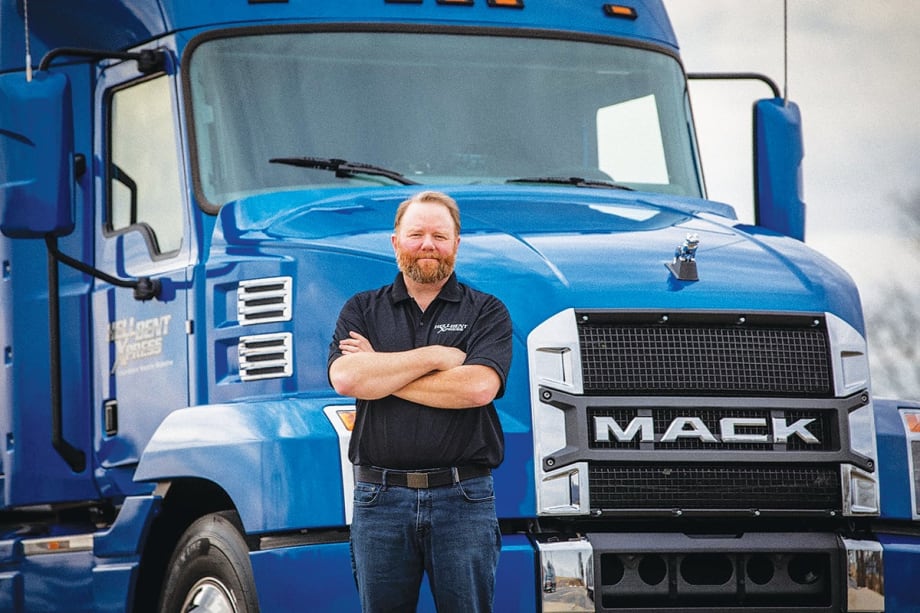
Photo: Hellbent Xpress

3 min to read


Jamie Hagen loves technology and using data to wring the most performance out of his equipment. He’s been tracking fuel economy his entire life – first as a financially strapped teenager trying to put as few dollars as possible in the tank of his little four-banger foreign car, to when he bought his truck and went to work on the road at age 21.

Ad Loading...

“I didn’t know anything other than fuel was my biggest expense, and I wanted to keep up with how much I was spending and burning,” Hagen says. “And I really didn’t know how to do anything with that data, other than I learned the importance of driving slower right off the bat.”

Ad Loading...

Hagen was soon reading up on the latest products aimed at boosting heavy-duty truck fuel economy. “I started hearing about all these really interesting systems,” he says. “Things like aerodynamics, liftable axles, downspeeding and other great ideas. And the idea of using technology to boost my fuel economy performance really became a passion then.”

In pursuit of his new passion, Hagen stumbled into a situation that is the envy of many owner-operators and small fleet owners – an intimate, two-way working relationship with a major truck maker.

“I went to the Mid-America Trucking Show looking for a new truck,” Hagen recalls. “I didn’t have any brand loyalty and was prepared to look at anything and everything. I just wanted the best possible truck for my business.”

At the Mack booth, Hagen talked with engineers about various technologies and systems, which led to a private ride-and-drive in a Pinnacle tractor. “After that, they sent me an email and asked me what I thought,” he says. “And I sent them this long, drawn-out reply basically saying, ‘Here’s what you do well, but here’s I think you could do in addition to those things…’ and the relationship grew from there.”

Soon, Hagen found himself working with both Volvo and Mack engineers, giving direct input on the companies’ automatic liftable axle system then in development. “I could tell they were really trying to embrace this technology and do something new with it,” he says.

Ad Loading...

Today, Hagen is the proud owner of a new Mack Anthem, fitted out with his dream suite of fuel-saving technology and components. But there have been some adjustments. Hagen says having an open mind is critical for success in a truck laden with this much new technology. “This truck is completely different than anything you’re used to, or have driven before,” he says. “It’s nothing like driving an older truck.”

As owner of a small fleet, Hagen also has drivers of his own to coach. He thinks downspeeding is the toughest adjustment for them in terms of new technology. “They often feel like the engine is struggling,” he says. “But you have to understand the engine is performing the way it’s designed to. The bottom line is you have to learn to use the new technology to get the most out of it. You have to be willing to let the cruise control do its job. I get comments all the time about just being a ‘steering wheel holder.’ But I’ve learned how to get the most out of the mDrive [automated manual transmission] in my truck – I can use my foot to shift up or down as needed on grades. But at the same time, I’m completely focused on safety when I’m going down the road. Because the mDrive is doing all the work managing and running the powertrain.”

Hagen has only had his new Anthem for a few months, and didn’t take delivery of the truck until the harsh South Dakota winter was about to set in. “At the moment, I’m sitting on a lifetime mph average of 8.8 for this truck,” he says. “The lifetime number on my last truck was 8 mpg. So that’s pretty good right out of the box. And I haven’t even hit the good hauling season up here yet. I have great numbers ahead of me. I have no doubt.


Subscribe to Our Newsletter

More Fuel Smarts

Solar panels on top of a red Class 8 truck sleeper cab
Equipmentby Deborah LockridgeMarch 15, 2026

Vanair Introduces Solar, Battery Power Ecosystem for Class 8 Trucks

The company’s expanded EPEQ ecosystem includes flexible solar panels, lithium batteries, hydraulic power systems, and a portable fast charger for electric trucks.

Read More →
HDT Talks Trucking thumbnail saying: NACFE's Messy Middle: Which Fuel Wins?
Fuel SmartsMarch 11, 2026

Run on Less “Messy Middle” Data Shows Multiple Paths for Truck Powertrains [Listen]

Listen as Mike Roeth of the North American Council for Freight Efficiency shares insights into battery-electric trucks, natural gas, biofuels, and clean diesel on this episode of HDT Talks Trucking.

Read More →
YouTube thumbnail with Mike Roeth of NACFE saying "NACFE's Messy Middle: Which Fuel Wins?"
Fuel Smartsby Deborah LockridgeMarch 11, 2026

Run on Less “Messy Middle” Data Shows Multiple Paths Forward for Truck Powertrains [Watch]

NACFE's Run on Less - Messy Middle project demonstrates the power of data in helping to guide the future of alternative fuels and powertrains for heavy-duty trucks.

Read More →
Ad Loading...
Mike Kucharski, vice president, JKC Trucking.
Fuel Smartsby Jack RobertsMarch 10, 2026

Trucking Executive Warns Fuel Spike from Middle East Conflict Hitting Fleets Fast

Mike Kucharski, vice president of refrigerated carrier JKC Trucking, says diesel price jumps tied to global instability are squeezing carriers already struggling with weak freight rates.

Read More →
A mechanic in a workshop leans over the open engine compartment of a large yellow vehicle, inspecting components while holding a tablet.
Sponsoredby Kristy CoffmanMarch 9, 2026

Smarter Maintenance Strategies to Keep Trucks Rolling

In today’s cost-conscious market, fleets are finding new ways to get more value from every truck on the road. See how smarter maintenance strategies can boost uptime, control costs and drive stronger long-term returns.

Read More →
Group of researchers and engineers standing next to an electric heavy-duty truck used in Purdue’s wireless charging project.
Fuel Smartsby News/Media ReleaseFebruary 3, 2026

Researchers Demonstrate Wireless Charging of Electric Heavy-Duty Truck at Highway Speeds

Purdue researchers demonstrated a high-power wireless charging system capable of delivering energy to electric heavy-duty trucks at highway speeds, advancing the concept of electrified roadways for freight transportation.

Read More →
Ad Loading...
Illustration showing diesel exhaust fluid pump sign and EPA headquarters
Equipmentby Deborah LockridgeFebruary 3, 2026

EPA Wants to Know: Are DEF De-Rates Really Needed for Diesel Emissions Compliance?

The Environmental Protection Agency is asking diesel engine makers to provide information about diesel exhaust fluid system failures as it considers changes to emissions regulations.

Read More →
SponsoredFebruary 1, 2026

6 Dashcam Tactics to Improve Safety & ROI

6 intelligent dashcam tactics to improve safety and boost ROI

Read More →
Fuel Smartsby Deborah LockridgeJanuary 29, 2026

California: Clean Truck Check Rules Still in Force for Out-of-State Trucks, Despite EPA Disapproval

The Environmental Protection Agency said California can’t enforce its Heavy-Duty Inspection and Maintenance Regulation, known as Clean Truck Check, on vehicles registered outside the state. But California said it will keep enforcing the rule.

Read More →
Ad Loading...
Illustration of Department of Justice building superimposed by truck exhaust stacks
Fuel SmartsJanuary 27, 2026

Justice Department Pulls Back on Criminal Prosecution of Diesel Emissions Deletes

The Trump administration has announced it will no longer criminally prosecute “diesel delete” cases of truck owners altering emissions systems in violation of EPA regulations. What does that mean for heavy-duty fleets?

Read More →