




Driving Autocar’s New Conventional Truck
The Autocar DC vocational truck combines toughness and technology. HDT's Jack Roberts takes it for a test drive.

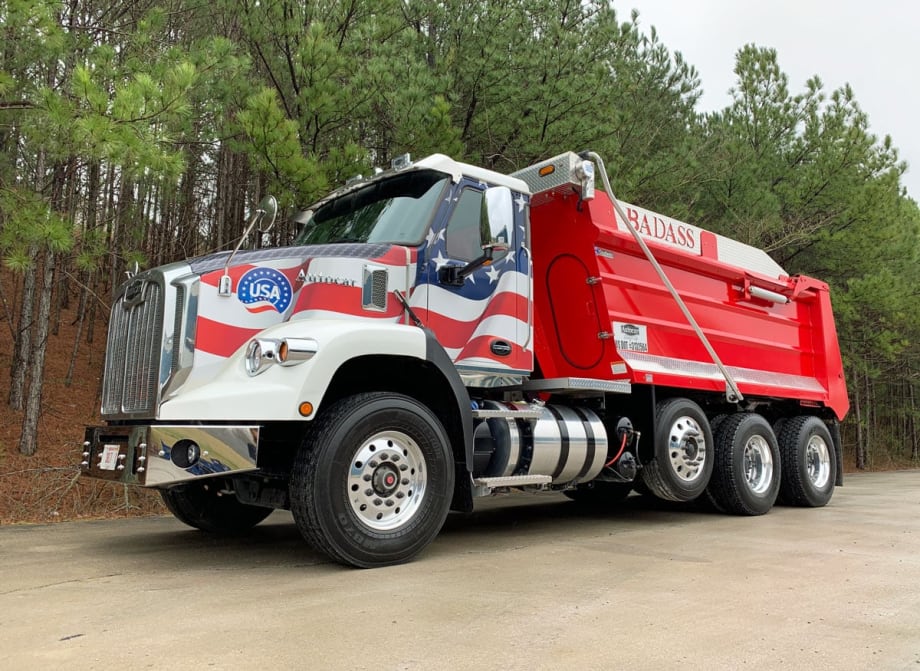
Autocar can custom-engineer versions of its DC-64 truck for a fleet's specific needs.
Photo: Deborah Lockridge
If you’re not in the refuse business or buying yard tractors, you might be forgiven for thinking Autocar was another one of those legendary truck brands that’s long-gone, like Brockway, Marmon, or Diamond Reo. But with its new DC model, Autocar has developed a conventional model that should turn the heads of severe-duty vocational fleets of all types.
The Autocar brand made its debut at the dawn of trucking, the first dedicated commercial vehicle rolling off the shop floor in 1899. In the century-plus that followed, the original company made its name building tough, specialized, heavy- and severe-duty trucks for construction, utility, refuse, and other vocational applications.
In 1953, White Trucks acquired Autocar, and the marque eventually ended up as a property of Volvo when the Swedish truck maker acquired White in 1981. But in 2000, Volvo Trucks North America produced its last Autocar, replaced by its own new VHD vocational truck and the lineup of its new sister company Mack.
Grand Vehicle Works Holdings bought the Autocar brand and the Xpeditor refuse-truck model from Volvo a year later and formed a new company, Autocar LLC. The company went back to its roots to purpose-build severe-service trucks, targeting the refuse market and later adding a yard tractor.
But in 2019, Autocar got the attention of the wider trucking industry when it unveiled its new DC Class 8 truck. The look is modern with vintage styling cues, with a sharply sloped hood, lots of chrome, and 325 degrees of glass, including rear-quarter windows.
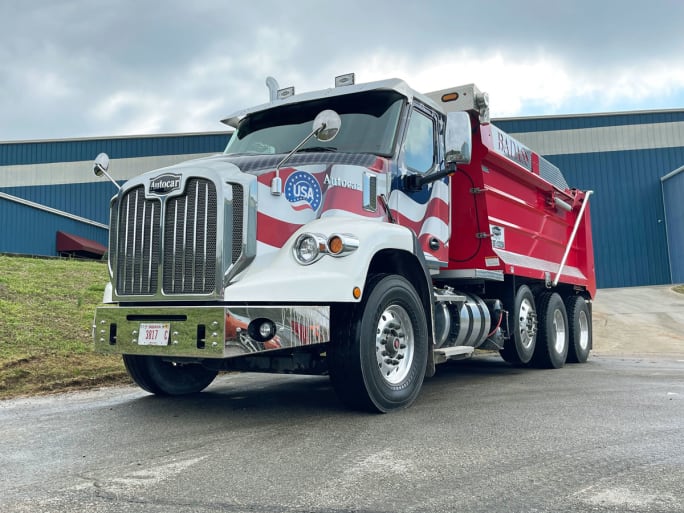
The look is modern with vintage styling cues, with a sharply sloped hood, lots of chrome and wrap-around windshield.
Photo: Jack Roberts
A Business Investment
Functionality is a constant theme with every engineering decision that goes into the truck, according to Bruce Mochrie, business development specialist, construction for Autocar.
A tour of the Birmingham, Alabama, plant floor with Mochrie before our test drive really drove this point home. Unlike most truck plants, there are no robots working frantically to weld or install vehicle components. There’s not even a moving assembly line. Because of the high amount of customization, each Autocar is a completely hand-built vehicle – insomuch as that is possible to do today. Production speed isn’t the main driver on the Autocar plant floor. Quality is. So, the workers take as much time as they need to build, test, and validate each truck before it rolls out of the plant and goes off to its new owners.
Given the tough applications they work in, Mochrie noted that Autocar takes great pains to build in as much reliability and durability as it possibly can.
“We’re building these trucks for customers who see them as an investment in their business,” he said. “These aren’t people who are interested in turning these trucks over five years from now. They fully expect them to be working and earning them money many years from now. And that’s the standard we have to meet with our design and build quality.”
To that end, the Autocar DC is loaded with lots of sensible touches to give these trucks long, reliable, working lives and make them easy for drivers to work in and for technicians to work on. That includes features such as a long-life aluminum coolant reservoir, color-coded wiring for easy identification, coolant hoses that aren’t proprietary to make them simple and affordable to replace, and easy-access oil sample and fluid checks located right under the driver-side steps to the cab.
Inside the Autocar DC cab
The DC-64D dump truck I’d be taking out for the afternoon sported an eye-catching, red-white-and blue patriotic paint job that got us many waves and thumbs-ups from other drivers during our run though Birmingham. The DC was built to Mochrie’s personal specs as a way to show off what Autocar can do in designing and building purpose-built Class 8 vocational trucks.
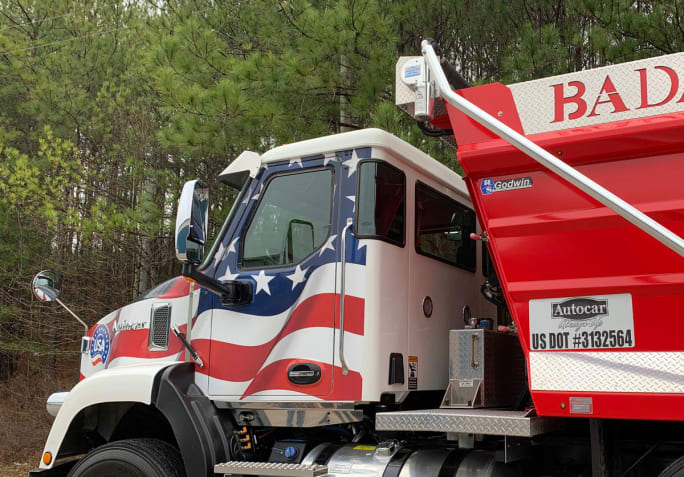
From this angle you can see the three-quarter windows on the back of the cab, which offer excellent visibility.
Photo: Deborah Lockridge
The first thing I noticed settling behind the wheel was how much natural light was flooding into the cab. Mochrie told me that the massive amounts of glass enclosing the cab, with a wrap-around windshield and rear-corner wrap-around windows, give drivers a full 325-degree field of view around the vehicle. That translates into lots of natural illumination coming in, as well.
At first glance, the DC dashboard looks like something you’d see on a truck from the 1970s or 1980s — a big steering wheel with stainless steel accents. But the old-fashioned array of gauges and switches are missing. I could see why as soon as I turned the key and fired up the 500-hp Cummins X12 diesel. At once, the 7-inch center display screen in front of the steering wheel burst to life with a sharp, glare-free graphics capable of displaying real-time information on every aspect of the truck’s performance and health.
This is Autocar’s new Smart Display, a proprietary driver information system that is revolutionary in that it not only provides drivers with critical vehicle information, but also gives technicians on-the-spot diagnostic and repair information, including in-cab access to service, body builder and operator manuals to expedite repairs.
The system is intuitive to use and completely customizable. A no-distraction mode helps keep drivers safe and focused on the road. But actionable messages and warnings are displayed as soon as a problem becomes mission-critical to prompt quick attention and avoid severe damage to the truck.
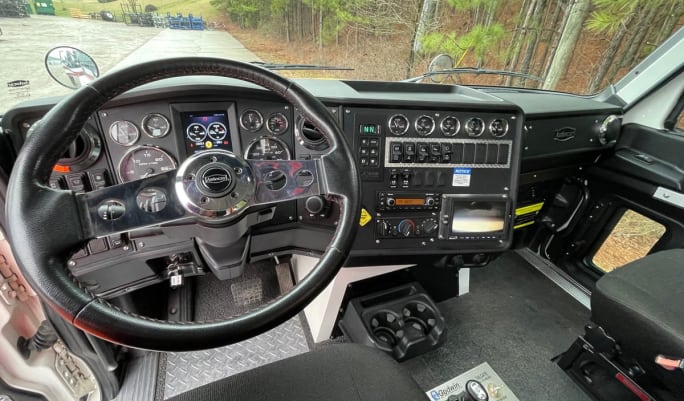
The 7-inch Smart Display gives drivers a light-cycle test for the pretrip inspection and allows drivers to choose the preferred level of information displayed. For technicians, it provides diagnostic information such as electrical diagnostic/report of failed fuses or circuits and easy access to wiring schematics.
Photo: Deborah Lockridge
On the Road — And Off
Mochrie had a typical severe-duty route laid out for our test drive in the Autocar DC. This included a mix of city and highway driving, as well as an off-road portion getting loaded with gravel at a local quarry. And we were in Birmingham, which is where the Appalachian Mountains begin (or end, depending on your point of view). So, we had steep grades to contend with as well.
Merging into traffic as I pulled out of the plant, I got my first real-world taste of how effective that large, glassy Autocar cab is. Twisting in the seat to check oncoming traffic, I found that rear-quarter window was perfectly framed to give me a quick, clear view of the cars behind me and to my left. It was a reminder how little details can provide big safety bonuses for drivers.
Mochrie spends a lot of time in this particular truck visiting customers, so it was spec’d with a few nice details, like a custom seat with adjustable arm rests and hockey-stick fender mirrors to help him out on long drives.
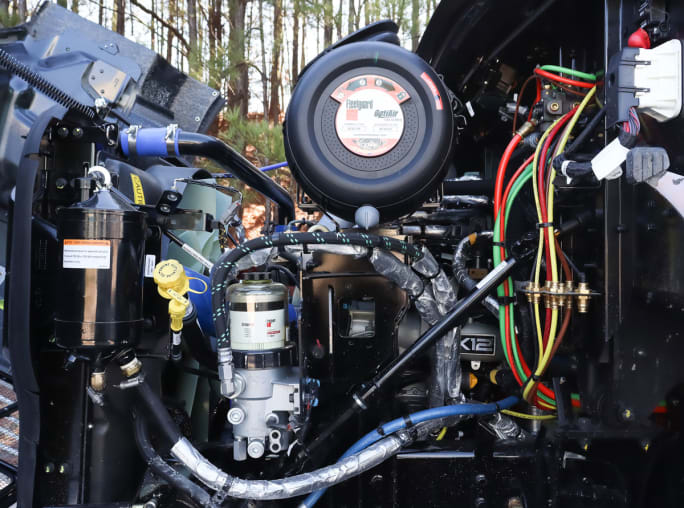
Lights under the hood make it easy to do oil checks and transmission levels even in the dark. Hoses that are exposed to heat are wrapped in insulation to extend their lives.
Photo: Autocar
Even unloaded, the truck rode smoothly with minimal jolts and jarring. The truck doesn’t wander around in its lane, either. Later on, when we were almost fully loaded at 76,000 lbs., the ride was even better, of course. But I noted that in both instances, there’s just not a lot of lateral or front-to-back sway in the DC when accelerating, steering or braking. The truck has a definite, solid, sure-footed feel on the road that Mochrie said doesn’t tire him out after a long day behind the wheel.
The DC was equally sure-footed on the wet, sloppy haul roads leading to the gravel pits at the quarry. A surprisingly tight turning radius, combined with the excellent sight lines out of the cab, made backing in and lining up to the big Deere wheel loader a cinch. Good visibility is critical for safety on a hectic jobsite like a quarry pit, and the DC certainly delivers on that front.
The Cummins X12 diesel, working hand-in-hand with the Allison automatic gearbox, got the loaded DC up and moving nicely and had no problems on the highway. On mountainous, two-lane portions of our drive, the DC held its own on most grades and managed to hold a steady 35 mph on even the steepest climbs as we drove back to the Autocar factory.
In all, the Autocar DC is exactly what Mochrie promised before our drive. It’s a truck that is designed for a very tough, no-nonsense work environment. But at the same time, it has technology and even luxury in just the right amounts in just the right places.
Everything on the truck, from the Smart Display screen to its steel cab construction to its 160,000-PSI frame rail, is designed for safety, performance and uptime with minimum fuss. It’s a well-thought-out blend of technology and toughness that honors the brand's longstanding reputation for toughness and quality.
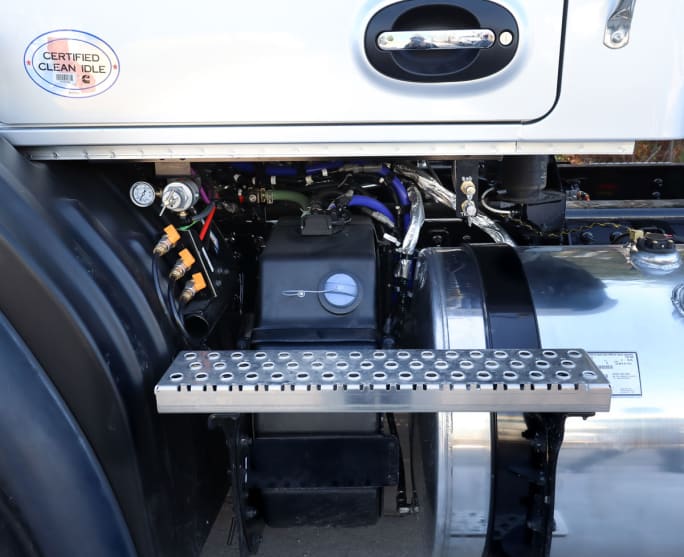
The DC64 is easy to work on. The driver can drain the air tanks right beneath the door. The technician has easy access to components under the cab.
Photo: Autocar
SPECS
Model: Autocar DC-64DVOCClass 8 Vocational Truck
GVWR: 79,500 lbs.
Body: R/S Godwin SCS, 14-Degree Asphalt Taper, 3/16 AR450 Hardox, Sloped Bulkhead with Man-Door, High-lift Tailgate, Backup Camera
Engine: Cummins X12 diesel
Horsepower: 500 hp at 1,900 rpm
Transmission: Allison 4500 RDS Series automatic 6-speed
Axle ratio: 4:30
Front suspension: Hendrickson Steertek 20,000 lbs.
Rear suspension: Hendrickson HMX-460, 46,000 lbs.
Lift Axle: Pusher Hendrickson Composilite EXS Steerable 13,500 lbs.
Front brakes: Meritor EX-225 Air Disc
Rear brakes: Meritor 16.5x7 Q Plus
Other Options: Underhood Service Lights, Air Reservoir Drain Central Manifold, 11.25” 160,000KSI 3.9M RBM Single Frame Rails
This article appears in the May 2022 issue of Heavy Duty Trucking.
More Equipment

How Volvo Updated Its D13 for EPA 2027 [Watch]
Volvo’s updated D13 promises lower emissions without sacrificing performance or fuel economy. Take a closer look at what changed inside the engine in this HDT Spotlight video.
Read More →
Michelin Tire Improves Efficiency and Durability for Regional Fleets
The Michelin X Multi Energy D2 is a regional haul drive tire engineered to help fleets improve fuel efficiency, durability and traction in demanding stop-and-go operations.
Read More →
ZF Expands Commercial Vehicle Push in North America
ZF is expanding its North American commercial-vehicle presence with new transmission applications, electrification, trailer technology and autonomous-driving systems.
Read More →
Tesla Wants a Self-Driving Semi. Are Cameras Enough?
Could Tesla’s camera-only autonomous driving technology work on an 80,000-pound Semi? In this commentary, HDT's Deborah Lockridge takes a look at Tesla, Cybercab, and how autonomous trucks see the road.
Read More →
Kodiak: Driverless Long-Haul Truck Launch on Track for 2026
Kodiak AI says its driverless long-haul safety case is 93% complete and it remains on track to begin commercial operations by year-end 2026.
Read More →
What DOT’s Automated Vehicle Strategy Means for Trucking
The U.S. Department of Transportation issued a new automated-vehicle strategy that outlines plans for driverless-truck regulations, cross-state freight corridors, and federal safety standards.
Read More →
East Coast Port Launches $45M Electric Truck Push
The Port Authority of New York and New Jersey announced millions in incentives for zero-emission drayage trucks, yard tractors, and new charging hubs near the port.
Read More →
PlusAI Going Public to Fund Autonomous Truck Launch
A SPAC deal could provide PlusAI with up to $300 million as it works toward a 2027 commercial launch of factory-built autonomous trucks.
Read More →
NHTSA Moves to Rewrite Truck Fuel-Economy Rules
The National Highway Traffic Safety Administration says it lacks authority to regulate medium- and heavy-duty truck engines separately from complete vehicles, but the existing standards have not yet been eliminated.
Read More →
Detroit Opens Orders for EPA 2027 Engines
Detroit isn’t starting from scratch to meet EPA 2027 diesel emissions standards. Its Gen 6 DD13 and DD15 engines keep much of today’s platform while updating the fuel and aftertreatment systems.
Read More →