




Related: Does Truck Platooning Have a Future?
Does Truck Platooning Work in the Real World?
In theory, truck platoons are an obvious way to improve fuel economy for multiple vehicles at a time. But actually doing it on the road presents its own challenges.
by John G. Smith
June 14, 2019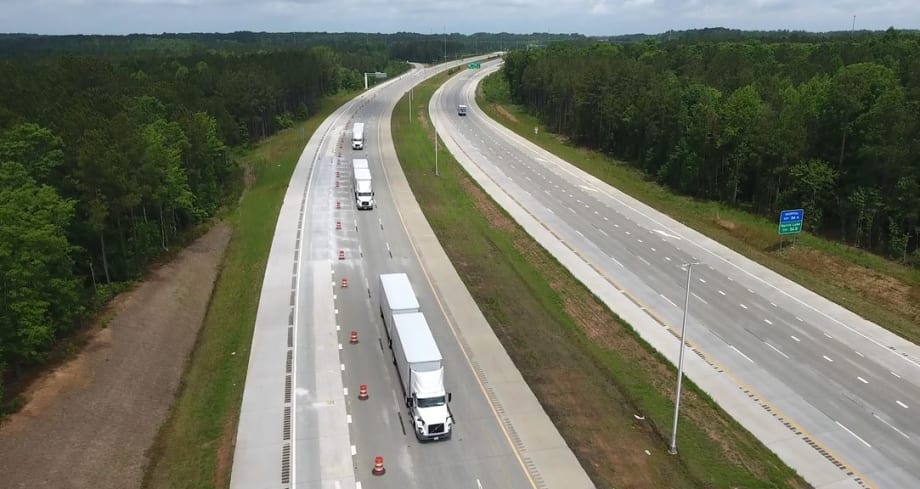
In theory, truck platoons are an obvious way to improve fuel economy for multiple vehicles at a time. But actually doing it on the road presents its own challenges.
Photo via Volvo Trucks North America
5 min to read
Tailgating tends to be discouraged. Just don’t tell those who research the benefits of platooning.
In the ongoing search for better fuel economy, engineers have found ways to connect tractor-trailers through electronic handshakes, automatically maintaining tight following distances that improve aerodynamic drag. Drivers in the lead trucks remain responsible for traditional acceleration and braking, but those to the rear leave some of their work in the hands of semi-autonomous systems.
And when the connections are maintained, there’s no question that platoons will work.
Several tests have demonstrated that trucks to the rear can improve their fuel economy by as much as 10%, and even those in the lead position can see fuel economy increase close to 4%, the North American Council for Freight Efficiency (NACFE) reports. In a real world setting, the fuel savings probably average out close to 4% across two trucks that maintain following distances of 40 to 50 feet, it says.
Transport Canada says 6% fuel economy gains are possible in platoons of three tractor-trailers, when each weighs 65,000 pounds and runs 57 feet or 0.6 seconds behind the truck ahead of them at highway speeds. And that’s without the benefit of side skirts or boat tails. Tests on a track in Blainville, Que. realized fuel savings as high as 14.2% when such equipment was run in a controlled setting.
Daimler Trucks and Buses remains unconvinced. The OEM recently announced it was abandoning platoon-related research. Any fuel savings realized by established platoons tend to disappear as trucks break and re-establish their following distances in real traffic, said global head Martin Daum. “We won’t start another project on platooning for fuel efficiency.”
Others continue to explore the idea, though.
Volvo Trucks North America and FedEx are still running platoons along NC 540 in North Carolina, helping the manufacturer amass more than 49,000 miles of experience with two- and three-vehicle platoons along the way. Each of these platoons includes a trio of tractors pulling double 28-foot trailers and spaced 1.5 seconds apart. And they’re realizing fuel economy despite the times they need to break up and re-establish themselves to make way for other traffic. Aerodynamic drag, after all, accounts for about 25% of the fuel a truck consumes, the manufacturer notes.
“There are many miles that trucks can operate — on long distances, on interstates — where they can take advantage of the technology and the use case that will allow for a significant volume of time and distance,” says Keith Brandis, Volvo’s vice-president – product planning. “We do not plan to platoon through New York City.”
“We’re very interested in hub-to-hub operations,” he adds, referring to the natural fit between platooning and such planned and organized truck routes. “Let’s say trucks are departing from the terminal within a reasonable time of one another. They’re in the same fleet. You can get the agreement between the drivers and the loads. They’re going to run on the same portion of the highway for an extended period of time.”
“We think that’s where it can start first. Then we can look at other types of planned, organized platooning efforts – maybe contract carriers and the like,” he says.
Resource road challenges
Still, resource roads present some unique challenges.
Last year’s tests discovered that highway-focused platooning equipment tends to rely too heavily on foundation brakes, which would be a problem when driving heavier logging trucks, Proust says. GPS signals also disappeared for a few seconds at a time in remote areas, and that could be “problematic” for technologies that rely on such connections, he adds.
Tight following distances that work on a well-paved road could also be a challenge on a gravel road, slinging debris and rocks onto the vehicles behind. It’s one of the reasons why the logging-related test maintained a 197-foot following distance – and took the time to ensure that connections could be maintained if distances had to stretch beyond that.
It was also difficult to maintain pre-set following distances on the resource road’s steep grades. “The systems available today are not necessarily set up for that kind of environment,” Proust explains. “The following vehicle does not necessarily have control over the lead truck. It’s more the other way around.”
Trucks in a rear position might require some level of control to ensure the gaps stay within an acceptable range, he says.
The challenge of maintaining a set following distance is not unique to logging roads, either. Those involved in the highway-focused research are also fine-tuning equipment to account for the “slinky effect” that occurs on rolling terrain, says Brandis.
“How do we manage both the lead and the following trucks so you minimize that effect?”
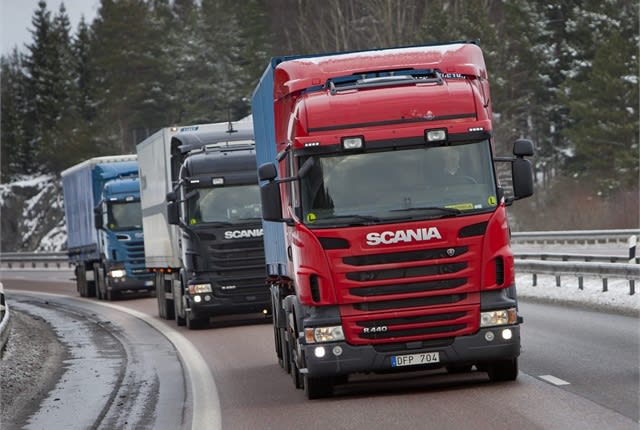
In Europe several manufacturers are testing out platooning.
Photo via Scania
Europe studies mixed platoons
Similar tests are ongoing across the Atlantic Ocean.
Volvo is one of the manufacturers participating in Europe’s Ensemble initiative, which is looking to set the standards needed for platoons that mix different equipment brands. That’s no small matter when you consider the unique approaches and technologies applied to tools such as adaptive cruise control.
There needs to be a communications protocol that establishes a handshake between different technologies, Brandis says. “We don’t have all the industry standards aligned.”
And tractors aren’t the only consideration in the tests on both continents.
“We need to know the trailers to a much larger extent,” Brandis explains. “An older trailer, with maybe worn brakes, has a different stopping distance than a brand new trailer with well-adjusted brakes and predicted braking. Those kinds of variables have to be considered.” So far, the North American tests have focused on new trailers with well-maintained brakes and predictable handling characteristics alike.
Then there’s the question of how platoons might run in northern climates, where winter represents “completely different questions and problems,” Brandis says, referring to factors like obscured lane markings and ice.
Ron McLane, the marketing head for the platooning system designers at Peloton, adds that any emerging systems need to consider human factors as well.
During the recent Movin’On summit on sustainable transportation, he discussed the need to inform drivers in rear vehicles about the road ahead. It’s why his company’s platoons are equipped with dedicated vehicle-to-vehicle radios. Video monitors display the road ahead so drivers understand why a platoon is braking or changing lanes.
After all, the research into platooning continues to move ahead. We just don’t know what direction the final systems will take.
John G. Smith is the editor of the award-winning Canadian publication Today's Trucking. This article was used under a cooperative editorial sharing agreement between HDT and its Canadian counterpart.
Subscribe to Our Newsletter
More Fuel Smarts

How Volvo Updated Its D13 for EPA 2027 [Watch]
Volvo’s updated D13 promises lower emissions without sacrificing performance or fuel economy. Take a closer look at what changed inside the engine in this HDT Spotlight video.
Read More →
Diesel Price Spike Shortens Payback for Natural Gas Trucks, Report Says
Energy Vision estimates fleets could recover the higher purchase price of an RNG-fueled Class 8 tractor in 1.3 to 2.8 years under current fuel-price scenarios.
Read More →
Calstart Becomes Catalyst Mobility, Reflecting Broader Focus
Calstart is now Catalyst Mobility, reflecting the nonprofit’s growing national role in clean transportation, including zero-emission trucks, infrastructure and incentive programs.
Read More →

Record Diesel Prices Squeeze Trucking Fleets
Average U.S. diesel prices have climbed to nearly $6 a gallon, surpassing the 2022 record as tight refinery capacity and Middle East disruptions keep fuel costs elevated.
Read More →
Sponsored•September 9, 2026
How Fuel Delivery Shapes Engine Performance
Fuel delivery depends on more than what happens at the injector. For fleet, maintenance and technical professionals, looking at the full path from pump to injector can provide useful context for understanding engine performance.
Read More →
East Coast Port Launches $45M Electric Truck Push
The Port Authority of New York and New Jersey announced millions in incentives for zero-emission drayage trucks, yard tractors, and new charging hubs near the port.
Read More →
California Bill Could Shed Light on Electric Truck Prices
Why do battery-electric Class 8 trucks remain so expensive? A California bill headed to Gov. Gavin Newsom would give fleets and state agencies more visibility into what manufacturers charge.
Read More →
Detroit Opens Orders for EPA 2027 Engines
Detroit isn’t starting from scratch to meet EPA 2027 diesel emissions standards. Its Gen 6 DD13 and DD15 engines keep much of today’s platform while updating the fuel and aftertreatment systems.
Read More →
Zero-Emission Truck Corridor Planned for West Coast
California, Oregon, Washington, British Columbia and Baja California are coordinating plans for truck charging and hydrogen fueling from Canada to Mexico.
Read More →
A Closer Look at Kenworth’s Electric T880E Vocational Truck [Video]
Learn more about Kenworth's T880E battery-electric vocational truck at the Paccar Technical Center, including its range, applications, upfitting considerations, and PTO options, in this HDT Spotlight video.
Read More →