




Developing a Digital Tire Management Strategy
If you’re still using pencils, paper, and binders to track your tire management, you’ve already fallen behind.
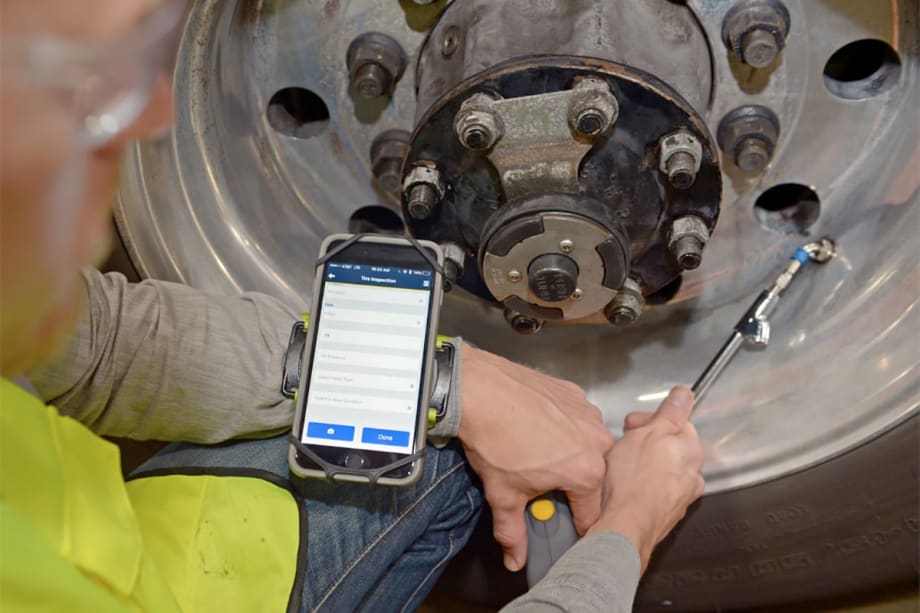
Photo: Goodyear
If you’re still using pencils, paper, and binders to track your tire management, you’ve already fallen behind.
“I’d say, we’re moving at warp speed,” Brian Cunningham, vice-president of fleet solutions for Bridgestone said during an American Trucking Associations Management Conference & Exhibition panel discussion on digital tire management strategies. “Adoption is happening quicker and quicker every day.”
Micah Tindor, connected fleet product manager with Goodyear, agreed, adding more advanced algorithms that assist with funneling data down into actionable insights have accelerated the adoption curve. The majority of large fleets have implemented a digital tire management program, and smaller fleets are catching up as more effective digital tools become available. But how does one get started on deploying a digital tire management strategy?
“A fleet’s best approach is to begin by identifying the current strength of your tire program,” said Shaun Hartoog, advanced customer consulting, digital solutions specialist with Dana. “What areas are most in need of improvement?”
Fleet maintenance managers need to evaluate current procedures, and ensure they’re consistent across every location and every single tire inspection. Digital tools can help achieve this by, for example, storing tire images in the cloud for evaluation. This allows managers to better measure compliance across all technicians and shops and to ensure accountability.
How long it takes to realize tangible benefits of a digital tire strategy will depend on the program, but Hartoog cited benefits such as better pull point compliance and inflation pressure maintenance.
“Over time you will see time savings, and you can eliminate the need for scrap analysis because you’re leveraging digital tools,” he said. “It takes months to build that type of data before seeing results and value.”
Such a program requires buy-in from the top of the organization, down to the drivers and technicians who actually touch the tires.
“If there is no commitment from the top to follow through and discuss successes, it slowly fades away to just another thing someone is being asked to follow,” said Cunningham.
Donna Murphy, initiative lead, connected pressure, services and solutions business line with Michelin, said a successful fleet strategy is to assign operations team members do tire spot checks before the truck leaves the yard, in addition to the driver and/or technician. “Having a secondary spot check, someone else double checking, got everybody on-board and following through,” she said of one fleet’s strategy. “They knew someone else was looking to see if the work was done.”
Another fleet, said Hartoog, improved compliance with tire rotation schedules using digital tools that communicated to technicians the company policy on rotations. Previously, technicians were checking in with other team members to inquire about rotation schedules and information was inconsistent.
Murphy said everyone in the organization should be informed of why a new tire management strategy is being put in place.
“Explain the benefit to the organization, the benefit to themselves,” she said, noting even employees in accounts payable will be affected in some way. When rolling out a program, schedule training and set timelines and fallback dates in case of delays. Once the program is implemented, recognize compliance with thank-you cards or rewards, Murphy suggested.
Drivers also need to be informed of the new strategy and urged to do their part. Tindor spoke of a driver who insisted an alert regarding a leaking tire was incorrect, because he had just completed a pre-trip inspection and the tire was fine. When he got out of the truck and checked it again, he admitted the report was correct and a slow leak had developed. Ignoring those technological cues defeats the purpose of the program.
“Set clear KPIs (key performance indicators) and communicate them to drivers to reduce the number of roadside breakdowns,” Tindor said.
Cunningham said whatever digital program is put in place needs to funnel the right data to the right people.
“If data is not tire-related and not geared to what you’re trying to do with your tire program, it should be funneled out,” he said. The data needs to be easily obtained and categorized into correct buckets for review and action.
“Talk to your vendors on how to get that done,” Cunningham said. “Filter out waste.”
“Look for a solution that can push data into the platforms you need it to be pushed into,” added Tindor.
Dashboards are an effective tool for allowing technicians to quickly and easily review important data. Separate dashboards may be required for mid- and senior-level executives who will be more interested in the financial aspects than tread depth or inflation pressures.
James Menzies is the editor of Today's Trucking, where this article originally appeared. This content was used with permission from Newcom Media as part of a cooperative editorial agreement.
More Equipment

How Volvo Updated Its D13 for EPA 2027 [Watch]
Volvo’s updated D13 promises lower emissions without sacrificing performance or fuel economy. Take a closer look at what changed inside the engine in this HDT Spotlight video.
Read More →
Michelin Tire Improves Efficiency and Durability for Regional Fleets
The Michelin X Multi Energy D2 is a regional haul drive tire engineered to help fleets improve fuel efficiency, durability and traction in demanding stop-and-go operations.
Read More →
ZF Expands Commercial Vehicle Push in North America
ZF is expanding its North American commercial-vehicle presence with new transmission applications, electrification, trailer technology and autonomous-driving systems.
Read More →
Tesla Wants a Self-Driving Semi. Are Cameras Enough?
Could Tesla’s camera-only autonomous driving technology work on an 80,000-pound Semi? In this commentary, HDT's Deborah Lockridge takes a look at Tesla, Cybercab, and how autonomous trucks see the road.
Read More →
Kodiak: Driverless Long-Haul Truck Launch on Track for 2026
Kodiak AI says its driverless long-haul safety case is 93% complete and it remains on track to begin commercial operations by year-end 2026.
Read More →
What DOT’s Automated Vehicle Strategy Means for Trucking
The U.S. Department of Transportation issued a new automated-vehicle strategy that outlines plans for driverless-truck regulations, cross-state freight corridors, and federal safety standards.
Read More →
East Coast Port Launches $45M Electric Truck Push
The Port Authority of New York and New Jersey announced millions in incentives for zero-emission drayage trucks, yard tractors, and new charging hubs near the port.
Read More →
PlusAI Going Public to Fund Autonomous Truck Launch
A SPAC deal could provide PlusAI with up to $300 million as it works toward a 2027 commercial launch of factory-built autonomous trucks.
Read More →
NHTSA Moves to Rewrite Truck Fuel-Economy Rules
The National Highway Traffic Safety Administration says it lacks authority to regulate medium- and heavy-duty truck engines separately from complete vehicles, but the existing standards have not yet been eliminated.
Read More →
Detroit Opens Orders for EPA 2027 Engines
Detroit isn’t starting from scratch to meet EPA 2027 diesel emissions standards. Its Gen 6 DD13 and DD15 engines keep much of today’s platform while updating the fuel and aftertreatment systems.
Read More →