




Demise of the Dumb Dump Truck
Today’s dump trucks are smart, connected and integrated — but still tough enough to handle heavy loads in tough working conditions.

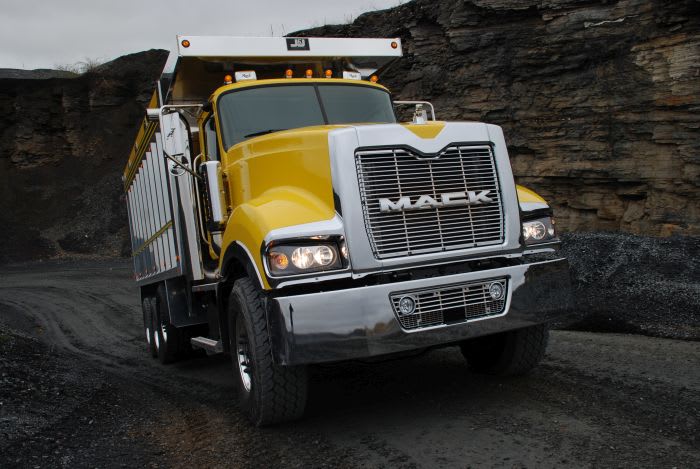
Dump trucks have always been tough. But today, they’re getting increasingly smarter as well. Photo: Mack
Dump trucks have always been tough. But today, they’re getting increasingly smarter as well.Photo: Mack
Technology tends to come late to Class 8 dump trucks. Usually, a new piece of technology has to spend a few years proving its value and durability on tractors spec’d for long-haul freight applications before it trickles down to vocational applications such as dumps.
That’s changing. Technology is transitioning from the on-highway segment into dump trucks at an unprecedented rate. This is partly because the adoption rate for new technology is much faster today. And partly it is because of regulatory pressure on truck makers to meet pollution and fuel economy standards. And, increasingly, since many on-highway and vocational trucks share common bodies and components, the trucks are simply hard-wired and ready to seamlessly accept all of the new technology available today.
But mainly, it is because dump truck fleets today face many of the same real-world business struggles their on-highway counterparts do. And new technology can deliver real help.
The result is a new type of dump truck: A vehicle that remains tough enough to handle heavy hauls in tough working conditions, but is also a connected vehicle with an often surprising degree of fuel economy and an ever-increasing focus on safety.
Safety first and foremost
If fuel economy is a priority for long-haul fleets, dump truck fleets today are focused on safety, says Chad Semler, HX marketing manager for International. “In some vocational segments with larger fleets today, we’re starting to see fleet managers who live and breathe safety. It’s really become a top concern for construction fleets today, which is why we see these professionals studying a wide range of items to address those concerns.”
Semler says safety items can range from mundane offerings such as specialized step and grab-handle packages all the way up to highly sophisticated interactive driver assistance systems. “Collision mitigation systems are now standard on International’s LT highway tractor,” he notes. “And we’ve really seen the take rate for that technology skyrocket in the past couple of years. And the severe service market segments have taken note.”
Onboard electronics systems have been an enabler for a wide array of safety devices. For instance, at International, the Diamond Logic multiplexed electronic control system allows engineers to easily integrate a host of systems on the vehicle, and even add systems from outside component builders, to make the trucks safer.
“Fleets now can very easily use Diamond Logic, for example, to configure an [automated manual transmission]-equipped truck so that it will not go into gear if a crane boom is extended, or limit a dump truck’s speed to 5 mph if the dump body is raised,” Semler explains. “You can even easily add audio and visual alarms to remind the driver these limitations are in place in those specific situations.”
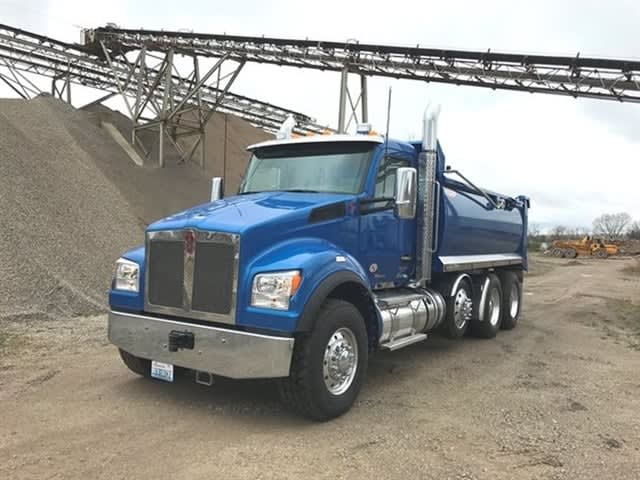
Advanced safety systems, from collision mitigation to tire pressure monitoring systems, are becoming increasingly common in dump truck fleets.Photo: Kenworth
Kurt Swihart, Kenworth marketing director, points out that the designers of vocational trucks are taking advantage of better visibility, camera-based systems for maneuvering, and interlocked systems for PTO functions (like dump bed operation).
“Vocational truck operators also are starting to utilize options such as tire pressure monitoring and collision mitigation systems. In the past, these were unheard of outside of on-highway applications, but are becoming more viable and desirable in the vocational industries,” Swihart says. “We’re also seeing more advanced safety systems, such as collision mitigation systems like Bendix [Wingman] Fusion and Meritor OnGuard, being spec’d as well. There is still a long way to go to get higher adoption rates for these systems, but they are definitely starting to get some attention in the construction industry.”
Peter Schimunek, marketing manager, Western Star Trucks, says that roll stability and enhanced stability control (ESC), offered in all its models, assist drivers in maintaining vehicle control by monitoring road conditions and automatically intervening when a rollover risk is detected.
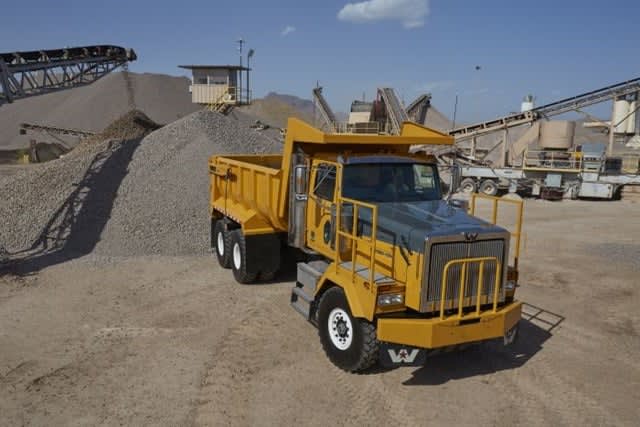
Telematics can do far more than just alert fleet managers that a truck needs maintenance. Dump fleets are using connected trucks to ensure timely deliveries of perishable payloads and measure fleet efficiencies on a daily basis.Photo: Western Star
The main challenge for dump truck OEMs with safety systems today is ensuring technology and devices that typically function in on-road tractors can also survive the abuse that vocational jobsites unleash, says Tim Wrinkle, construction product manager for Mack Trucks. “Just keeping the safety devices clean in order to function properly can sometimes be a challenge for fleets,” he notes. “That’s why some of these technologies are slow to catch on: because many vocational truck owners do not wish to complicate the work of their drivers or add hardware that could cause additional maintenance or reasons for a truck to be in the shop.”
But safety isn’t all about high-tech safety systems. For instance, safety and ergonomics often go hand-in-hand, especially in an age of driver shortages. “For jobs that require the driver to get in and out of the truck many times during the day, ergonomic and properly placed grab handles make it easier and safer for the driver to get in and out of the truck,” Schimunek says.
Semler agrees, noting, “steps and handles on a dump truck are just so important to drivers. That’s why we really study how to best lay them out for optimal comfort and safety and then get lots of feedback from drivers and what works — and what doesn’t. And that really goes for the inside of the truck as well. We also study what we at International call the ‘Primary Zone,’ in the cab — the area where the dials, controls and switches that get used most are placed. We put a lot of thought into making those controls easy to reach and intuitive to use.”
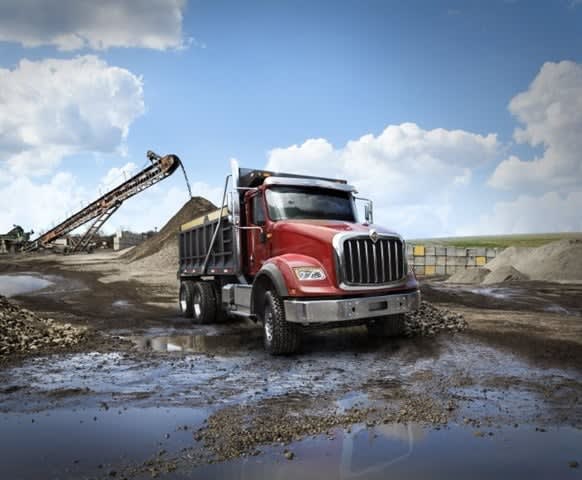
Safety and ergonomics go hand-in-hand and affect everything from the placement of dials, gauges and switches to the number of steps and handles and their locations outside the cab.Photo: International
Death of the dumb dump
One technology that has not been slow in catching on in dump truck design is vehicle telematics. Increasingly faster and more connected vehicles are proving their worth in the toughest working conditions imaginable.
“The use of telematics solutions and GPS is something that is growing faster in vocational applications than the on-highway segments,” says Wrinkle. “It’s a technology that helps better connect drivers, fleet managers and customers, and will likely drive the biggest efficiencies during the next several years. We have some customers using telematics to monitor and measure efficiencies in their daily operations above and beyond a truck’s individual performance.”
Brian Daniels, vocational market segment manager for Freightliner Trucks, says he generally sees dump truck users demanding a blend of the latest on-highway advancements along with the durability of a rugged vocational truck. But, he adds, dump trucks today typically experience a daily profile that includes 200-plus miles of pure on-highway travel followed by low-gear, locked-diff crawling over rough terrain at maximum suspension articulation. “It’s a very demanding application that demands maximum uptime to help the operator turn a profit.”
“When you’re talking about onboard, self-diagnosing powertrains today, all sorts of options are available to fleet managers,” Semler says. In addition to flashing fault codes to fleets, the system can be used to fine-tune many dump-specific operations to boost vehicle and fleet efficiency.
For instance, Semler adds, “If you’re in a vocational application hauling perishable loads like hot asphalt or concrete, the system can send notice to a fleet manager or driver that the vehicle is starting to overheat, so you can move it to the front of the line and unload it before it is disabled or has to leave the jobsite and return to the shop. That can really be important when you look at how much it costs to remove asphalt or concrete from a truck body once it’s set up.”
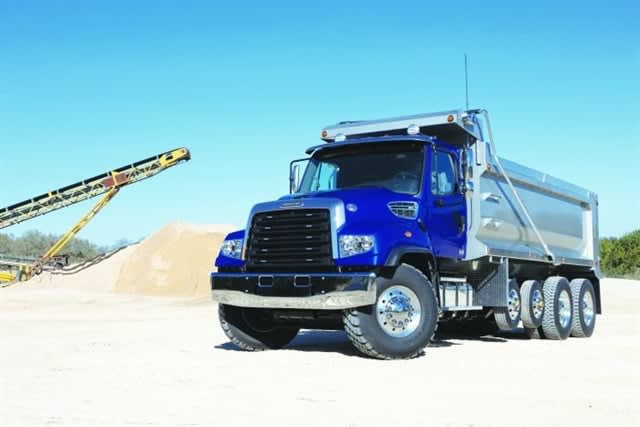
Electronics today are creating better communication between trucks and bodies, including in-cab and dashboard warning indicators that alert a driver if an axle is raised or a PTO is engaged.Photo: Freightliner
Smarter, connected bodies
Increasingly, body builders are taking advantage of how technology can integrate a truck chassis and body and allow them to work together more effectively.
Charlie Wells, vice president, sales and marketing, for East Manufacturing, says truck manufacturers today are much better at designing trucks with the body installer in mind. New electronics and associated communications systems are integral to that approach. “The body-builder cable offered by manufacturers like Peterbilt now provides multiplexing capability,” Wells says. “This technology provides in-cab and dashboard warning indicators to allow the driver to know if, for instance, an axle is raised. The connectivity primarily makes it easier for the driver to know if something is engaged. It also allows the driver to operate things like tarps from the ground, often eliminating climbing up onto the truck body.”
Wrinkle notes that “there is a growing demand for truck bodies to be able to communicate back and forth with the truck,” a demand that has led to components such as Mack’s BodyLink III electrical connector.
He says this specialized connector simplifies the installation of a customer’s body onto the chassis and provides installers with a multiplex-capable, integrated communication system from the body to the truck ECU via the J1939 data bus. “It provides the necessary connections without the need to splice wires or compromise quality,” he says. Post block terminals located in the top of the dash offer additional connection points.
Swihart says mechanical and electrical interfaces are equally important to most body builders. “On the electrical side, Kenworth has offered increasingly, more robust reference manuals. In the mechanical area, we work with body builders to provide custom frame layout options, which offers them an opportunity to meet their needs by changing the layout of components, such as battery boxes, fuel tanks, air tanks, air dryer, and crossmembers. This helps to reduce upfit time, because they aren’t required to just make it work by relocating components.”
OEMs and body builders are just beginning to explore the possibilities that ever-faster and more capable electronics deliver. And vocational fleet managers are quickly learning that telematics can do more than simply tell them when a vehicle needs maintenance, allowing them to do more, earn more, and save more than ever before.
More Equipment

How Volvo Updated Its D13 for EPA 2027 [Watch]
Volvo’s updated D13 promises lower emissions without sacrificing performance or fuel economy. Take a closer look at what changed inside the engine in this HDT Spotlight video.
Read More →
Michelin Tire Improves Efficiency and Durability for Regional Fleets
The Michelin X Multi Energy D2 is a regional haul drive tire engineered to help fleets improve fuel efficiency, durability and traction in demanding stop-and-go operations.
Read More →
ZF Expands Commercial Vehicle Push in North America
ZF is expanding its North American commercial-vehicle presence with new transmission applications, electrification, trailer technology and autonomous-driving systems.
Read More →
Tesla Wants a Self-Driving Semi. Are Cameras Enough?
Could Tesla’s camera-only autonomous driving technology work on an 80,000-pound Semi? In this commentary, HDT's Deborah Lockridge takes a look at Tesla, Cybercab, and how autonomous trucks see the road.
Read More →
Kodiak: Driverless Long-Haul Truck Launch on Track for 2026
Kodiak AI says its driverless long-haul safety case is 93% complete and it remains on track to begin commercial operations by year-end 2026.
Read More →
What DOT’s Automated Vehicle Strategy Means for Trucking
The U.S. Department of Transportation issued a new automated-vehicle strategy that outlines plans for driverless-truck regulations, cross-state freight corridors, and federal safety standards.
Read More →
East Coast Port Launches $45M Electric Truck Push
The Port Authority of New York and New Jersey announced millions in incentives for zero-emission drayage trucks, yard tractors, and new charging hubs near the port.
Read More →
PlusAI Going Public to Fund Autonomous Truck Launch
A SPAC deal could provide PlusAI with up to $300 million as it works toward a 2027 commercial launch of factory-built autonomous trucks.
Read More →
NHTSA Moves to Rewrite Truck Fuel-Economy Rules
The National Highway Traffic Safety Administration says it lacks authority to regulate medium- and heavy-duty truck engines separately from complete vehicles, but the existing standards have not yet been eliminated.
Read More →
Detroit Opens Orders for EPA 2027 Engines
Detroit isn’t starting from scratch to meet EPA 2027 diesel emissions standards. Its Gen 6 DD13 and DD15 engines keep much of today’s platform while updating the fuel and aftertreatment systems.
Read More →