




Daycab A/C Units Offer Quick Payback
Dump trucks sit in a line waiting to load or unload, and the line moves every few minutes, trucks idling all the while

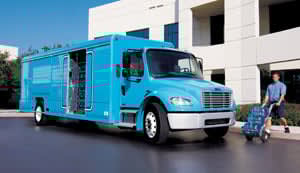
Because daycabs idle so much, payback can be quick on an auxiliary A/C unit.
Dump trucks sit in a line waiting to load or unload, and the line moves every few minutes, trucks idling all the while.
Some drivers think idling uses less fuel than shutting off and restarting the engine. Some want to get back at the company for not taking better care of its trucks. Most just want to keep the cab cool.
However, all but the most modern engines send polluting fumes into the air while idling, and all engines make noise and burn expensive fuel. Drivers might feel that these are someone else's problems, though citations and fines for violating state or municipal idling bans will get their attention. Most anti-idling ordinances make exceptions for operating on-board equipment and keeping sleepers comfortable in extreme temperatures, but what about daycab trucks?
Until fairly recently there was no way to cool the cab besides running the engine to power a vehicle's built-in air conditioning. Now there are add-on A/C products that operate independently of the engine. They can make economic sense if anti-idling laws are strictly enforced or idling tends to be often or lengthy. For starters, savings come from avoiding fines and not burning diesel fuel, which is now above $3 a gallon and likely to rise higher as the economy recovers. Avoiding engine wear can also be a factor.
Add-on products include special batteries that power A/C and heating units, which are split into modules. The compressor and evaporator are in a housing placed between the truck's seats. Vents distribute cold or heated air into the cab. The condenser is mounted outside the cab.
Batteries are usually mounted on the truck's frame; they are deep-cycle AGM (absorbed glass-mat) types designed to recover from hours of energy draw-down while being recharged by the engine-spun alternator. The products add weight and take up some interior space, but they eliminate engine idling while the truck's standing still. If the truck's A/C or heater fails, they also can be run while on the go.
A daycab A/C unit can cost about $5,000, which can be paid back quickly through fuel savings alone, and even faster if avoiding fines for violating idling bans is factored in. Here are a few such products:
* Bergstrom Nite Day Cab No-Idle System is based on the Nite system for sleepers. It uses a separate bank of AGM batteries so the truck's battery complement is not discharged. An optional heater consumes only 0.05 gallon of diesel fuel per hour, the company says. It runs quietly, at less than 50 dbA in A/C mode, and requires minimal maintenance.
* Dirna MiniCool uses dual compressors in an ABS plastic, paintable housing with versions for mounting on a cab's rear wall or roof. Electrically powered, it takes up no frame room, weighs 60 pounds, and operates manually or automatically via touch-pad controls. MiniCool is sold by Cool Moves, which also markets a Bycool evaporative cooler using a 9-gallon water tank, blower and in-cab controls.
* Dometic battery-powered daycab HVAC requires replacement of the truck or tractor's alternator with a large 275-amp alternator, and its Group 31 lead-acid batteries with the same number of AGM batteries. A 2,000-watt inverter runs the unit on 115-volts alternating current. The external condenser and internal housing for the compressor, evaporator and blower are connected by reusable refrigerant lines with quick connect fittings at either end. The units and lines are precharged at the factory so they automatically are flooded with the correct refrigerant pressure when connected, and there is no need to recharge or add refrigerant at installation. It also provides supplemental electric heat.
* Idle Free Electric APU is a battery-based system that uses an independent AGM battery bank, while a reefer-run system uses a patented Reefer Link to take power from the the truck or trailer's refrigeration unit. The reefer-based system comes with combined heat and A/C, heat-only, and A/C-only; owners who choose to invest initially in a heat-only or A/C-only configuration can easily expand their systems later. Battery and reefer systems include standard shore-power equipment to plug into available outlets at terminals, docks or truckstops.
Replacement parts lead to add-on system
Clean air was not the reason Dometic, a major supplier of truck air conditioning systems, got into the add-on A/C business. "We got a call from a New Jersey fleet that got tired of replacing air conditioning components when they wore out," says Lou Siegel, vice president for USA truck division development. "They wondered if we could stick another unit on there instead of trying to replace the OE parts," which the customer considered shoddy. Dometic product people could and did.
"We were told at that time that daycabs idle at least 60 percent of the time," Siegel says. "Research indicated that a typical [pick up and delivery] truck in congested cities will idle for a half hour, then go out on a run that takes 20 to 45 minutes between stops. In areas where anti-idling laws are strictly enforced, like New York City, batteries have about a half hour to be recharged" while running between stops. That's why quick-charging AGM batteries are needed to power an A/C unit.
"We have sold about 1,200 daycab units since last year," Siegel says. "Business seems to be picking up. First it was because of concerns over environmental laws, but now it's an economic situation due to fuel prices."
A Dometic daycab system costs about $4,500 to install, including all components, but the payback is quick, he says, based on the huge amount of idling time saved - as quick as a year or less.
From the June 2010 issue of Heavy Duty Trucking.
More Equipment

How Volvo Updated Its D13 for EPA 2027 [Watch]
Volvo’s updated D13 promises lower emissions without sacrificing performance or fuel economy. Take a closer look at what changed inside the engine in this HDT Spotlight video.
Read More →
Michelin Tire Improves Efficiency and Durability for Regional Fleets
The Michelin X Multi Energy D2 is a regional haul drive tire engineered to help fleets improve fuel efficiency, durability and traction in demanding stop-and-go operations.
Read More →
ZF Expands Commercial Vehicle Push in North America
ZF is expanding its North American commercial-vehicle presence with new transmission applications, electrification, trailer technology and autonomous-driving systems.
Read More →
Tesla Wants a Self-Driving Semi. Are Cameras Enough?
Could Tesla’s camera-only autonomous driving technology work on an 80,000-pound Semi? In this commentary, HDT's Deborah Lockridge takes a look at Tesla, Cybercab, and how autonomous trucks see the road.
Read More →
Kodiak: Driverless Long-Haul Truck Launch on Track for 2026
Kodiak AI says its driverless long-haul safety case is 93% complete and it remains on track to begin commercial operations by year-end 2026.
Read More →
What DOT’s Automated Vehicle Strategy Means for Trucking
The U.S. Department of Transportation issued a new automated-vehicle strategy that outlines plans for driverless-truck regulations, cross-state freight corridors, and federal safety standards.
Read More →
East Coast Port Launches $45M Electric Truck Push
The Port Authority of New York and New Jersey announced millions in incentives for zero-emission drayage trucks, yard tractors, and new charging hubs near the port.
Read More →
PlusAI Going Public to Fund Autonomous Truck Launch
A SPAC deal could provide PlusAI with up to $300 million as it works toward a 2027 commercial launch of factory-built autonomous trucks.
Read More →
NHTSA Moves to Rewrite Truck Fuel-Economy Rules
The National Highway Traffic Safety Administration says it lacks authority to regulate medium- and heavy-duty truck engines separately from complete vehicles, but the existing standards have not yet been eliminated.
Read More →
Detroit Opens Orders for EPA 2027 Engines
Detroit isn’t starting from scratch to meet EPA 2027 diesel emissions standards. Its Gen 6 DD13 and DD15 engines keep much of today’s platform while updating the fuel and aftertreatment systems.
Read More →