




CSA Advisory Committee Takes on Daunting Analysis
The advisory committee that is preparing recommendations on the CSA enforcement program for the Federal Motor Carrier Safety Administration has a dense thicket to chop through

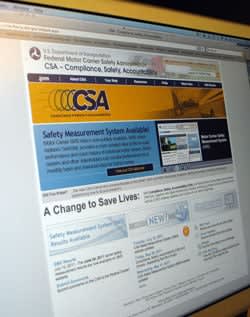
The advisory committee that is preparing recommendations on the CSA enforcement program for the Federal Motor Carrier Safety Administration has a dense thicket to chop through.
The complexities and contradictions of CSA were on full display yesterday as a subcommittee of the Motor Carrier Safety Advisory Committee took in testimony from the analysts who designed the program and researchers who have enumerated its flaws.
The committee, a group of stakeholders appointed by the agency to advise on regulatory and program matters, is charged with producing recommendations on how to resolve the numerous problems that have surfaced during the past two years of CSA implementation.
Yesterday's presentations did not contain new information about CSA, but they did give the panel's members a chance to query key researchers on the details and shortcomings of the program.
The prominent issues have been have been discussed in detail in a range of venues, from congressional hearings to commentary in the rulemaking docket.
The panel members talked about such problems as the quality of the data that underpins the CSA system, the variable accuracy of the systems predictions of crash risk, and how shippers and brokers misunderstand and misuse the system.
It was evident that the subcommittee will struggle to resolve the question of crash accountability.
Trucking interests believe that FMCSA needs to find a way to measure fault in the crashes that show up in the CSA database.
Robert Petrancosta, vice president of safety for Con-way Freight, said the data in CSA is not useful to him if it does not indicate fault.
"How do we train to that?" he said. "Wouldn't you rather me dedicate my resources to a problem we can fix, rather than just correct a score?"
But safety advocates on the panel are concerned that the process of adjusting for fault might sully the data with subjective judgments about the quality of police accident reports. John Lannen, executive director of the Truck Safety Coalition, said he is concerned that in the process of assigning fault the police report will be misinterpreted.
The agency has a research program under way to address crash accountability. Its report is due next summer.
Additional perspective emerged yesterday when the American Transportation Research Institute unveiled a study that looks at CSA's benefits and drawbacks.
The Institute, an arm of American Trucking Associations that has authored several important analyses of CSA, found that CSA has not caused the wholesale loss of drivers that had been predicted.
Only a small fraction of current drivers have been put out of work by CSA, the study found. On the other hand, CSA and another program, Pre-employment Screening, have had a significant impact on the hiring of new drivers.
The programs are helpful in screening out undesirable drivers but they also have made it more difficult for carriers to find drivers, the Institute reports.
Two other points about drivers: CSA has prompted carriers to offer financial incentives for good performance, which promotes safety compliance; and most drivers are not taking the initiative to learn about CSA.
"A more targeted learning approach is necessary for drivers," the Institute says. It is up to "informed stakeholders" to reach out to drivers, rather than wait for the drivers to act. Drivers are motivated to learn, but its hard for them to find the time to access the material.
Carriers, on the other hand, are actively engaged -- 96% access their CSA data at least once a month and try to use it to improve their performance, the Institute reports.
One ongoing concern, the Institute found, is the perception among carriers that FMCSA is not responding to their concerns about CSA.
Just 14% of carriers in the survey were satisfied with the agency's responsiveness. But counterbalancing that is an improvement from 2011 to 2012 in carrier perception that CSA would harm their ability to stay in business.
"This suggests CSA has not presented as many obstacles as expected," the report says.
The Institute also looked at CSA's impact on the relationship between carriers and shippers. It found that, as is the case with drivers, the impact was stronger on new relationships than on existing ones.
Shippers are more inclined to stick with a carrier that has higher CSA scores, than to choose a new carrier whose scores are high.
The survey also found that the enforcement community has the most favorable perception of CSA, although more training and education are needed.
It adds up to a growing perception in the industry that CSA is a long-term project.
"The program did not immediately result in a mass exodus of drivers or dramatically exacerbate shipping and operational costs," the Institute said. "Still, the program remains a work in progress and will continue to draw criticism until persistent flaws are addressed."
And those flaws are where the advisory panel comes in. The CSA subcommittee meets next in February to consider recommendations from its members on how to address CSA issues.
More Fleet Management

Color Match Smarter: Tools That Restore & Perform
For fleet managers and collision repair professionals keeping heavy-duty trucks on the road, getting the color right the first time isn't just about appearance — it's about efficiency, turnaround time, and bottom-line results. Discover how today's digital color tools are transforming the repair process from guesswork to precision.
Read More →
FMCSA Pauses Biennial-Update Enforcement Amid Motus Transition
Carriers whose updates were due on or after June 1 have more time, while FMCSA works to stabilize its new registration system and warns of phishing sites impersonating its new carrier registration system, Motus.
Read More →
2026 Blueprint for Countering Smarter Supply Chain Theft
Cargo theft is no longer just the cost of doing business. It's a multi-billion-dollar criminal enterprise exploiting vulnerabilities across your fleet, drivers, and supply chain.
Read More →


How Telematics Improves Visibility, Control, and Performance in Refrigerated Fleets
Explore how telematics help refrigerated fleets improve visibility, uptime, efficiency, compliance, and cargo protection across connected cold chain operations.
Read More →
What the U.S.-Canada Trade War Means for Trucking
Escalating U.S.-Canada tariffs could disrupt cross-border freight, reduce truck volumes, raise costs, and create new uncertainty for carriers on both sides of the border.
Read More →
What Are Trucking’s Top Concerns for 2026?
The American Transportation Research Institute wants to know what's worrying trucking fleet managers, drivers, and other stakeholders in its annual Industry Issues survey.
Read More →
American Trucking Associations Looks for a New Leader
ATA President and CEO Chris Spear abruptly left his job at the association on August 21, at a pivotal time for the trucking industry.
Read More →
Public Wi-Fi Cybersecurity Risks: How Truck Drivers and Fleets Can Protect Their Data
Public Wi-Fi can expose truck drivers and fleets to credential theft, malware, and other cyber threats. Here’s how to reduce the risk on the road.
Read More →
For Nicky Cupp, Fleet Innovation Starts With Frustration
HDT Truck Fleet Innovator Nicky Cupp turns everyday pain points at Fraley & Schilling into opportunities for better technology and smarter processes.
Read More →
Adam Buttgenbach’s Approach to Electric Trucks: Start With Where They Fit
HDT Truck Fleet Innovator Adam Buttgenbach helped PepsiCo build one of North America’s largest EV fleets by focusing on where electric trucks make operational sense.
Read More →