




Con-way Truckload's Strategies for Success
When you have 2,600 trucks and nearly 3,000 professional drivers on the road you need to make sure that not only are your clients’ products making it to their destination on time, but that they are also making it there safely.

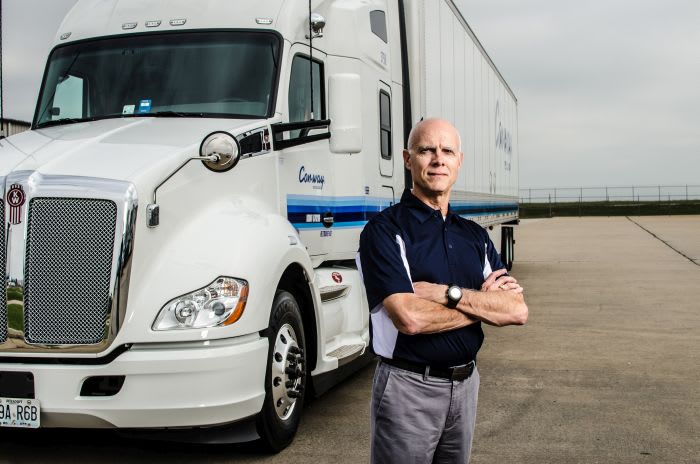
Albert Johnson, Con-way Truckload's vice preisent of human resources, works from the company's Joplin, Mo., headquarters: Photo by Drew Kimble, 12 Eighty-One Photography.
Albert Johnson, Con-way Truckload's vice preisent of human resources, works from the company's Joplin, Mo., headquarters: Photo by Drew Kimble, 12 Eighty-One Photography.
When you have 2,600 trucks and nearly 3,000 professional drivers on the road, when routing, maintaining, and managing them, you need to make sure that not only are your clients’ products making it to their destination on time, but that they are also making it there safely.
This, according to Albert Johnson, is the key to success that Con-way Truckload has enjoyed for more than 50 years.
“At Con-way Truckload we are driven by our core values of safety, integrity, commitment and excellence. We create a safe and positive work environment where people are encouraged to grow. Guided by our principles, we maximize shareholder value, exceed expectations and provide customers with best-in-class service,” recited Johnson, Con-way Truckload’s vice president of human resources, as he read over the company’s mission statement from the company’s Joplin, Mo., headquarters.
When anyone reads this same statement on the company’s website, Johnson hopes people understand that Con-way Truckload’s employees are dedicated to providing value to its customers — “that we’re here for our customers,” he says.
Strategy No. 1: World Class Safety
Safety is not something that Johnson and the rest of Con-way Truckload’s executive team decided was suddenly important one day. “World class safety is at the foundation of how we do business,” Johnson explains.
The importance of safety has become a core tenant in what Johnson refers to as the company’s “house.”
“Our house has our vision, mission and strategic objectives, and we have four rooms in our house: world class safety, customer satisfaction, driver focus, and yield and utilization,” Johnson says. Con-way Truckloads executive team decided that these four rooms were all interrelated.
“First off, you’ve got to have a driver to drive the truck, and they have to be motivated to be safe when they’re out on the road to pick up our customers’ freight and deliver our freight. Then, hopefully, we’re doing that right, so that in the end we make money and can be an ongoing, sustainable organization.”
Johnson and the Con-way Truckload employees — particularly the professional drivers — are faced with the driving public every single day. Over the years, the company has put more focus on safety, which has been helped by the advent of certain technologies, such as rear collision avoidance, anti-rollover and lane departure systems.
“There’s all sorts of systems that are available from a technology perspective to help ensure that we’re being safe out there, number one, and to be able to coach our drivers with regards on how to be safe. Then, secondly, just to show us what’s out there on the road today.”
Con-way Truckload also utilizes temporary training cameras to enhance the coaching period for its student drivers. “As we go, we measure and we identify,” Johnson adds. “We’re always looking for continuous improvement opportunities by taking a look at all the information that’s being provided from that technology to see how we want to proceed.”
Strategy No. 2: Finding the Best Drivers
Con-way Truckload utilizes a two-fold strategy to bring more people into the commercial driving industry. First, they attempt to uncover new sources for potential drivers.
“We go fishing in some new ponds, so to speak, where we have not fished before,” Johnson explains. “For example, we look at high unemployment rates in specific geographic areas.”
Johnson and his team go out into these types of communities and introduce truck driving as a career for this available pool of workers. In some cases, Con-way Truckload will put prospective employees into the company’s student training program, which is how Johnson is filling many of the trucks today. “Not to say that we’ve given up on the experienced driver because we still do hire drivers with experience, but I think for those companies that want to be viable in the future, they have to build their own workforce,” he says.
For Johnson, it’s multi-faceted. If a driver is hired directly out of a school, they attend a week-long orientation. From there, the newly trained drivers are placed in a Con-way Truckload truck with a driver trainer that he calls a “finisher.”
“They’re with that finisher for a minimum of 7,500 miles, with the student doing most of the driving,” Johnson says. “The experienced driver, the finisher, is actually coaching that new student driver on how to drive better.”
But, it’s not just about driving, it’s also about learning the systems and processes as they relate to Con-way Truckload. After passing both a driving test and a written upgrade test, these new drivers are promoted into their own truck, which are equipped with the temporary training cameras. The driver is then coached for a minimum of four months.
Con-way Truckload also offers a tuition reimbursement program where applicants, receive assistance to attend a professional driving school before they are placed in the “finisher” program.
Strategy No. 3: Training the Best Drivers
Even with all the initial training that Con-way Truckload drivers receive, combined with the ongoing experience they build with each mile on the road, Johnson and his team require annual Smith training, a widely used training program that Con-way Truckload driver trainers are certified on every other year to maintain the highest level of safety.
Drivers are able to train in multiple locations across the country, which can make it easier with the constant movement of Con-way Truckload trucks coast to coast. Online training resources are also available, especially if drivers are on the road and cannot find a location they can visit.
“There’s four generations of drivers in the workplace today,” Johnson says. “The younger generation has a tendency to learn better online. The older generation wants a hands-on type experience in training. It’s not one size fits all. It’s really what’s best for that individual.”
A positive attitude also goes a long way, according to the Con-way Truckload code, which can be crucial for Johnson since he does not want anyone on the road that has a negative attitude impacting the way they drive.
“They also have to be customer-focused,” he continues. “Our drivers are the face of our company, so they have to be able to interact with all sorts of different people — from the shipping department to all our dispatchers and all our office personnel.”
Drivers also have to maintain a good appearance for that same reason, which includes striving for a healthy lifestyle.
“In this industry, you’re in and out of your truck, and it’s not just hopping into car. You have to climb up into the trailer or you have to climb up into the truck, or you might have to bend underneath; it’s a physical job,” Johnson says.
To guarantee that Con-way Truckload drivers are healthy drivers, each employee must pass a fitness test that mimics what the driver physically does each day on the job: bending, stooping, lifting, climbing, and so on.
Drivers also have access to health resources that the company pays for, which can provide assistance in monitoring diabetes and high blood pressure, as well as sleep apnea, with the goal of achieving improved health. There is even a program to help drivers quit smoking.
“We’re trying to help drivers live a better lifestyle,” Johnson says.
Strategy No. 4: Selecting and Maintaining High-Quality Vehicles
When the Great Recession hit in 2009, Con-way Truckload, like most companies, looked for ways to cut costs without cutting employees. The first step in this process was extending the replacement cycle for company trucks.
“We had to save money, so we didn’t replace trucks during that cycle,” Johnson says. “Now we’re back on that cycle of three to four years to get new equipment on the road, averaging a fleet age of 2.1 years.”
According to Randy Cornell, vice president of maintenance and asset management for Con-way Truckload, the company replaces its tractors at 4 years or 500,000 miles. “New tractors are less costly from an ongoing maintenance perspective because they are within warranty and the newer trucks have improved MPG, which supports our sustainability efforts.”
When it comes time to decide on new models, a number of parties are involved in the process, including the professional drivers. Con-way Truckload contacts the OEMs, who bring the prospective models to the company’s different facilities, including terminals up in Taylor, Mich., and West Memphis, Ark., and Lancaster and Laredo, Texas
“We get what we call the voice of the customer, which is our drivers, and ask them their thoughts with regards to the type of equipment,” Johnson says, adding that in many cases, it is the creature comforts within the cab itself that can steer a driver’s opinion to a certain truck model.
According to Cornell, systematic inspections are performed at each and every preventive maintenance service to ensure that the new vehicles continue to perform as well as the day they were purchased.
As an added layer of protection, every truck coming through the Joplin terminal gets a full, front-to-back, top-to-bottom inspection to ensure any needed repairs are identified and completed.
The company’s maintenance facility at its Joplin headquarters houses 106 technicians. When maintenance needs to be performed, Cornell routes the vehicles through the facility whenever possible.
“We also have a partnership with our sister company, Con-way Freight, where they will also perform preventive maintenance,” Johnson says, adding that if that doesn’t work while out on the road, the company partners with a third-party maintenance provider.
Strategy No. 5: Assessing Future Changes
While some companies are rushing to ride the green wave of alternative fuels, Con-way Truckload is taking a more measured approach, thoroughly testing new technologies when available. While there are options for medium- and heavy-duty alternative-fuel vehicles, one of the most important parts of the equation is missing according to Johnson.
“It’s an infrastructure issue for us. Our trucks are in all 48 states and you just don’t see the infrastructure built to be able to provide that today, and our trucks don’t stay in one place. They can be in Portland yesterday and in Texas tomorrow. It’s almost impossible in today’s environment to be able to do that. Now, as the infrastructure gets built up, that’s a totally different story,” Johnson explains.
“Our focus is really on aerodynamics and driver behavior, because how a driver shifts a truck is important, how much idling that the driver does — because it is their home on the road — and how many out-of-route miles that they drive.”
Due to the increased use of aerodynamic improvements to the trucks, including the addition of undertrays, side skirts and tails, Con-way Truckload reports that the fleet is seeing an increase in miles per gallon.
But, while Con-way Truckload is currently cautious about trying alternative-fuel vehicles, when it comes to the impending federal electronic logs mandate, the carrier is ahead of the curve. Con-way Truckload has already been in compliance with the mandate for the past three years.
“Number one, the writing’s on the wall,” Johnson says. “Number two, it’s the right thing to do simply from a safety perspective. If drivers are on the road longer than what they’re allowed to drive by law, they are most likely going to be tired or distracted and have the opportunity for a crash, and we don’t want that.”
While Johnson admits that Con-way Truckload was not the first one to comply with the mandate, the company has the buy-in from the most important piece of the puzzle — the drivers. “Our drivers were supportive of the e-log implementation,” he says. “I think drivers found that they could actually increase the amount of time they could drive legally because they can manage their time better on the onboard computer systems, versus with a paper log.”
Admittedly, it is not a perfect system, according to Johnson, but it is a fair and accurate system to help both the company and drivers manage resources.
While Johnson and his team at Con-way Truckload utilize a number of different strategies to ensure the smooth, safe and secure transport of their clients’ products, the most basic principle of all is at the core of the company’s ideology — and is echoed by Johnson and the fleet team: “We have people that are dedicated to providing value to our customers; we’re here for our customers.”
Editor's Note: This article was originally published in Leading Fleets magazine. Click here for the digital edition.
More Fleet Management

What the U.S.-Canada Trade War Means for Trucking
Escalating U.S.-Canada tariffs could disrupt cross-border freight, reduce truck volumes, raise costs, and create new uncertainty for carriers on both sides of the border.
Read More →
What Are Trucking’s Top Concerns for 2026?
The American Transportation Research Institute wants to know what's worrying trucking fleet managers, drivers, and other stakeholders in its annual Industry Issues survey.
Read More →
American Trucking Associations Looks for a New Leader
ATA President and CEO Chris Spear abruptly left his job at the association on August 21, at a pivotal time for the trucking industry.
Read More →
Public Wi-Fi Cybersecurity Risks: How Truck Drivers and Fleets Can Protect Their Data
Public Wi-Fi can expose truck drivers and fleets to credential theft, malware, and other cyber threats. Here’s how to reduce the risk on the road.
Read More →
For Nicky Cupp, Fleet Innovation Starts With Frustration
HDT Truck Fleet Innovator Nicky Cupp turns everyday pain points at Fraley & Schilling into opportunities for better technology and smarter processes.
Read More →
Adam Buttgenbach’s Approach to Electric Trucks: Start With Where They Fit
HDT Truck Fleet Innovator Adam Buttgenbach helped PepsiCo build one of North America’s largest EV fleets by focusing on where electric trucks make operational sense.
Read More →
Deen Albert: Let Automation Do the Math, People Make the Decisions
HDT Truck Fleet Innovator Deen Albert makes sure people are still at the heart of operations at Grand Island Express, even while adopting artificial intelligence tools. AI-assisted dispatch helped boost revenue 25% with the same number of trucks.
Read More →
Trimble’s New AI Agent Takes Aim at Fleet Back-Office Busywork
Arc Agent works across Trimble TMS products to automate repetitive tasks such as freight orders, maintenance, invoices, fuel costs and more.
Read More →
How HDT’s 2026 Truck Fleet Innovators Are Rethinking Fleet Operations
Meet five trucking leaders who are challenging assumptions, solving operational problems, and putting innovative ideas to work.
Read More →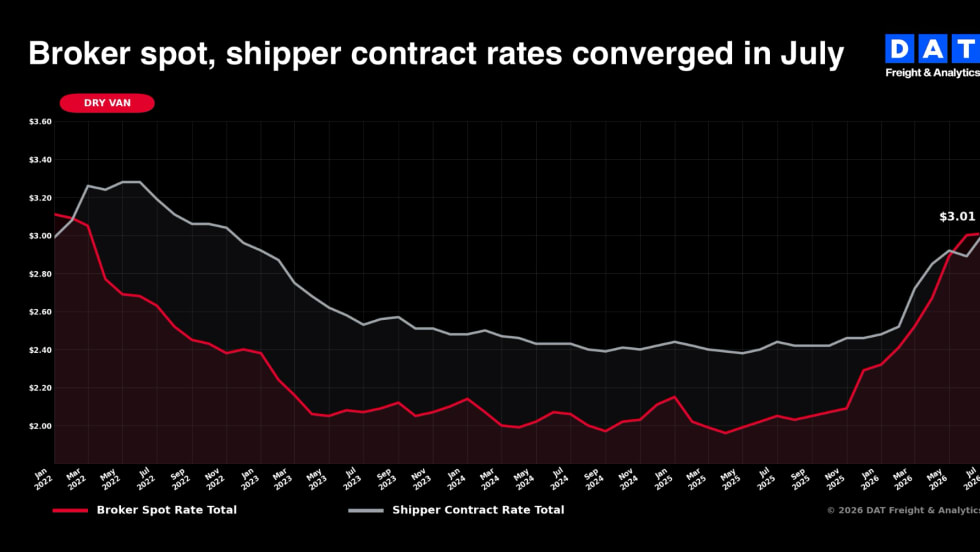
Tight Trucking Capacity Pushes Rates Higher Even as Freight Volumes Fall
“Spot rates moving ahead of contract rates have historically signaled a tightening market, but we haven’t seen a capacity-driven market quite like this one,” said DAT's Dean Croke.
Read More →