




Commentary: What Tonnage, Carloads and PMI Mean for Freight Demand
Understanding the relationship between truck tonnage and railroad carloads, as well as the importance of the Purchasing Managers’ Index in forecasting the direction of truck tonnage.

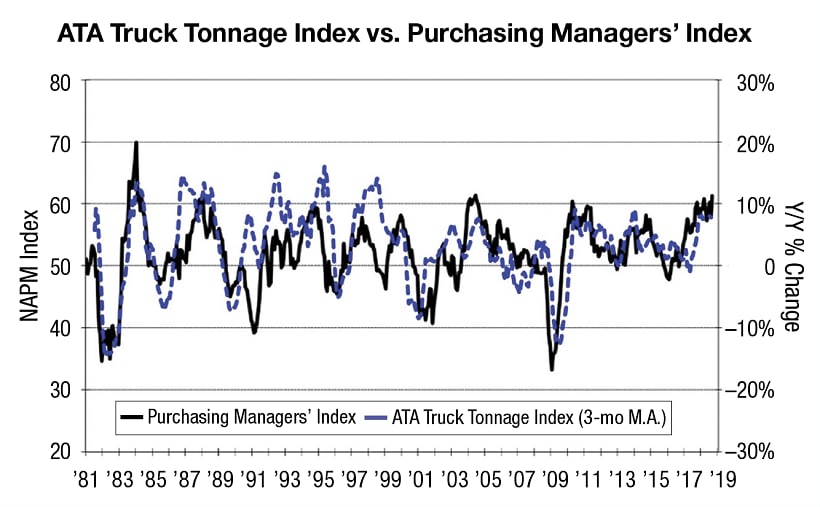
Source: Association of American Railroads and American Trucking Associations
Last month, we introduced the importance of corporate profits as a driver of equipment demand, and the ability of industrial production statistics to help give us a view of where those profits were headed. We also introduced the importance of railroad car loading reports as a real-time read on industrial production trends. This month, given the uncertainty in the stock market about the staying power of this freight market, we’re putting off the “where are we in the cycle update” and will instead talk more about the relationship between truck tonnage and railroad carloads, as well as the importance of the Purchasing Managers’ Index (PMI) in helping forecast the trending direction of truck tonnage.
The American Trucking Associations’ monthly truck tonnage index (non-seasonally adjusted) seems to have reasonably strong predictive value on a two- to three- month lag on where rail carloads may be headed. This makes sense when you consider that truck-related movements tend to represent final sales, while rail carloads tend to be part of the intermediate manufacturing process.
However, what we note in the graph below is that truck tonnage growth tends to be a follower of changes in the Institute for Supply Management’s PMI. What can the ISM’s monthly reports tell us about potential demand for truck services? Plenty! ISM also goes so far as to discuss regional economic strength, industry strength, and also measures interest in new order activity, inventories, and prices – all important factors in determining freight-related demand.
In the ISM’s September report (released Oct. 1), the headline figure was 59.8%. What is important to understand is that this is a sentiment index. It’s a monthly survey sent to more than 400 freight executives, focusing on five areas: new orders, inventory levels, production, supplier deliveries, and employment. The survey asks its respondents if business conditions are getting better, worse, or the same. These responses are graded to an index of 0 to 100, with a reading of 50 representing “no change.” The headline PMI is rarely above 60 or below 40, and we consider the 49 to 51 range to be middling growth. Above 52 we consider growth expectations improving, and below 48, contracting.
So back to 59.8%. This is a strong number historically, and coincides with freight tonnage growth in the mid-to-high single digits (see graph above), but the details of the report paint a broader and more helpful picture of the health of demand for freight services.
Looking behind the numbers, comments from the panel seemed to reflect continued expanding business strength. Demand remains strong, with the New Orders Index at 60 or above for the 17th straight month, and the Customers’ Inventories Index remaining low. The Backlog of Orders Index continued to expand, but at lower levels compared to the previous month. Consumption improved, with production and employment continuing to expand, despite shortages in labor and materials. Continued supply chain inefficiencies are leading to an increased consumption of inventory and a slight expansion of imports. Lead-time extensions, steel and aluminum disruptions, supplier labor issues, and transportation difficulties continue to limit potential activity levels. Respondents noted concerns about tariff-related activity.
Of the 18 manufacturing industries, 15 reported growth in September, with Textile Mills; Miscellaneous Manufacturing; and Plastics & Rubber Products leading the way. The only industry reporting contraction in September was Primary Metals.
Next month: Where we are in the cycle and the third quarter freight earnings update.
Jeff Kauffman has been a recognized transportation authority for almost 30 years, most notably heading freight transportation research for Merrill Lynch. Currently he is managing director for Loop Capital Markets and also heads Tahoe Ventures, a transportation consulting company. He can be reached at jkauffman@truckinginfo.com.
More Fleet Management

Color Match Smarter: Tools That Restore & Perform
For fleet managers and collision repair professionals keeping heavy-duty trucks on the road, getting the color right the first time isn't just about appearance — it's about efficiency, turnaround time, and bottom-line results. Discover how today's digital color tools are transforming the repair process from guesswork to precision.
Read More →
FMCSA Pauses Biennial-Update Enforcement Amid Motus Transition
Carriers whose updates were due on or after June 1 have more time, while FMCSA works to stabilize its new registration system and warns of phishing sites impersonating its new carrier registration system, Motus.
Read More →
2026 Blueprint for Countering Smarter Supply Chain Theft
Cargo theft is no longer just the cost of doing business. It's a multi-billion-dollar criminal enterprise exploiting vulnerabilities across your fleet, drivers, and supply chain.
Read More →


How Telematics Improves Visibility, Control, and Performance in Refrigerated Fleets
Explore how telematics help refrigerated fleets improve visibility, uptime, efficiency, compliance, and cargo protection across connected cold chain operations.
Read More →
What the U.S.-Canada Trade War Means for Trucking
Escalating U.S.-Canada tariffs could disrupt cross-border freight, reduce truck volumes, raise costs, and create new uncertainty for carriers on both sides of the border.
Read More →
What Are Trucking’s Top Concerns for 2026?
The American Transportation Research Institute wants to know what's worrying trucking fleet managers, drivers, and other stakeholders in its annual Industry Issues survey.
Read More →
American Trucking Associations Looks for a New Leader
ATA President and CEO Chris Spear abruptly left his job at the association on August 21, at a pivotal time for the trucking industry.
Read More →
Public Wi-Fi Cybersecurity Risks: How Truck Drivers and Fleets Can Protect Their Data
Public Wi-Fi can expose truck drivers and fleets to credential theft, malware, and other cyber threats. Here’s how to reduce the risk on the road.
Read More →
For Nicky Cupp, Fleet Innovation Starts With Frustration
HDT Truck Fleet Innovator Nicky Cupp turns everyday pain points at Fraley & Schilling into opportunities for better technology and smarter processes.
Read More →
Adam Buttgenbach’s Approach to Electric Trucks: Start With Where They Fit
HDT Truck Fleet Innovator Adam Buttgenbach helped PepsiCo build one of North America’s largest EV fleets by focusing on where electric trucks make operational sense.
Read More →