




Commentary: The Price of a Night's Rest
The ELD mandate may have forced the adoption of more paid, reserved parking, but that doesn’t mean drivers are happy about it. Commentary by Editor in Chief Deborah Lockridge.

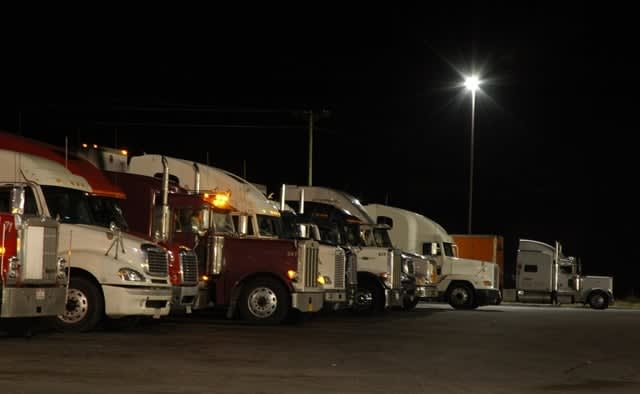
It’s not like we didn’t know that truck parking was going to be a problem with mandatory ELDs. Photo: Jim Park
Photo: Jim Park
While it may be painful in many ways, the electronic logging device mandate does appear to be casting a much-needed spotlight on some long-standing problems, including the hours of service rules, excessive detention time, driver pay – and truck parking.
It’s not like we didn’t know that truck parking was going to be a problem with mandatory ELDs. In the most recent critical issues survey done by the American Transportation Research Institute, the lack of available truck parking was once again in fourth place overall – but among drivers, it moved up to second place.
One problem especially evident in the wake of mandatory ELDs: What do drivers do when they’ve run out of hours while loading or unloading and are now stuck at the shipper or receiver? In the past, they likely would have fudged their paper logs and run over hours long enough to find a safe parking spot for the required off-duty and sleeper time. With that no longer an option, ideally they will be able to park at the shipper or receiver location.
Social media and some trucker apps allow drivers to share information on shippers and receivers, including whether they’re likely to offer out-of-hours truckers a place to park or if they instead run them off. Facilities that want to be a “shipper of choice” for capacity-crunched fleets should pay attention – as should fleets that want to attract and retain drivers.
Another problem is that in many areas of the country, there’s simply a shortage of truck parking. Travel plazas and rest areas fill up fast.
A pilot project in eight Midwest states will soon be using technology to alert truckers along the road about parking available at rest areas. There already are a number of apps to help drivers find parking spaces. And then there’s the option of reserving – and paying – for parking in advance via an app reservation system.
The ELD mandate may have forced the adoption of more paid, reserved parking, but that doesn’t mean drivers are happy about it.

Deborah Lockridge
Photo: HDT File
A couple of savvy owner-operators recently shared opposing viewpoints on the topic of paid truck parking through Freightliner’s Team Run Smart blogs.
Bob and Linda Caffee contend that truck parking should be considered a logical cost of doing business as a trucker. “As time is moving on with the ELD mandate in place, it seems as if the travel plazas parking is more crowded. Many of the rest areas at night are full of parked trucks, often making it impossible to use their facilities so we are back to using the parking lot at the travel plazas to run in and use the restroom and not purchase anything. More wear and tear on a parking lot with no purchase. How much can a travel plaza give away and still be profitable?” And the peace of mind of a reserved spot, they say, is worth paying in advance.
Meanwhile, Jeff Clark takes the opposing view.
“It used to be that if we went to a truck stop, and there was no parking, we could just move on to the next one. The [ELD] mandate has made that harder,” he notes. “Truck stops have every right to charge to park. I have every right to not pay for it… I have been a good customer. I will continue to be a good customer, but for the chains that charge to park, I feel as though I am no longer a valued customer.” He says his first choice is to take his 10-hour break at the customer. His second choice is to find a mom-and-pop truck stop or a restaurant that offers truck parking.
But those free spaces could get harder and harder to find. As one commenter on the Caffee blog said, “I think one of these days, free parking will only be a space on the Monopoly game board.”
Earlier this year, Illinois-based Nussbaum Transportation announced it was adopting a policy of paying all reserved/paid parking, without question, to support drivers in finding safe and legal parking locations.
Why aren’t more companies doing that? If an owner-operator can recognize it as a cost of doing business, fleets should, too.
Related: How ELDs Could Cut the High Cost of 'Crash Harm'
More Safety & Compliance

FMCSA Pauses Biennial-Update Enforcement Amid Motus Transition
Carriers whose updates were due on or after June 1 have more time, while FMCSA works to stabilize its new registration system and warns of phishing sites impersonating its new carrier registration system, Motus.
Read More →
ZF Expands Commercial Vehicle Push in North America
ZF is expanding its North American commercial-vehicle presence with new transmission applications, electrification, trailer technology and autonomous-driving systems.
Read More →
Truck Drivers Need More Than Another Alert
Fleets have more visibility into truck health, safety events, and driver activity than ever. The next challenge is turning all that information into useful guidance for the person who has to decide what to do next.
Read More →
Tesla Wants a Self-Driving Semi. Are Cameras Enough?
Could Tesla’s camera-only autonomous driving technology work on an 80,000-pound Semi? In this commentary, HDT's Deborah Lockridge takes a look at Tesla, Cybercab, and how autonomous trucks see the road.
Read More →
What DOT’s Automated Vehicle Strategy Means for Trucking
The U.S. Department of Transportation issued a new automated-vehicle strategy that outlines plans for driverless-truck regulations, cross-state freight corridors, and federal safety standards.
Read More →
NYC Expands Speed, Pedestrian Safety Tech Across Fleet
New York City is expanding intelligent speed assistance and pedestrian-alert systems across its municipal fleet, moving the technologies from pilot programs into vehicle procurement and retrofit requirements.
Read More →
FMCSA Removes 110 Truck Driver Training Schools from Certified ELDT List
Federal regulators also are targeting more than 160 additional training providers and launching a nationwide audit of third-party CDL skills testers as part of a broader crackdown on trucking fraud.
Read More →
Beyond DOT Compliance: What Makes a Trucking Fleet Truly Safe?
A trucking fleet can follow every rule and still make unsafe decisions. The real test comes when safety conflicts with freight, productivity, or cost.
Read More →
Hours of Service Pilot Programs: FMCSA Readies for 2027 Rollout
Two pilot programs could eventually reshape hours-of-service rules, giving truck drivers options to pause their 14-hour clock or use longer split sleeper rest periods.
Read More →
New Guide Offers Pet Safety Tips for Truck Drivers
Hundreds of thousands of pets travel in truck cabs. A new safety guide from Volvo Trucks and the Center for Pet Safety offers practical advice for truck drivers who bring dogs and cats along for the ride.
Read More →