




Choosing Tires for On and Off the Road
There are still big differences in tire designs for on-highway and off-road tires, but newer designs make it possible to do a little of both.

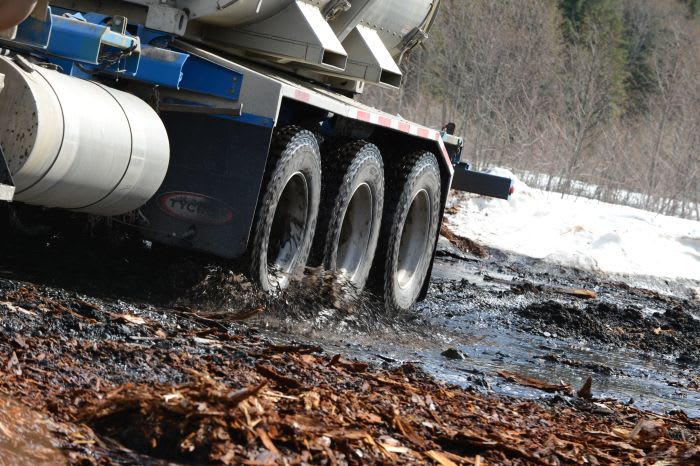
Who knows what you’ll find when the pavement comes to an end. At that point it’s too late to realize that you spec’d the wrong tires.
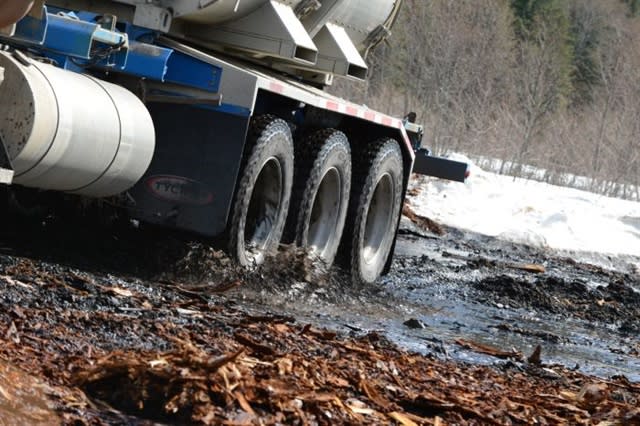
Who knows what you’ll find when the pavement comes to an end. At that point it’s too late to realize that you spec’d the wrong tires.
It doesn’t make sense to ask a plow horse to run the Kentucky Derby, or to a hitch a thoroughbred to a tiller. Yet that’s the sort of choice faced by fleets that operate in mixed on- and off-road service. There’s no straight answer, just a bunch of compromises.
Trucks used in construction, mining, logging and other severe-service, off-road applications often travel across challenging surfaces strewn with rocks, nails and other debris that can cause tire damage. Off-road tires are designed for toughness; resistance to cuts, chips and tears; on- and off-road traction; and long miles to removal. Tires intended for on-highway use are designed a long, fuel-efficient life that is only occasionally threatened by anything worse than a pothole.
So how does a fleet manage the spec’ing decision? It helps to assign priorities to the problem, such as how much time will the truck spend off road, how severe is the terrain it will operate in, and how important fuel economy is compared to the risk of a terrain-induced tire failure or a mission-limiting traction event.
Let’s use as an example a fleet that hauls aggregate, logs, cement or some such commodity from a mill or plant to a customer about 100 miles away. The truck may spend 5% of its time in the plant on rough ground, so the tires will need some traction and cut resistance. But the majority of the time would be spent on highway at highway speed where fuel economy matters.
“If the fleet operates more on-highway than off-road, then they may prioritize fuel economy,” says Matt Schnedler, product manager at Bridgestone. Such a fleet might opt for a lug-type drive tire that still offers decent life and fuel efficiency while providing sufficient traction for milder off-road conditions.
“However, highway tires may not provide the cut/chip resistance or durability needed in more severe off-road applications,” he adds. “Off-road tires are developed with the rigors of this application in mind. The casing design is typically different from a highway tire and the compounds used are more durable for off-road applications.”
If the truck spends half its time on unpaved roads or in gravel or rocks, the tires will take a beating, so more of the design focus has to be on preventing tire and casing damage while providing some enhanced level of traction.
Michelin, for example, offers a line of tires designed for a mix of on- and off-road operation. They have the words X Works or X Force in the tread designations. Tires with the X Works designation are for applications expected to be 80% on-road use and 20% off-road. They have a maximum speed of 65 mph. Tires with the X Force designation are for applications expected to be 20% on-road use and 80% off-road. Some of the “L” or “X Force” designated tires have a maximum speed of 50 mph, while others have maximum speeds of 55, 60, or 70 mph.
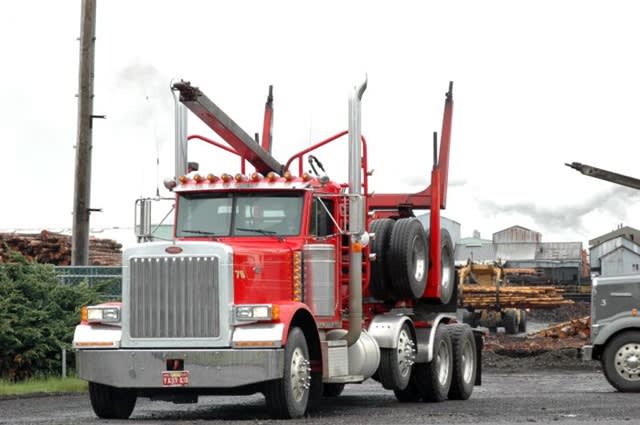
Chances are you’ll miss the traction of a highway tire when running off road more than you’ll miss the fuel economy when running on-highway.
Vocational Applications for Tires
Tires used in vocational applications, such as concrete mixers, dump trucks, utility trucks and the like, are subject to different kinds of stresses. They are more likely to run up against a curb in a city or a large rock on a job site.
They therefore need different sorts of protection and require a different design criteria. Their time at highway speed is likely to be much lower, so fuel efficiency would not be a top concern, while the ability to resist wear and damage from tight turns, curbs and objects embedded in mud would be a higher priority.
“Vocational fleets – like all fleets – are ultimately looking for tires that help them lower their operating costs,” suggests Brian Buckham, general manager, product marketing at Goodyear. “When you boil it all down, that’s what they want. So regardless of vocation, application and wheel position, we believe it is important to achieve the right balance between toughness, wear and fuel efficiency — or as we call it, the performance triangle.”
In the past, when one benefit, such as low rolling resistance, in a particular type of tires was optimized, the other benefits of the performance triangle were reduced. This dynamic is much less prevalent these days. Buckham says Goodyear is constantly developing technologies and designs to expand and enhance the elements of the performance triangle, so fleets can get off-road toughness as well as on-highway performance.
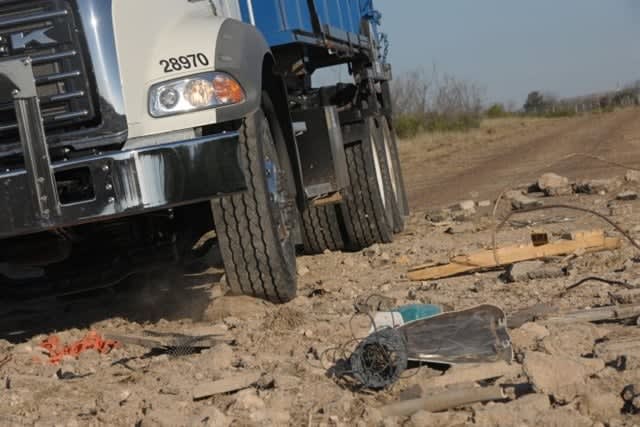
The risk of casing damage is as great as a puncture in some off-road situations. Destroy the casing and you lose the tire for retreading.
“We also recognize that as fuel efficiency regulations continue to tighten with the GHG Phase 2 rule beginning in 2021, the need for tires that deliver reduced rolling resistance and enhanced fuel economy will only grow,” he says. “Goodyear is developing tires that help fleets reduce their fuel consumption, but continue to perform well in on- and off-road conditions.”
For example, Goodyear’s G731 drive tire looks a bit like a closed-shoulder highway drive tire with a center group of lug treads. The tread compound, however, is more resistant to chipping, cutting, and chunking, while offering more miles to removal than the tire it replaced, the company says. The G731 is also available, as are other models, with Goodyear’s patented DuraSeal Technology, which can automatically seal puncture wounds up to a quarter of an inch in diameter in the repairable area of the tire’s tread.
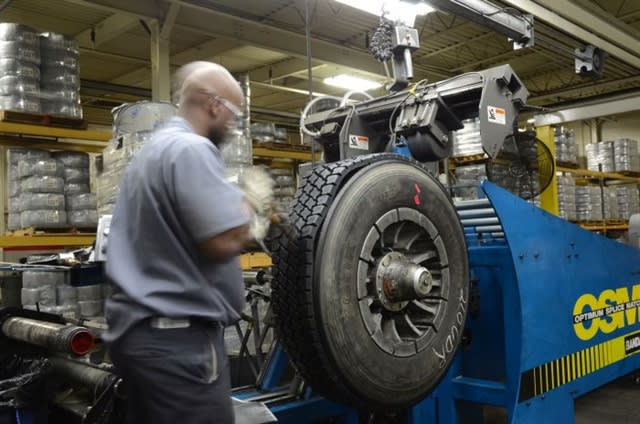
Retreads come in a variety of tread designs suitable for any application.
Exposure analysis
Proper tire selection depends on the time spent in off road applications and the condition of the road surfaces. Once the conditions of use are known, then the tire with the correct balance of performance criteria can be chosen.
Bridgestone’s Schnedler recommends fleets work closely with their tire dealer or manufacturer’s field service reps to establish benchmarks and get insight into best practices from other fleets in similar segments.
“Fleet managers can tap the knowledge and support of dealers and tire manufacturers to tailor the most efficient and cost-effective tire-management practices for their companies,” Schnedler says.
Fleets also can take advantage of the data-gathering capability of built into many tire maintenance and tire pressure monitoring apps and tracking programs, such as Goodyear’s Tire Trac online tire management tool.
“Tire Trac monitors tire installations, the performance of tires in the field or on the road, reasons why tires were removed from service, and other key metrics,” Buckham says. “Tire Trac also helps fleets identify tire maintenance opportunities, which can result in real savings, and many fleets use Tire Trac to compare performance data with similar fleets, as well.”
Data is gathered through fleet surveys conducted by trained tire service technicians who perform on-site inspections, measuring tire inflation levels, tread depths and other aspects of a tire’s condition. The captured information is used to create customized reports that show how a fleet’s tires are performing, which allows fleets to zero in on a specific tire or look at all of the tires across their operation. Fleets can compare cost-per-mile from location to location, and also identify systemic trends, Buckham says.
So choosing the right tire for the application no longer has to be a roll of the dice. Data analysis can help determine the safest compromises while getting the best possible tire life and performance in even difficult situations.
More Equipment
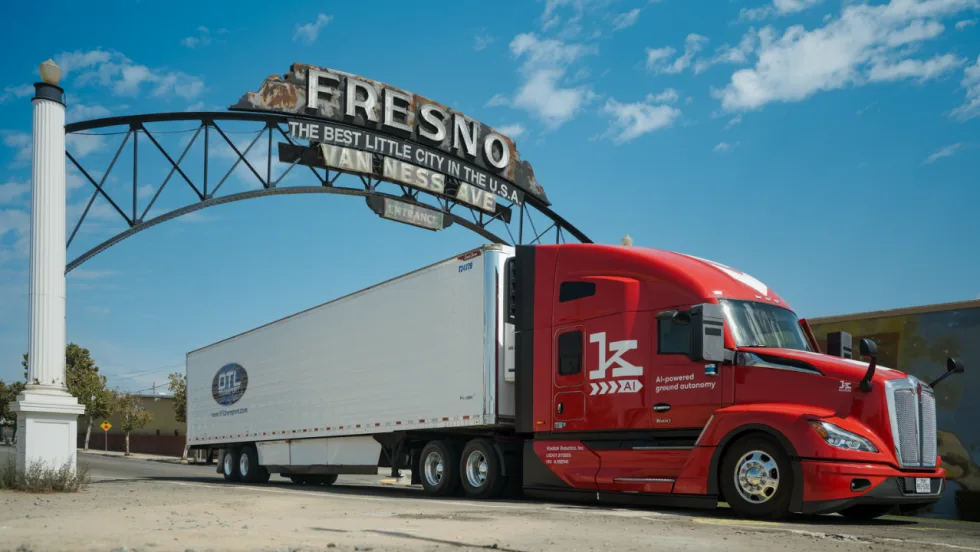
Kodiak Hauls Produce in California Autonomous Truck Pilot
Kodiak AI and DTL Transport have begun hauling produce between Fresno and Los Angeles under California’s new rules for testing heavy-duty autonomous trucks. A safety driver remains behind the wheel.
Read More →
Used-Truck Remarketing Math Is Changing
Used-truck value is no longer just a concern at trade-in. Decisions made throughout a truck’s first life can influence what it’s worth years later.
Read More →
How Volvo Updated Its D13 for EPA 2027 [Watch]
Volvo’s updated D13 promises lower emissions without sacrificing performance or fuel economy. Take a closer look at what changed inside the engine in this HDT Spotlight video.
Read More →
Michelin Tire Improves Efficiency and Durability for Regional Fleets
The Michelin X Multi Energy D2 is a regional haul drive tire engineered to help fleets improve fuel efficiency, durability and traction in demanding stop-and-go operations.
Read More →
ZF Expands Commercial Vehicle Push in North America
ZF is expanding its North American commercial-vehicle presence with new transmission applications, electrification, trailer technology and autonomous-driving systems.
Read More →
Tesla Wants a Self-Driving Semi. Are Cameras Enough?
Could Tesla’s camera-only autonomous driving technology work on an 80,000-pound Semi? In this commentary, HDT's Deborah Lockridge takes a look at Tesla, Cybercab, and how autonomous trucks see the road.
Read More →
Kodiak: Driverless Long-Haul Truck Launch on Track for 2026
Kodiak AI says its driverless long-haul safety case is 93% complete and it remains on track to begin commercial operations by year-end 2026.
Read More →
What DOT’s Automated Vehicle Strategy Means for Trucking
The U.S. Department of Transportation issued a new automated-vehicle strategy that outlines plans for driverless-truck regulations, cross-state freight corridors, and federal safety standards.
Read More →
East Coast Port Launches $45M Electric Truck Push
The Port Authority of New York and New Jersey announced millions in incentives for zero-emission drayage trucks, yard tractors, and new charging hubs near the port.
Read More →
PlusAI Going Public to Fund Autonomous Truck Launch
A SPAC deal could provide PlusAI with up to $300 million as it works toward a 2027 commercial launch of factory-built autonomous trucks.
Read More →