Securing loads is a matter of safety and good business. If a piece of cargo is damaged because it shifts or falls off a trailer, the carrier and driver won’t be paid because the load didn’t get delivered, and someone could get hurt or killed.
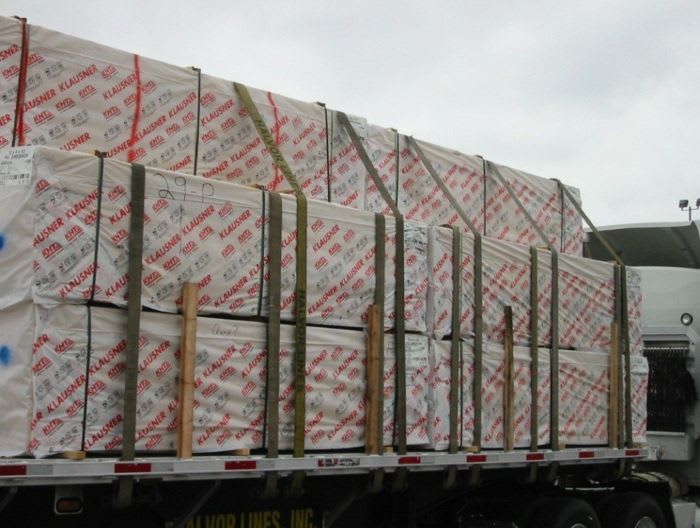
Belly strapping: The lower stack of this load was secured before the top stack was placed aboard and tied down. There are more than enough straps to satisfy safety and regulatory demands.
Photo: Commercial Vehicle Safety Alliance
5 min to read
Proper cargo securement is crucial for ensuring safety on the road.
Shifting or falling cargo can lead to financial losses for carriers and drivers.
Inadequate securement of cargo poses a risk of injury or death.
*Summarized by AI
Securing loads is a matter of safety and good business. If a piece of cargo is damaged because it shifts or falls off a trailer, the carrier and driver won’t be paid because the load didn’t get delivered, and someone could get hurt or killed.
Ad Loading...
Keeping loads in place during transit is the aim of federal Part 393 regulations governing how items are to be blocked, braced or tied down on flatbeds and inside vans and refrigerated trailers – and on the tractor, for that matter. On a truck that’s moving, will the load stay put during turns and sudden stops?
What do inspectors look for in safety violations?
Ad Loading...
“Make sure you have enough (securement) straps for the weight of the load,” says Kevin Tomlinson, director of maintenance at South Shore Transportation, a flatbed carrier based in Sandusky, Ohio.
“We do a lot of belly strapping [on the first tier of the load] and then more on top. They check loads for having enough straps, and that they’re not frayed. The enforcement officers look for that kind of thing.”
What About Tie-Down Ratings?
The combined ratings of all the straps or chains must equal at least one-half the load’s total weight, says Kerri Wirachowsky, director of roadside inspection programs for the Commercial Vehicle Safety Alliance, and a 26-year veteran of enforcement work with the province of Ontario’s Ministry of Transportation.
If the load is 40,000 pounds, all the tie-downs together must equal at least 20,000. There are further rules for blocking dense cargo.
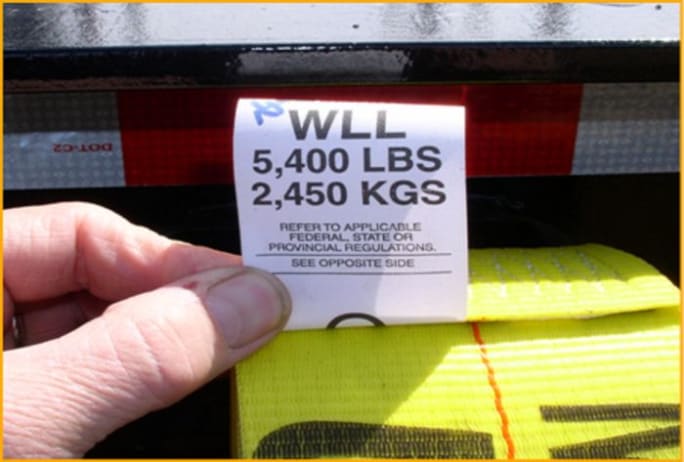
A strap’s WLL, or working load limit, must be visible and readable or it’s not legal in Canada. In the U.S., inspectors will downgrade an illegibly labeled strap based on size and type.
Credit:
Commercial Vehicle Safety Alliance
“In Canada, the working load limit (WLL) must be visible and readable, printed, stamped or embossed on the strap tie down,” she says. “If it’s not readable, if it’s old or sun faded, in Canada, it’s given a rating of zero and treated like it’s not there. In the U.S., the tie-down is defaulted and given a WLL based on its size and type.
Ad Loading...
“On chains, every foot there’s a manufacturer’s mark cast in. This translates to a working load limit as listed by size in a table in the regulations. But on old, rusty chains, it’s sometimes hard to find.
"I have looked at rusted chains, all up and down, trying to find a mark. ‘Just one, that’s all I need,’ I’ve said, and have asked drivers to look for a mark. If we can’t find it, I can’t give the chain the WLL that it might deserve.”
As with straps, chain ratings must equal at least one-half the weight of the cargo. Heavy equipment over 10,000 pounds requires direct tie-downs, and a minimum of four per piece, though carriers tend to use more, Wirachowsky says. In some cases, carriers will use larger chains with a higher rating than the common 3/8-inch size.
Void filler braces the paper roll against the sidewall’s scuff plate and keeps the load from shifting during turns.
Photo: Commercial Vehicle Safety Alliance
What About Strap Placement?
On flatbed trailers with no header board carrying lighter cargo, like fiberboard and drywall or general freight on pallets, two straps must be placed in the first 10 feet (about 3 meters in Canada), and one for every 10 feet after that, she says.
Weight and friction tend to keep loads from moving across a trailer’s deck, and the first stack of cargo helps keep the second in place if they’re butted together. If so, a strap every 10 feet on the second stack suffices; if a second stack of cargo is not butted against the first, the second still needs the initial two straps, plus the others.
Ad Loading...
“Miscellaneous metal articles or individual pieces of lumber are sometimes inserted in a larger portion of a load,” she says.
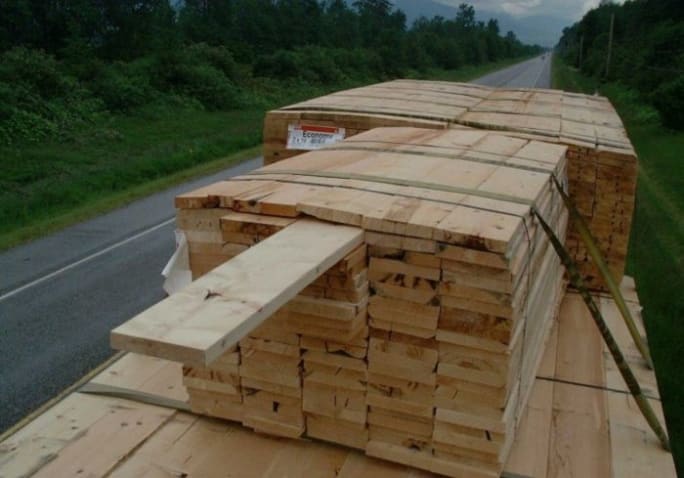
“If there’s something like a board or rebar inside some lumber that has no downward pressure to keep it in place, it’s not secured,” and it’s not legal, and the vehicle will be placed out of service.
In all cases, chains and straps face limits on cuts and breaks as defined in a Defect Classification Table in the CVSA guidelines. Be sure tie-downs are in good condition.
Specifics in Vans & Reefers
In vans, dense items such as rolled paper and metal coils have specific securement requirements. General freight needs to be protected from shifting, and that can be done with bracing, blocking, void fillers or friction mats. If a van or reefer is loaded right to the walls, then it can’t move.
But walls of some vans flex, so load-lock poles placed against the walls can lose their grip and fall, allowing cargo to tip and tumble. If the pole ends lock into logistics tracks, then poles will stay put and loads are likely to stay in place.
Ad Loading...
Hanging on by a thread: This is an extreme example of strap damage. More common are slight cuts which might or might not be acceptable, according to CVSA inspection guidelines.
Photo: Commercial Vehicle Safety Alliance
“Enforcement of van requirements will vary by jurisdiction, and inspectors may or may not open a van trailer’s doors,” Wirachowsky says.
“Officers may look inside if documents say there are metal coils, rolled paper or light vehicles, for which there are specific requirements, or if there’s hazardous materials in there. All hazmat has to be blocked or braced or tied down to prevent release of hazardous substances. If they’re not blocked and braced, the truck is out of service.”
Who’s responsible for securing loads in van or reefer trailers?
“In a loaded and sealed van, it should be on the shippers,” she continues. “Drivers may be told they can’t break a seal to look at the sealed load.
"But on the side of the road, it’s the driver and the company that are responsible, even though the shipper is the one that put it in there. If driver signs off on a load, there’s a lot of faith put in the shipper. If the driver feels the load is not secured, he has the right to refuse the load, or at the very least, call his company” for instructions.
Ad Loading...
What About When it’s Not Cargo?
In recent years, safety authorities in the United States and Canada have looked more closely at what’s hanging on the tractor and under the trailer, from wooden dunnage to ladders to oil jugs, and how it’s all secured.
State and provincial members of the CVSA have decided that common rubber bungee cords or tarp straps are not sufficient as tie-downs because they carry no load ratings, and might or might not keep items from falling onto the pavement and causing accidents.
A long board inserted in the lumber stack appears to have little downward pressure on it, so is not sufficiently secured. It should be separately tied down.
Photo: Commercial Vehicle Safety Alliance
A truck can be placed out of service if a bungee or tarp strap is the primary thing keeping an object from falling off a vehicle – a fuel can or oil jug on the cat walk behind the cab or sleeper, for instance. If an item is wedged in place, like between a saddle tank and the frame, and would stay there if the bungee were removed, then it’s probably OK. But officers have discretion in such matters.
Carriers whose updates were due on or after June 1 have more time, while FMCSA works to stabilize its new registration system and warns of phishing sites impersonating its new carrier registration system, Motus.
ZF is expanding its North American commercial-vehicle presence with new transmission applications, electrification, trailer technology and autonomous-driving systems.
Fleets have more visibility into truck health, safety events, and driver activity than ever. The next challenge is turning all that information into useful guidance for the person who has to decide what to do next.
Could Tesla’s camera-only autonomous driving technology work on an 80,000-pound Semi? In this commentary, HDT's Deborah Lockridge takes a look at Tesla, Cybercab, and how autonomous trucks see the road.
The U.S. Department of Transportation issued a new automated-vehicle strategy that outlines plans for driverless-truck regulations, cross-state freight corridors, and federal safety standards.
New York City is expanding intelligent speed assistance and pedestrian-alert systems across its municipal fleet, moving the technologies from pilot programs into vehicle procurement and retrofit requirements.
Federal regulators also are targeting more than 160 additional training providers and launching a nationwide audit of third-party CDL skills testers as part of a broader crackdown on trucking fraud.
Two pilot programs could eventually reshape hours-of-service rules, giving truck drivers options to pause their 14-hour clock or use longer split sleeper rest periods.
Hundreds of thousands of pets travel in truck cabs. A new safety guide from Volvo Trucks and the Center for Pet Safety offers practical advice for truck drivers who bring dogs and cats along for the ride.