




Autonomous Trucks Could Reshape How We Think About Insurance
Who’s liable in an autonomous-truck crash? How will self-driving trucks change how insurance underwriters evaluate trucking fleet risk?

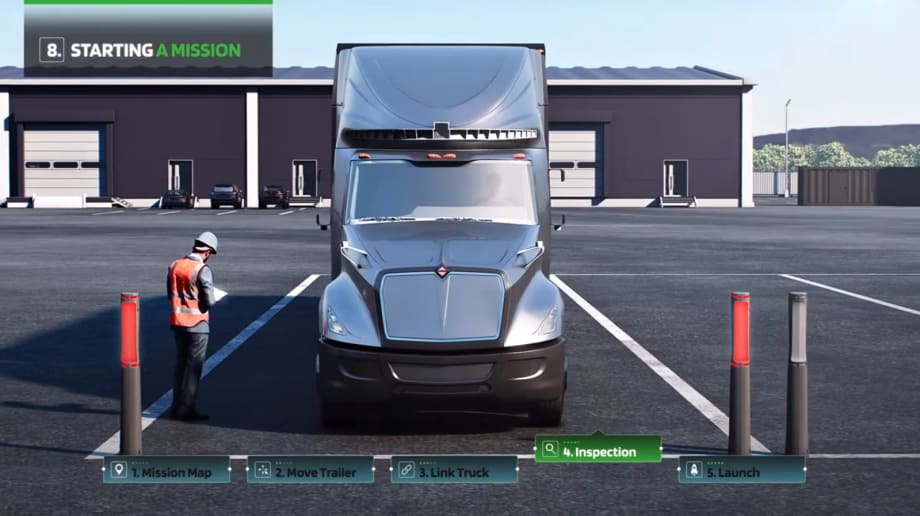
Maintenance and inspection practices would likely receive even more scrutiny for fully autonomous trucks.
Photo: TuSimple
Who’s liable in an autonomous-truck crash? How will self-driving trucks change how insurance underwriters evaluate trucking fleet risk?
Those were some of the questions discussed during a panel discussion on insurance and autonomous trucks at the Technology & Maintenance Council’s annual meeting. I attended the session hoping to learn what fleets could expect if and when they adopt this technology. Right now, however, it looks like there are more questions than answers.
The mini-technical session was part of the S.18 Study Group during the American Trucking Associations’ TMC annual meeting in Orlando, Florida.
Brand-spanking-new Federal Motor Carrier Safety Administration Deputy Director Earl Adams gave a short update on the agency, and kicked off the discussion of autonomous trucks by referencing the agency’s recent regulatory notice requesting more information on how it should regulate these vehicles.
Adams pointed out that uncertainty increases risk. And there are a lot of uncertainties as the industry moves forward with highly automated trucks, from a patchwork of state laws and regulations, to public acceptance of the technology, to who will be liable when an autonomous truck crashes.
“I don’t have answers, but I do have questions, things I know we have to ask ourselves,” Adams said. “Some would have it be a strict product liability system. Others believe it should be no different than standard automotive insurance that we currently have.”
He said FMCSA has been funding some projects to try to get insight to help the industry and regulators answer some of these questions, such as a study by the Virginia Tech Transportation Institute.
“It is something we are going to continue to look at.”
All those questions make it tough for the insurance industry to figure out how they’re going to write insurance policies for autonomous trucks.
And these questions are important to answer. Mike Dorfman, co-founder and COO of Koffie Financial, pointed out that as with previous technologies, larger fleets are the first to adopt, with it trickling down to smaller fleets.
“If you don’t do an insurance product properly for the entire industry,” he said, “the small fleets and owner-operators will really see the brunt of any increases.”
How Do You Determine Risk for Autonomous Vehicles?
Traditional insurance rates are built around historic data for the industry and the motor carrier. Obviously, we don’t have that type of information for something as new as autonomous trucks. So what’s an insurance underwriter to do?
Andy Roth, director of insurance for Roth Insurance, has worked with autonomous-vehicle companies on insurance, and he said it requires a lot of communication with those developers.
But he also pointed out that these trucks are generating vast amounts of data.
“Collecting data has advanced in autonomous-vehicle tests in the sense of, we have a much better idea what we want to know from a risk perspective and we’re starting to lay the groundwork for collecting and modeling that data.”
Who’s Liable in a Self-Driving Truck Crash?
When an autonomous truck crashes, is the trucking company liable as it is with traditional human-driven trucks? Or is it a product fault or misfunction?
Dorfman said, “I think OEMs will need to start buying some product liability of their own.” But that doesn’t fit in with the current product liability mindset, he said. We need clear guidance on where product liability stops and starts and where auto liability stops and starts. “Right now we don’t have a framework for that.”
Clayton Cavell, president of Paul Hanson Partners, suggested that regulations might be needed to require providers of autonomous truck technology to maintain a certain minimum amount of insurance, just as motor carriers currently do.
And should the minimum required liability insurance be different for fleets operating autonomous trucks?
Dorfman raised the specter of plaintiffs’ attorneys, who might decide that a big multinational company selling autonomous trucks is a bigger fish to go after for a catastrophic crash than a motor carrier.
Cavell added, “We could very easily reduce the number of crashes but not actually reduce the costs from an insurance perspective.”
Autonomous-Vehicle Maintenance and Insurance
Dorfman said currently, insurers already evaluate things such as hiring policies and driver training and safety practices. “The natural extension of that will be safety and maintenance policies around AVs. Insurers are going to have to look deeply into that in order to get comfortable with risk.”
TMC’s Jack Legler said he believes maintenance will become even more important when dealing with insurance questions.
“We [in maintenance] will be responsible for making sure the AI is up and running like the rest of the vehicle,” Legler said. And that may mean fleets will have to adjust their maintenance practices.
Roth pointed to sensors as an example. If those get misaligned, it can affect performance of an autonomous vehicle. (As it does for advanced driver assistance systems.)
“It’s something regulators will want to pay close attention to and understand. We’re not there yet. There’s not a practice you can look at and say this is sort of a benchmark.”
Legler pointed out that one of TMC’s latest Recommended Practices is about ADAS and maintenance practices, such as checking sensor alignment after collisions or when replacing a windshield. “These things will obviously have the same effect on AVs but at a higher level.”
In fact, Legler suggested, the maintenance department will effectively take over a lot of roles that used to belong to safety — because the driver, instead of someone to be hired and trained, is now a robot that needs to be maintained.
Faster Claims?
On the other hand, speakers noted that actually processing clams and defending against lawsuits may become faster and easier. With AVs being connected, notification of a crash and all the data related to that crash will become almost instantly available — including, in many cases, 360-degree camera coverage.
“So I think it’s going to be more efficient,” Roth said. “It has the ability to be handled much more quickly than it might be today, with faster notification and greater certainty about what happened.”
More Fleet Management

Geotab Links Fleet Card to Vehicle Data
The new card combines fuel discounts with telematics-based purchase controls. Geotab’s analysis also points to potential savings from choosing lower-priced fuel stops.
Read More →
How MFA Helps Protect Trucking Fleets
Multi-factor authentication adds protection when passwords are stolen. Here’s how it works and where fleets should start.
Read More →
How Better Freight Data Helps Trucking Teams Get Ahead of Disruption
Trucking and logistics teams have plenty of data. The problem is getting the right information in front of the right people soon enough to act. Better-connected data can help teams spot trouble earlier and make smarter decisions before small problems become big ones.
Read More →

Trimble: Taking Artificial Intelligence in Trucking Beyond Faster Tasks
At Insight 2026, Trimble executives argued that fleets may need to redesign workflows to get more from AI as it introduced new products and enhancements. AI’s value will depend on how fleets combine automation with their people's knowledge.
Read More →
Build a bulletproof fleet: Uniting ELDs and dash cams for total compliance
An ELD can prove compliance, but it cannot always prove what happened on the road. Discover how uniting accurate ELD data with AI-powered dash cam video can help your fleet strengthen compliance, defend against liability, protect drivers and reduce operational costs.
Read More →
Nominations Open for HDT Emerging Leaders
Heavy Duty Trucking is looking for accomplished trucking fleet professionals under 40 who are making an impact and helping lead the industry forward.
Read More →
Why Private Fleets Are Taking More Freight
Private fleets are putting their own trucks on demanding customers and high-cost lanes as companies seek greater control over service, costs, and capacity.
Read More →
Color Match Smarter: Tools That Restore & Perform
For fleet managers and collision repair professionals keeping heavy-duty trucks on the road, getting the color right the first time isn't just about appearance — it's about efficiency, turnaround time, and bottom-line results. Discover how today's digital color tools are transforming the repair process from guesswork to precision.
Read More →
FMCSA Pauses Biennial-Update Enforcement Amid Motus Transition
Carriers whose updates were due on or after June 1 have more time, while FMCSA works to stabilize its new registration system and warns of phishing sites impersonating its new carrier registration system, Motus.
Read More →
2026 Blueprint for Countering Smarter Supply Chain Theft
Cargo theft is no longer just the cost of doing business. It's a multi-billion-dollar criminal enterprise exploiting vulnerabilities across your fleet, drivers, and supply chain.
Read More →