





Related: Autonomous Trucks Could Radically Transform U.S. Logistics Within a Decade
Q&A: Autonomous Truck Developer TuSimple Makes Its Case
In a sit-down interview with HDT Equipment Editor Jim Park, Robert Brown, director of public affairs for truck tech start-up TuSimple, explains the capabilities, current limitations and potential for its autonomous truck technology.
February 27, 2019
Robert Brown, director of public affairs for truck tech start-up TuSimple explains the capabilities, current limitations and potential for its autonomous truck technology.
Photo: TuSimple
5 min to read
In the race to be first to market with a viable, fully-autonomous operating system for heavy duty tractor-trailers, the American-Chinese tech company TuSimple has certainly staked out a position at the head of the pack. The company recently made headlines when it announced a $1 billion valuation. And it also announced that its existing autonomous truck fleet would expand to more than 50 operational units running real-world, revenue-generating routes in Arizona, with new routes set to begin in Texas soon.
At the CES Show in Las Vegas earlier this year, HDT Equipment Editor Jim Park visited the TuSimple booth on the show floor and spoke with Robert Brown director of public affairs for TuSimple on the company’s overall technological vision and its plans for the future.
HDT: What is the view from 30,000 feet in regards to TuSimple’s operations in North America?
Brown: Our testing and development center is in Tucson, Arizona. We have about 400 employees split between different areas. We are laser focused on heavy-duty trucks -- no passenger car. Nothing else. Just heavy duty trucks. Last year we were here at CES with our Peterbilt truck retrofitted with our technology.
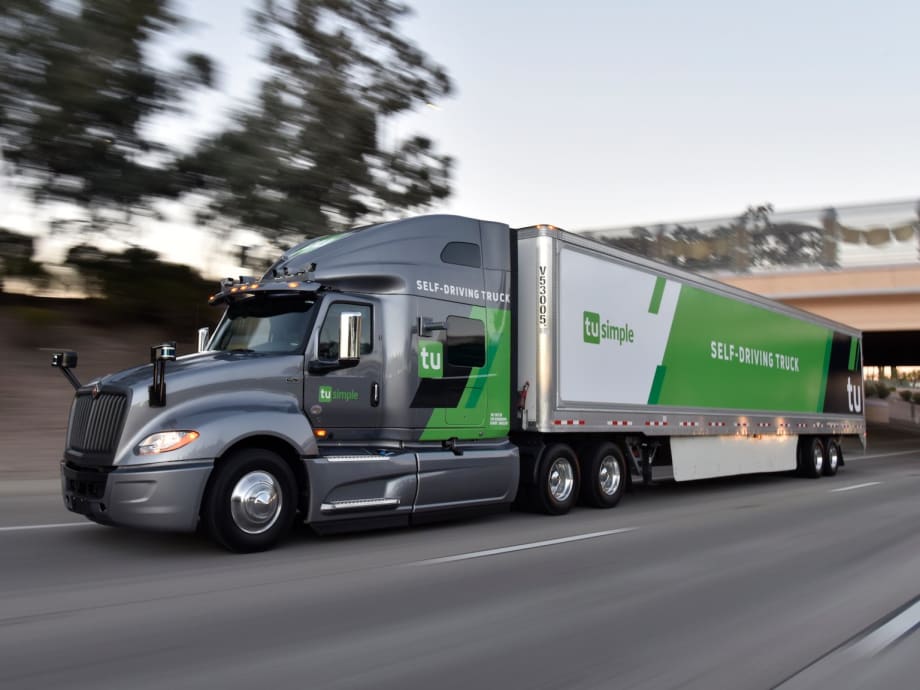
HDT: And this year, we are sitting in an International ProStar as we speak.
Brown: Yes. So that's progress. We're working with two of the major OEMs now. But we're talking to everyone. We'd love to eventually have TuSimple in with all the truck OEMs. We are hauling regular routes today. We're not profitable yet. But at least we're making revenue. When we got that first check, it was pretty exciting for a startup because, you know, startups, all they do is burn cash. They don't get the bring a lot of cash in. So it's been fun.
HDT: And you are still testing your technology today?
Brown: Yes. Part of getting to the product stage is what we would call a validation fleet. Part of that validation fleet is millions and millions and millions of test miles inside the transportation industry hauling goods. And what you're seeing here are different routes that we go on in Arizona. From a technical perspective, what really makes us at a strategic advantage is our perception system. Our system can “see” up to 1,000 meters ahead of the vehicle. And that allows us to be efficient, but also safe.
HDT: Obviously there’s more to this than just looking ahead, though.
Brown: Yes. The vehicle perceives the world around it, locates itself on the high definition routing map that we generate, that is another distinguishing feature of our technology. And we feel this technology is perfect for heavy-duty trucking, particularly long haul line haul routes that are going from distribution center to distribution center and repeating that route over and over and over. So it can't do a random pick up in Des Moines and random pick up in Jacksonville. It has to be, you know, distribution center to distribution center on a regular recurring basis. Think of it like railroads for the future. The truck can only go where we map it to go.
HDT: Can you get from dock to dock? Or do you have go to a hub?
Brown: We can get to the front gate of a distribution center. And that's actually one thing that we've learned, most of our customers don't want us messing around in their distribution centers. They say, "Get it here. We'll take it from there." I would think in the future, you know, we will be able to get all the way to the dock. But since this technology is so new, I think a lot of people are just kind of like, "Get it to here and we'll take it from there." Which is understandable.
HDT: Can the system take the truck on, say, a secondary road between a distribution center and the highway?
Brown: Yeah. Luckily most large distribution centers are located outside city centers on industrial roads. We won't be able to do every route. We'll have to assess each route and decide if it's doable for the technology, because obviously safety is critical.
HDT: What kind of feedback are you getting from fleets – potential customers?
Brown: We've given our demonstration rides to some of the top OEMs and fleet customers that we have. And the feedback we've gotten is that our system is “polite.” But it's not so polite to the point that it can't, you know, handle a merge. It's not always the one slowing down. It can also speed up to handle oncoming and offloading traffic. And we can handle unprotected left turns, stop signs, traffic lights, we do a railroad crossing, luckily, almost every day because our facility is right next to a railroad crossing, and all sorts of the madness that the highway brings.
HDT: You always have a driver and a systems engineer in the truck at all times?
Brown: Where you’re sitting now (in the International ProStar – editor’s note) we always have a CDL train driver monitoring the system, and riding co-pilot with that person, is a safety engineer. They work in tandem on purpose-driven testing. So I want to reassure people that as the system matures we test with safety in mind because we don't want to ever put the American public or the Canadian public in jeopardy. And the safety applications of this technology is incredible. In terms of reaction time, it never gets sleepy. It never texts. It never gets intoxicated or impaired in any way. It can drive 24 hours a day, 365 days a year.
HDT: Are there any limitations at all?
Brown: Yes. But we are working on them. We're confident we can get to night driving relatively soon. And the potential there is interesting. If you’re running these trucks in the middle of the night and avoiding those hot traffic zones during rush hours, that'll be really helpful for daily commuters and the public in general. So it's very exciting.
Subscribe to Our Newsletter
More Equipment

How Volvo Updated Its D13 for EPA 2027 [Watch]
Volvo’s updated D13 promises lower emissions without sacrificing performance or fuel economy. Take a closer look at what changed inside the engine in this HDT Spotlight video.
Read More →
Michelin Tire Improves Efficiency and Durability for Regional Fleets
The Michelin X Multi Energy D2 is a regional haul drive tire engineered to help fleets improve fuel efficiency, durability and traction in demanding stop-and-go operations.
Read More →
ZF Expands Commercial Vehicle Push in North America
ZF is expanding its North American commercial-vehicle presence with new transmission applications, electrification, trailer technology and autonomous-driving systems.
Read More →
Tesla Wants a Self-Driving Semi. Are Cameras Enough?
Could Tesla’s camera-only autonomous driving technology work on an 80,000-pound Semi? In this commentary, HDT's Deborah Lockridge takes a look at Tesla, Cybercab, and how autonomous trucks see the road.
Read More →
Kodiak: Driverless Long-Haul Truck Launch on Track for 2026
Kodiak AI says its driverless long-haul safety case is 93% complete and it remains on track to begin commercial operations by year-end 2026.
Read More →
What DOT’s Automated Vehicle Strategy Means for Trucking
The U.S. Department of Transportation issued a new automated-vehicle strategy that outlines plans for driverless-truck regulations, cross-state freight corridors, and federal safety standards.
Read More →
East Coast Port Launches $45M Electric Truck Push
The Port Authority of New York and New Jersey announced millions in incentives for zero-emission drayage trucks, yard tractors, and new charging hubs near the port.
Read More →
PlusAI Going Public to Fund Autonomous Truck Launch
A SPAC deal could provide PlusAI with up to $300 million as it works toward a 2027 commercial launch of factory-built autonomous trucks.
Read More →
NHTSA Moves to Rewrite Truck Fuel-Economy Rules
The National Highway Traffic Safety Administration says it lacks authority to regulate medium- and heavy-duty truck engines separately from complete vehicles, but the existing standards have not yet been eliminated.
Read More →
Detroit Opens Orders for EPA 2027 Engines
Detroit isn’t starting from scratch to meet EPA 2027 diesel emissions standards. Its Gen 6 DD13 and DD15 engines keep much of today’s platform while updating the fuel and aftertreatment systems.
Read More →