With all the advantages provided by today’s advanced safety systems, what a shame it would be if they couldn’t live up to their potential because of poorly maintained foundation brakes or inadequate friction material.
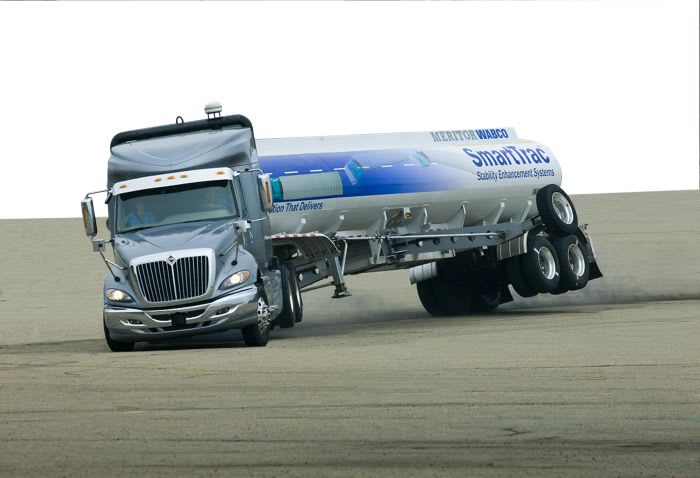
Stability control and collision mitigation systems depend on a fully functioning brake system set to OEM specs.Photo: Meritor Wabco
6 min to read
Stability control and collision mitigation systems depend on a fully functioning brake system set to OEM specs.Photo: Meritor Wabco
With all the advantages provided by today’s advanced safety systems, what a shame it would be if they couldn’t live up to their potential because of poorly maintained foundation brakes or inadequate friction material.
Ad Loading...
Stability control systems, for example, use a variety of sensor inputs to figure out what’s going on and then use various algorithms to trigger an intervention to mitigate or prevent a rollover or loss of control event. The system will command the brakes to deliver as much power as is needed to change the outcome of the situation — but if the brakes aren’t operating as designed, the outcome might not be as you expected.
“By not paying attention to the fundamentals, you’re putting at risk the money you invested in those advanced safety systems,” says Fred Andersky, director of customer solutions and marketing, controls division, at Bendix Commercial Vehicle Systems. “Your advanced safety system may not be able to help when you need it most.”
Ad Loading...
Advanced safety systems, including electronic stability control, roll stability, or the more comprehensive systems such as Bendix’s Wingman Advanced or Wingman Fusion, Meritor Wabco’s OnGuard or Daimler’s Detroit Assurance, are all engineered around a braking system that’s in showroom condition. The systems can tolerate normal wear and tear, component degradation, etc., but they can’t function as intended if parts are seized, out of adjustment or missing, any more than they can cope with bad electrical connections, corroded wires or a bad air supply.
There’s not enough room here to go into everything that can go wrong at the wheel-end with foundation brakes. We all know what those problems are, but it’s important to note that they can inhibit performance of your safety system.
Fleets can inadvertently undermine their safety system’s performance by spec’ing non-OE friction material at reline or pad-change time.
“In some cases if you’re going from OE-certified RSD [reduced stopping distance] friction material to non-RSD material, the difference in stopping distance can be up to 100 feet or more,” cautions Keith McComsey, director of marketing and customer solutions, Bendix Spicer Foundation Brake. “Those electronic safety systems are depending on the friction material to stop the truck, but if the friction isn’t up to the job, the safety system might not be as effective as it otherwise could be.”
There’s nothing new in fleets installing aftermarket friction at service intervals. Depending on the material, there could be some performance degradation compared to the OE material, but in the past it wasn’t seen as a critical discrepancy. The difference today, McComsey says, is that these advanced systems cost money, and fleets want an ROI on the system, even if it has to function as designed only once.
Ad Loading...
“If you’re expecting a certain level of performance from those systems, you have to upkeep the rest of the system, too,” he says.
The same thinking applies to the pads on air disc brakes. Aftermarket materials probably don’t undergo the same level of testing needed to certify to the RSD distance requirements that were phased in August 1, 2011. That’s not to dismiss the quality of aftermarket parts, but some material is certainly not up to OE standards.
“How the advanced safety system performs really comes down to the way it interfaces with the friction material,” says Peter Moss, product manager, brakes - North America at Meritor.
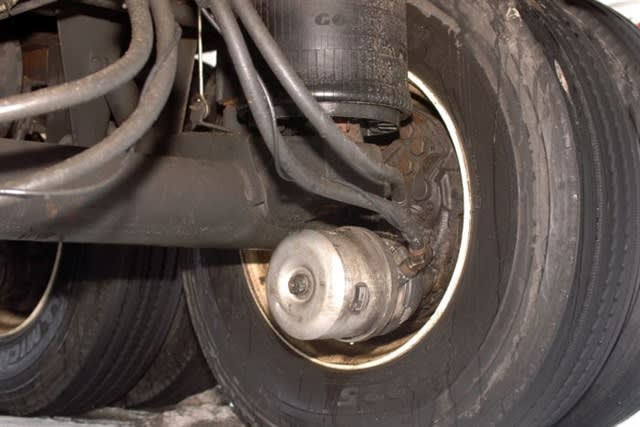
Air disc brakes have fewer external moving parts exposed to the debilitating effects of corrosion from aggressive road de-icing compounds.Photo: Jim Park
ADBs gaining ground
According to McComsey, air disc brakes are now on 27% of tractors and 20% of trailers, so there are still plenty of fleets not yet on board. If you’re still looking for a reason to try air disc brakes, have you considered corrosion resistance?
It’s no secret that some of today’s road de-icing compounds can complicate brake maintenance. From rust-jacking of brake shoes to rust-related seizing of clevis pins, cam bushings and slack adjuster mechanisms, it takes a lot of shop time to stay ahead of the problem.
Ad Loading...
Four years ago, Penske Truck Leasing saw brake service costs rising unexpectedly. This, according to Paul Rosa, senior vice president of procurement and fleet planning, coincided with the introduction of more aggressive road de-icing compounds in some northern jurisdictions.
When states started treating the roads with more powerful chemicals, Penske immediately saw brake repair intervals shorten and started seeing a lot more repairs than in the past.
“We had to do something; we just couldn’t live in that world anymore,” Rosa says. “The vehicles were down so much more than we expected due to the corrosive material they use on the roads. The worst area was a U-shaped region from Minnesota to Maine, around the Great Lakes.”
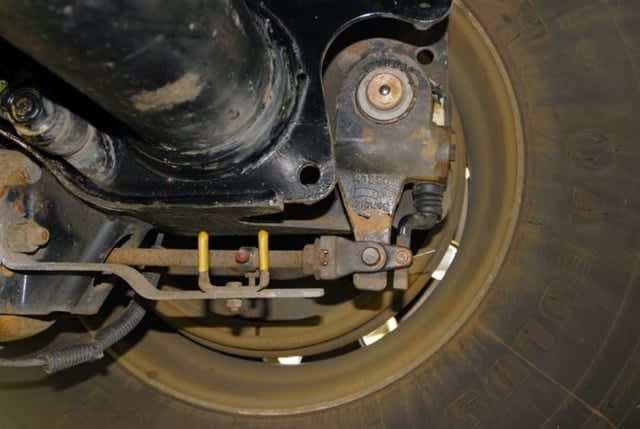
Penske Truck Leasing started seeing more frequent brake repairs and higher maintenance costs with S-cam brakes exposed to corrosive road de-icing compounds.Photo: Jim Park
Penske began an evaluation four years ago on air disc brakes in that region. The biggest takeaway was a large reduction in technician touch-time and greater uptime for his customers.
“We later expanded the evaluation to see if we could learn anything new in hot dry states like Arizona or at altitude in Colorado and the Northwest,” he says. “We even evaluated trucks running from Vancouver, British Columbia, through the Rockies to Calgary, Alberta. The additional positive results we saw in those tests prompted us to make disc brakes the standard going forward.”
Ad Loading...
The results of the first year’s trial of ADBs were what Rosa called pleasing, but it really came together in the second and third year, he says.
“We weren’t seeing the trucks come in for brake work nearly as often. What drove the switch from drums to air discs was what was happening to a lot of the components in the S-cam brake system,” Rosa explains.
Penske elected not to go with the split system (discs on the front, wide-block drums on the drives), because that would have left some brakes in the truck still vulnerable to corrosion.
“We saw the reduction in maintenance in our initial tests. We stepped over the hybrid or split system because we saw and understood the benefits of corrosion resistance,” Rosa says. “Once we had the results we decided to go all in, and it was the right decision.”
Safety system maintenance and diagnostics can reveal electronic faults. Last year, CVSA’s Roadcheck results found 8.8% of air-brake-equipped trucks and 15.8% of trailers had ABS violations.Photo: Bendix
Cost and weight
Disc brakes continue to suffer from the age-old bugaboos of increased cost and weight, but that’s changing slowly. Bendix recently released a new disc brake for trailers, the ADB 22X LT, that’s 10 pounds lighter than its predecessor. SAF-Holland last year introduced the P89, which is said to be “weight-neutral” compared to drum brakes.
Ad Loading...
There’s still a significant upcharge for most disc brake options, but when factoring in lifecycle costs, the premium price is starting to melt away. Rosa’s experience suggests the higher cost is easily offset by reduced maintenance costs in certain regions of the country. Meanwhile, brake producers are improving pad formulations and adding surface area to the pads for even longer life.
Bendix offers a new brake pad with the LT brake, called PX276. According to McComsey, it has an additional 2 mm of wearable lining and 8% more wearable volume, and a new friction formulation can improve wear rates by 40% compared to previous pads.
“ADB friction pad life is already 1.5 times the life of drum friction,” he says. “That could eliminate a friction change before trade in and push fleets past the break-even point on their air disc investment.”
There’s already a long list of compelling reasons to take another look at air disc brakes, but the performance when coupled with the advanced safety systems just might be the clincher.
“Regardless of the supplier of either the safety system or the wheel-end brake assembly, the controllers will send a signal to the brake, and the brakes will respond to that signal,” says Meritor’s Moss. “What’s important for the end user is that the system is maintained properly using parts aligned with the original brake specification. Operation of the brake is more important than ever if you expect to maintain the original performance from your safety system.”
Ad Loading...
E-braking may come sooner than you think
Brake experts say tractor-trailer stopping distances could be further reduced by faster brake application made possible by an electrical signal rather than the current pneumatic actuation signal. And performance of stability control and collision mitigation systems could be enhanced through better inter-vehicle communication.
But the rapidly increasing need for electronic communications between tractors and trailers could require the use of an additional trailer electrical connection. The standard J560 seven-way connector cable from tractor to trailer is almost at capacity for carrying signals.
That’s the view of Fred Andersky, of Bendix Commercial Vehicle Systems, expressed during a press briefing at this year’s Mid-America Trucking Show in Louisville, Kentucky. He said an additional, and separate, wire is needed to carry signals that ensure optimum timing and balance across the brakes while providing more precise signaling between tractors and trailers.
“It’s got to happen if trailers are to become an integrated part of a combination vehicle,” which federal safety authorities are talking about, he said. “But retrofitting the extra cable on existing trailers could be a problem.”
Alternatives include the expanded use of power line carrier technology (PLC), where multiplexing allows the current cable’s seventh circuit to carry electrical power and signaling over the same piece of wire. Experts are also looking at wireless local area networks, or LANs.
Using a LAN would be easier; communications boxes could be installed on each vehicle that communicate wirelessly. But wireless signals are subject to interference and hacking.
An extra cable could securely perform the signaling function until LANs are protected against outside interference, perhaps through encryption, to the same level as a wire.
The federal requirement for a fully redundant air system alongside a brake-by-wire system is a big barrier to uptake, experts say. An incremental step such as electronic braking control could open doors to an electronically actuated traditional pneumatic brake system.
– With reporting from Tom Berg, Contributing Senior Editor
Carriers whose updates were due on or after June 1 have more time, while FMCSA works to stabilize its new registration system and warns of phishing sites impersonating its new carrier registration system, Motus.
ZF is expanding its North American commercial-vehicle presence with new transmission applications, electrification, trailer technology and autonomous-driving systems.
Fleets have more visibility into truck health, safety events, and driver activity than ever. The next challenge is turning all that information into useful guidance for the person who has to decide what to do next.
Could Tesla’s camera-only autonomous driving technology work on an 80,000-pound Semi? In this commentary, HDT's Deborah Lockridge takes a look at Tesla, Cybercab, and how autonomous trucks see the road.
The U.S. Department of Transportation issued a new automated-vehicle strategy that outlines plans for driverless-truck regulations, cross-state freight corridors, and federal safety standards.
New York City is expanding intelligent speed assistance and pedestrian-alert systems across its municipal fleet, moving the technologies from pilot programs into vehicle procurement and retrofit requirements.
Federal regulators also are targeting more than 160 additional training providers and launching a nationwide audit of third-party CDL skills testers as part of a broader crackdown on trucking fraud.
Two pilot programs could eventually reshape hours-of-service rules, giving truck drivers options to pause their 14-hour clock or use longer split sleeper rest periods.
Hundreds of thousands of pets travel in truck cabs. A new safety guide from Volvo Trucks and the Center for Pet Safety offers practical advice for truck drivers who bring dogs and cats along for the ride.