





Related: Knowing Isn't Fixing
When Safety Comes From the Top
For J&M Tank Lines, safety technology is simply a tool in its quest to make sure drivers get home safely.
March 27, 2017
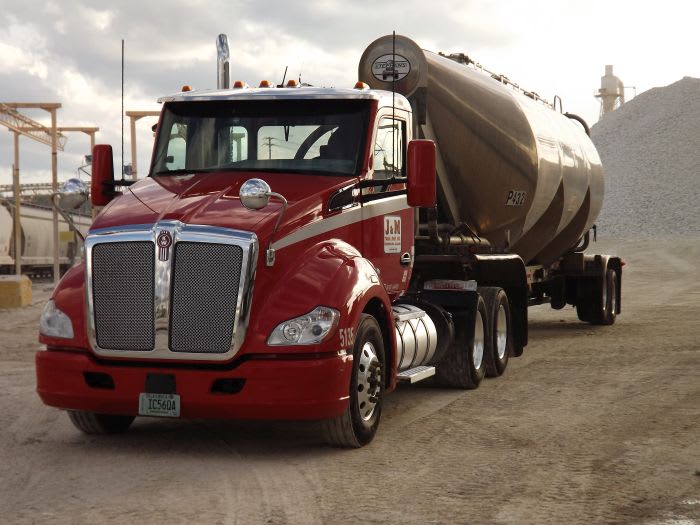
J&M operates 13 terminals in Alabama, Georgia, Oklahoma, South Carolina, and Texas. The fleet specializes in carrying industrial and food grade products, as well as liquid bulk goods. Photo: Bendix
4 min to read
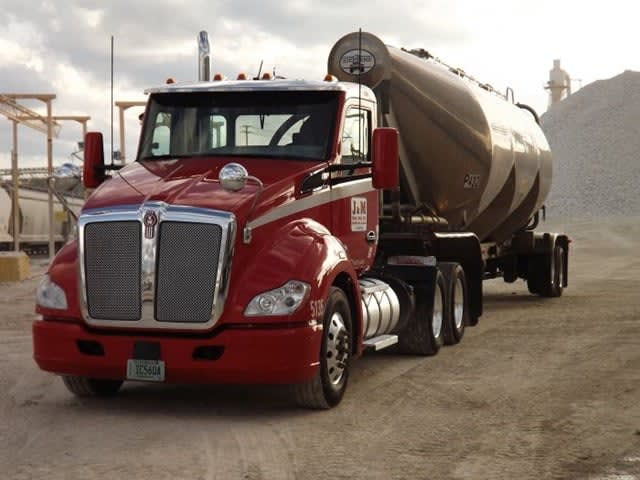
J&M operates 13 terminals in Alabama, Georgia, Oklahoma, South Carolina, and Texas. The fleet specializes in carrying industrial and food grade products, as well as liquid bulk goods.Photo: Bendix
These days there’s a lot of emphasis on high-tech safety systems such as collision mitigation, but Randy Watson is a firm believer that safety at any trucking company starts at the top.
“I’ve been doing this since 1987, and I’m a firm believer that regardless of how fancy the technology and how much money you spend, no safety program is any better or worse than the ownership allows it to be. Everyone talks the talk, but few walk the walk.”
At J&M Tank Lines, where Watson is vice president of safety, CEO Harold Sumerford Jr. does walk the walk.
“Our number one customer could call Harold and say, ‘I need this load covered and was told no,’ and if we don’t have a driver who can legally do it, we won’t budge,” Watson says. “That permeates throughout the company. The culture is so strong, I’ve had dispatchers come to me and rat their own drivers out because they were trying to run hot.”
Go to J&M Tank Lines’ website, and right there on the home page it says, “Safety First.” The nearly-400-unit tanker fleet, which is headquartered in Birmingham, Alabama, but also has operations in Texas and Georgia, was named Grand Champion of the 2016 Georgia Fleet Safety Awards by the Georgia Motor Trucking Association.
“Safety takes a backseat to nothing, and that starts with Harold,” Watson explains. “Then it’s incumbent on the rest of us to figure out what are we going to do to make sure we’re doing it right. What are our well-thought-out policies, checks and balances, how do we convey this message to all our employees. The number one message is, you get back home to the people who love you, period. And that’s what drives me.”
Unlike some carriers, where safety, operations, and maintenance may operate in silos or even be in conflict with one another, at J&M the heads of all three areas work as a team.
“This is what I’ve been searching for all my life, to do safety the way it’s meant to be done.”
Using safety tools
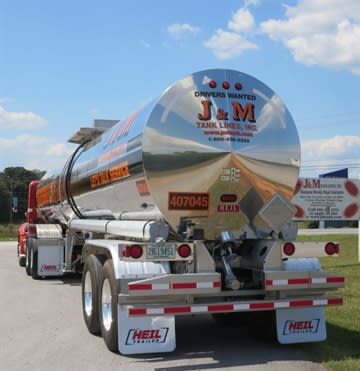
J&M’s fleet includes some 700 trailers — mostly pneumatic tanks, but also a number of liquid tanks and about a dozen flatbeds.Photo: Deborah Lockridge
Part of the safety culture does involve investing in equipment and tools that help the company reach its safety goals, including electronic logs to track driver hours of service, and air disc brakes on all axles.
“Harold realizes, unlike some other people, that everything doesn’t have to show ROI in black and white on a piece of paper,” Watson says. “That sometimes it’s hard to measure the intangibles on your accounting form.”
J&M uses a wide array of onboard safety technology, including a full suite of Bendix products, such as electronic stability, Bendix Wingman Advanced and more recently the new Wingman Fusion collision mitigation systems, AutoVue lane departure warning and BlindSpotter side object detection system.
But key to getting the most value out of those technologies, Watson says, is following up on what they show you. J&M uses Bendix’s SafetyDirect web portal to analyze the data coming from the Bendix safety systems. An onboard telematics system automatically transmits real-time driver performance data and event-based information to the fleet’s back office, including recorded video taken from the AutoVue camera. The resulting reports help the fleet develop more targeted driver support, reward, and training programs
“We have good drivers; sometimes they just have bad habits,” Watson says. The key is identifying those habits and coaching drivers. The Bendix system, he says, “is the most proactive tool I’ve ever had in identifying them and act on them before [drivers] get in situations where someone gets hurt.”
One longtime driver, he says, was surprised to learn that he had unwittingly been following too close for years and promised to do better. “Six weeks later he was in a situation where he avoided an accident.”
Watson emphasizes that he doesn’t use the videos “to just nail the driver to the wall,” but instead brings a driver in and shows him the video and uses it to prompt a discussion of what happened and how the company can help the driver to improve. At the same time, he says, he uses the videos to identify drivers exhibiting good habits in a situation that triggered the camera and reward them with recognition and gift cards. The videos are also used in safety meetings, where they have more impact than generic training videos, Watson says, because “this is the driver sitting beside you.”
Watson personally views all the videos that are sent when triggered by the system. He says he gets about five to 10 per day. Some are not triggered by driver error, but from other vehicles pulling out in front of them. A common trigger is too much G force when a driver takes a curve a little too fast, which presents a coaching opportunity. And he looks for patterns of behavior, and combines the data coming from the safety system with other information such as motorists calling in to complain.
“We preach that these systems are not as good as the human brain and the human eye — at the end of the day they are mitigation systems, not prevention systems,” Watson says. Drivers are told, “You’re the driver and you have to be on top of your game.”
Subscribe to Our Newsletter
More Safety & Compliance

FMCSA Pauses Biennial-Update Enforcement Amid Motus Transition
Carriers whose updates were due on or after June 1 have more time, while FMCSA works to stabilize its new registration system and warns of phishing sites impersonating its new carrier registration system, Motus.
Read More →
ZF Expands Commercial Vehicle Push in North America
ZF is expanding its North American commercial-vehicle presence with new transmission applications, electrification, trailer technology and autonomous-driving systems.
Read More →
Truck Drivers Need More Than Another Alert
Fleets have more visibility into truck health, safety events, and driver activity than ever. The next challenge is turning all that information into useful guidance for the person who has to decide what to do next.
Read More →
Tesla Wants a Self-Driving Semi. Are Cameras Enough?
Could Tesla’s camera-only autonomous driving technology work on an 80,000-pound Semi? In this commentary, HDT's Deborah Lockridge takes a look at Tesla, Cybercab, and how autonomous trucks see the road.
Read More →
What DOT’s Automated Vehicle Strategy Means for Trucking
The U.S. Department of Transportation issued a new automated-vehicle strategy that outlines plans for driverless-truck regulations, cross-state freight corridors, and federal safety standards.
Read More →
NYC Expands Speed, Pedestrian Safety Tech Across Fleet
New York City is expanding intelligent speed assistance and pedestrian-alert systems across its municipal fleet, moving the technologies from pilot programs into vehicle procurement and retrofit requirements.
Read More →
FMCSA Removes 110 Truck Driver Training Schools from Certified ELDT List
Federal regulators also are targeting more than 160 additional training providers and launching a nationwide audit of third-party CDL skills testers as part of a broader crackdown on trucking fraud.
Read More →
Beyond DOT Compliance: What Makes a Trucking Fleet Truly Safe?
A trucking fleet can follow every rule and still make unsafe decisions. The real test comes when safety conflicts with freight, productivity, or cost.
Read More →
Hours of Service Pilot Programs: FMCSA Readies for 2027 Rollout
Two pilot programs could eventually reshape hours-of-service rules, giving truck drivers options to pause their 14-hour clock or use longer split sleeper rest periods.
Read More →
New Guide Offers Pet Safety Tips for Truck Drivers
Hundreds of thousands of pets travel in truck cabs. A new safety guide from Volvo Trucks and the Center for Pet Safety offers practical advice for truck drivers who bring dogs and cats along for the ride.
Read More →