





Related: Trucking Industry Debates Driver-Assistance Technologies
Are We Adopting Advanced Safety Systems Quickly Enough?
Advanced driver assistance systems present an opportunity to save thousands of lives and drive economic expansion over the next decade – but we need to move faster, contended Brian Collie, partner and managing director of Boston Consulting Group, in a recent speech.
November 6, 2017

Forward collision warning is becoming more common, but other ADAS technologies lag behind.
5 min to read
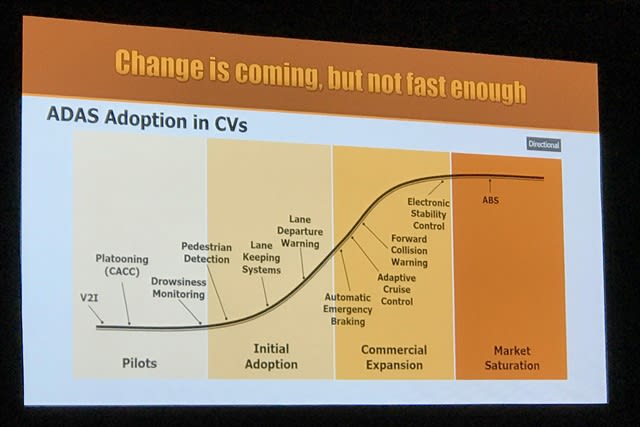
Forward collision warning is becoming more common, but other ADAS technologies lag behind.
Advanced driver assistance systems present an opportunity to save thousands of lives and drive economic expansion over the next decade – but we need to move faster, contended Brian Collie, partner and managing director of Boston Consulting Group, in a recent speech.
“We can do better, and we have to do better,” said Collie, speaking to a room full of trucking supplier representatives at the Heavy Duty Manufacturers Association’s Breakfast & Briefing during the North American Commercial Vehicle show in Atlanta this fall.
Boston Consulting Group helps its clients prepare for transformation to help stay at the top of their markets, and in a 2015 study it found that advanced driver assistance systems, such as forward collision warning/mitigation, blind spot detection, lane departure warning, and others, could avert nearly 30% of crashes. The 2015 study, commissioned by HDMA’s parent organization, focused on the sluggish uptake by consumers buying cars, but Collie’s remarks at NACV focused on commercial users.
Each year, he said, large-truck accidents result in more than 4,000 fatalities, $2.4 billion in property damage, and more than $50 billion in societal harm — and 90% of those are caused by human error. Since 2009, he said, large truck crashes and the resulting injuries and fatalities have risen significantly.
“It’s going to get far worse before it gets better,” he said, as distracted driving continues to increase.
“We do have the answer.” While progress has been made in the last few years seeing adoption of forward collision warning and mitigation systems, he said, in other areas, such as lane keeping systems or drowsiness monitoring, “adoption is not there,” especially among smaller fleets.
And a lot of that comes down to the question of payback, or return on investment. While large fleets tend to take a larger view at that, incorporating factors such as the cost of downtime, smaller fleets, he said, may look at competing by offering lower cost services, made possible by buying less expensive equipment on the secondary market and not making investments in advanced safety systems, thinking “it won’t happen to me.”
“What they often don’t realize is when it does happen, the savings all goes out the window,” Collie said. “Some of these accidents put these small fleets out of business.”
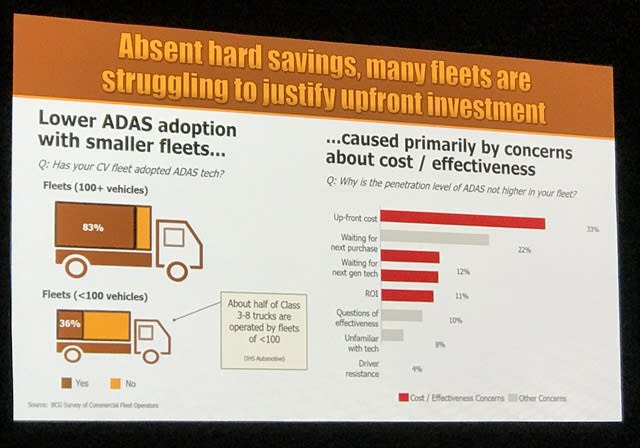
Many fleets struggle to justify the investment and payback in advanced safety tech.
Beyond antilock braking systems and electronic stability control, both of which are benefiting from government regulations, forward collision warning is the most widely adopted ADAS, Collie said, followed by related adaptive cruise control and automatic emergency braking. A number of OEMs, he pointed out, have recently announced collision mitigation systems as standard on some vehicles. Schneider, he noted, reported it eliminated 70% of rear end collisions using the technology, and reduce the severity of such incidents by 95%. “When do we find a technology which suggests a significant value proposition” such as this, he said, it is more widely adopted.
However, other systems, such as lane departure warning and lane keeping assist, are not catching on as quickly he said, and aren’t likely to any time soon.
When these technologies advance to allow for more automated commercial vehicle operation, he said, the “hard cash benefits of ADAS technologies really come to life,” Collie said, noting he’s “a big believer in Level 4, Level 5, autonomy,” saying it “will happen a lot faster than many of us would like to believe.”
Adoption of ADAS for more autonomous operations, he said, “allows the business case to dramatically improve,” driving significant utilization improvements on trucks, addressing the drivers shortage, and reducing crashes. “We expect a roughly 90% reduction in accidents with fully autonomous technology,” he said. Of course, he said, there are obstacles, including the need for a national regulatory framework, and “how can I hire drivers at the same time I’m telling them it won’t be a career anymore?”
Nevertheless, Collie contended, “The opportunity is to big to ignore. We project over the next 13 years, this industry can save more than 10,000 lives” if the full suite of current ADAS technology were to be made standard and extend all the way from Class 3 through Class 8 commercial vehicles.
To get there, he said, there are three areas that need to be addressed:
1. Educating truck owners about ADAS. “When a lot of fleets think about ADAS, they feel it's overly complex or it means a need to remove the driver right now.” He encouraged suppliers to educate customers about the tangible benefits that can come, including significant fuel economy gains and less downtime.
2. Make sure education is followed by true incentives. “We need government to step up to offer tax incentives,” he said, noting that already insurance companies starting to offer discounts for those using these technologies. The government also could make adoption of such technologies part of its safety ratings of carriers. “And ultimately preferential pricing for logistics providers able to offer those trucks.”
3. “Frankly given where we are, this is the one case – and believe me I love the free market economy – where regulation is sorely needed.”
In the meantime, he encouraged the supplier audience to publicly share field performance results to help make the technology better. “We're no longer just a regional industry. We're now increasingly global – so let's work with our European colleagues and drive some common standards.”
He likened the situation to “an opportunity for our industry’s moon shot. This is not easy, in the short term this might not look like the right thing to do, but there are lives at stake. We can do better and we certainly have to.”
Subscribe to Our Newsletter
More Fleet Management

What the U.S.-Canada Trade War Means for Trucking
Escalating U.S.-Canada tariffs could disrupt cross-border freight, reduce truck volumes, raise costs, and create new uncertainty for carriers on both sides of the border.
Read More →
What Are Trucking’s Top Concerns for 2026?
The American Transportation Research Institute wants to know what's worrying trucking fleet managers, drivers, and other stakeholders in its annual Industry Issues survey.
Read More →
American Trucking Associations Looks for a New Leader
ATA President and CEO Chris Spear abruptly left his job at the association on August 21, at a pivotal time for the trucking industry.
Read More →
Public Wi-Fi Cybersecurity Risks: How Truck Drivers and Fleets Can Protect Their Data
Public Wi-Fi can expose truck drivers and fleets to credential theft, malware, and other cyber threats. Here’s how to reduce the risk on the road.
Read More →
For Nicky Cupp, Fleet Innovation Starts With Frustration
HDT Truck Fleet Innovator Nicky Cupp turns everyday pain points at Fraley & Schilling into opportunities for better technology and smarter processes.
Read More →
Adam Buttgenbach’s Approach to Electric Trucks: Start With Where They Fit
HDT Truck Fleet Innovator Adam Buttgenbach helped PepsiCo build one of North America’s largest EV fleets by focusing on where electric trucks make operational sense.
Read More →
Deen Albert: Let Automation Do the Math, People Make the Decisions
HDT Truck Fleet Innovator Deen Albert makes sure people are still at the heart of operations at Grand Island Express, even while adopting artificial intelligence tools. AI-assisted dispatch helped boost revenue 25% with the same number of trucks.
Read More →
Trimble’s New AI Agent Takes Aim at Fleet Back-Office Busywork
Arc Agent works across Trimble TMS products to automate repetitive tasks such as freight orders, maintenance, invoices, fuel costs and more.
Read More →
How HDT’s 2026 Truck Fleet Innovators Are Rethinking Fleet Operations
Meet five trucking leaders who are challenging assumptions, solving operational problems, and putting innovative ideas to work.
Read More →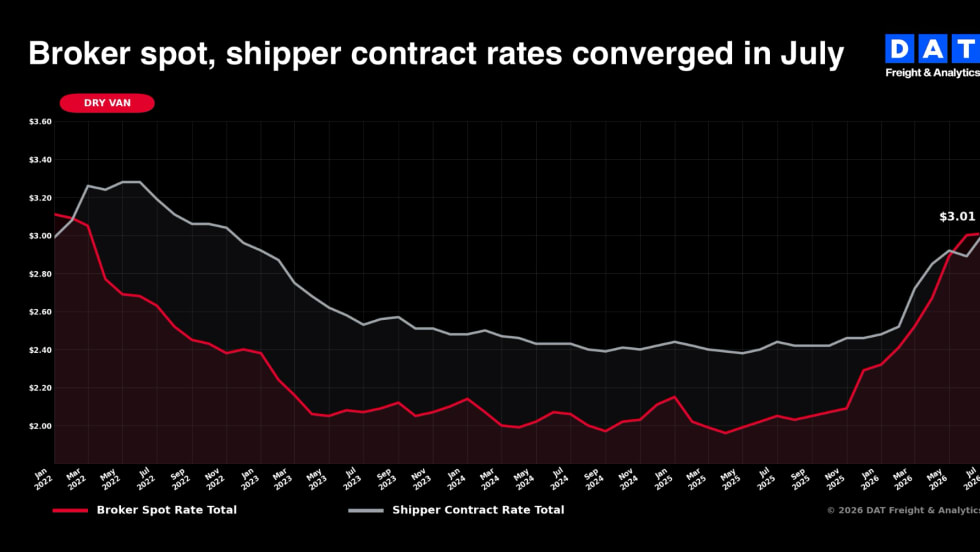
Tight Trucking Capacity Pushes Rates Higher Even as Freight Volumes Fall
“Spot rates moving ahead of contract rates have historically signaled a tightening market, but we haven’t seen a capacity-driven market quite like this one,” said DAT's Dean Croke.
Read More →