





Dig Deeper: Do Your Trailers Have Legal Rear Impact Guards with Labels That Say So?
Are Underride Guards Good Enough?
Last March, the Insurance Institute for Highway Safety announced results of crash-testing of several van trailers whose underride guards did not perform well, except in a couple of cases
January 17, 2012
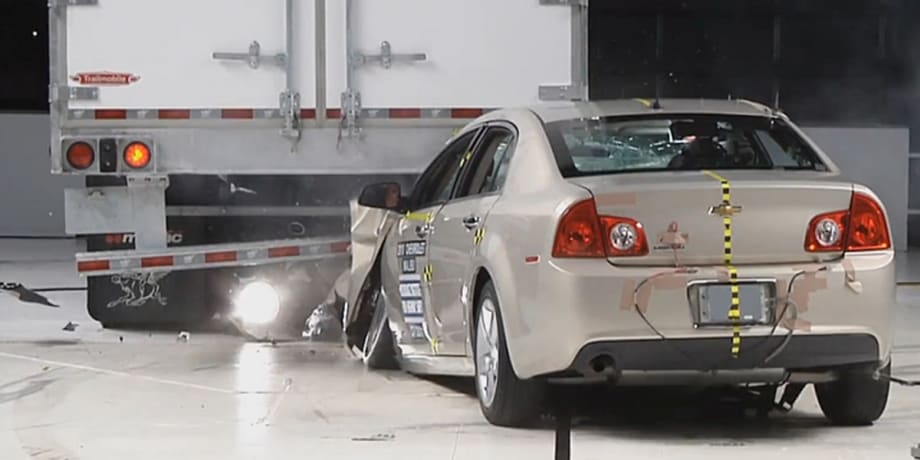
The Insurance Institute for Highway Safety tested underride guards and found them lacking.
Photo: IIHS
5 min to read
Last March, the Insurance Institute for Highway Safety announced results of crash-testing of several van trailers whose underride guards did not perform well, except in a couple of cases.
In most instances where new Chevrolet Malibu sedans were thrown at 35 mph into the trailers' rear ends, the cars' occupants would have been killed, IIHS's report said.
The National Highway Traffic Safety Administration has estimated that about 423 people in passenger vehicles die each year when their vehicles strike the backs of large trucks. That's a small percentage of the 32,000-plus people killed yearly on our highways. In most cases, motorists are clearly at fault in those accidents, so is it fair that truck owners be further burdened with expensive equipment requirements that offer no operational savings? Yes, says the IIHS -- and the feds seem to be listening.
Truck-Trailer Underride Tests
The car-trailer crash testing was done over several months in 2010. Testing was scientific, using instrumented dummies "driving" the remote-controlled Malibus, which have the institute's top ratings for frontal and other crashes against other autos and light trucks. But the cars didn't do well against the large, heavy trailers, whose structures were higher than the cars' protective crush zones and jammed into the front-seat area while the trailers hardly moved. In other words, the cars underrode the trailers.
IIHS bought Hyundai, Vanguard and Wabash vans from a dealer near its test center at Ruckersville, Va., repairing some of them properly for more crash tests, said David Zuby, IIHS's chief research engineer. The Wabash van had a stronger Canadian-spec guard, which performed better than the U.S.-spec guards on the other two.
"The main finding is that there is a wide range of performance among the guards," he said. Two prevented underride in full-frontal impacts, but one failed. All failed in offset crashes, at the ends of the guards where they're weakest. IIHS feels that the outside ends of U.S. guards should be strengthened to stand up to offset impacts.
Current Requirements for Underride Guards
The current specification went into effect in 1996 after NHTSA researched such crashes against the simple "ICC bumpers" used at the time, which resembled inverted goal posts. It decreed that a stronger, energy-absorbing guard must be used. The design had been defined in a recommended practice by the Truck Trailer Manufacturers Association, so NHTSA used those specifications with some modifications. At that time the bumper also got a more elegant name: rear impact guard. Trailer makers designed their own guards and crash-tested them to ensure compliance, then certified them.
Meanwhile the Canadian safety agency did its own research and settled on a guard that absorbs two-thirds more energy. Canadian truckers operating there use this guard, and American-based trailers that go into Canada also are supposed to have them. The two types don't look much different and cannot be easily identified, manufacturers say, except by reading a certification label affixed to a vertical support, usually on the vehicle's right side.
Rear impact guards are required on van, reefer and other trailers whose rearmost axle is sometimes far forward of a vehicle's rear end. Trailers with rear-set axles, like tankers and some flatbeds, needn't use the guards because the rear axles act as a barrier. There are other exemptions for trailers whose configurations make mounting impractical.
Underride Guard Operational Headaches for Fleets
When the 1996 rules went into effect, fleet managers complained that damaged guards could not be easily or quickly repaired with lengths of angle iron, as the old bumpers were. Original equipment parts must be used to repair the structure, and must be attached the same way that trailer makers assembled them, whether by bolting or welding. This is meant to ensure that the guard performs as well as it was designed to. If parts are not handy in a truck shop, they must be obtained from a dealer who sells that make of trailer.
Truckers also have complained about size and placement dimensions outlined in Federal Motor Vehicle Safety Standard 224. For example, the bottom-most horizontal member must be no more than 22 inches above the pavement. A guard that low can be dragged and damaged as a trailer with a forward-set tandem and a long overhang is pulled over a steep apron, fleet managers have said.
IIHS had wanted that member to be lower, but found that many already were, and that it wasn't as much of a problem as originally thought, Zuby said. More important is that guards sometimes failed at their connections to trailers. IIHS feels they should be tested for compliance while attached to an actual trailer, not a rigid object as the current standard allows.
NHTSA Ponders Underride Standards
FMVSS 224 and its companion, Safety Standard 223, which defines strength and the amount of energy that must be absorbed, have been in effect for 15 years. NHTSA has been gathering statistics to see if the better guards have reduced fatalities and injuries. Data from North Carolina and Florida indicates that they definitely have, but not enough data are available to make a valid judgment, the agency says. Like IIHS, the federal agency has concluded that more protection is warranted at trailers' rear corners, and is pondering this. There is no hint yet of impending changes to the standards, but NHTSA has listed underride as a subject of study between now and 2014.
In the meantime, Wabash National and Hyundai Translead have made the better-performing Canadian underride guard standard where guards are required. Both say the cost is minimal — $50 to $100 per trailer — because of production economies. Another manufacturer that didn't want to be named in this story said it has designed an underride guard that's superior to the Canadian and U.S. types, and now puts it on vans, reefers and other trailers where federal standards apply.
Fleet managers who want to offer more protection to the motoring public or avoid future issues with underride guards might ask trailer makers what's available besides the U.S. standard. Using the best available guard might cost a little more, but could be a good defense if a rear-ender maims or injures someone and the case goes to court.
Subscribe to Our Newsletter
More Equipment

How Volvo Updated Its D13 for EPA 2027 [Watch]
Volvo’s updated D13 promises lower emissions without sacrificing performance or fuel economy. Take a closer look at what changed inside the engine in this HDT Spotlight video.
Read More →
Michelin Tire Improves Efficiency and Durability for Regional Fleets
The Michelin X Multi Energy D2 is a regional haul drive tire engineered to help fleets improve fuel efficiency, durability and traction in demanding stop-and-go operations.
Read More →
ZF Expands Commercial Vehicle Push in North America
ZF is expanding its North American commercial-vehicle presence with new transmission applications, electrification, trailer technology and autonomous-driving systems.
Read More →
Tesla Wants a Self-Driving Semi. Are Cameras Enough?
Could Tesla’s camera-only autonomous driving technology work on an 80,000-pound Semi? In this commentary, HDT's Deborah Lockridge takes a look at Tesla, Cybercab, and how autonomous trucks see the road.
Read More →
Kodiak: Driverless Long-Haul Truck Launch on Track for 2026
Kodiak AI says its driverless long-haul safety case is 93% complete and it remains on track to begin commercial operations by year-end 2026.
Read More →
What DOT’s Automated Vehicle Strategy Means for Trucking
The U.S. Department of Transportation issued a new automated-vehicle strategy that outlines plans for driverless-truck regulations, cross-state freight corridors, and federal safety standards.
Read More →
East Coast Port Launches $45M Electric Truck Push
The Port Authority of New York and New Jersey announced millions in incentives for zero-emission drayage trucks, yard tractors, and new charging hubs near the port.
Read More →
PlusAI Going Public to Fund Autonomous Truck Launch
A SPAC deal could provide PlusAI with up to $300 million as it works toward a 2027 commercial launch of factory-built autonomous trucks.
Read More →
NHTSA Moves to Rewrite Truck Fuel-Economy Rules
The National Highway Traffic Safety Administration says it lacks authority to regulate medium- and heavy-duty truck engines separately from complete vehicles, but the existing standards have not yet been eliminated.
Read More →
Detroit Opens Orders for EPA 2027 Engines
Detroit isn’t starting from scratch to meet EPA 2027 diesel emissions standards. Its Gen 6 DD13 and DD15 engines keep much of today’s platform while updating the fuel and aftertreatment systems.
Read More →