




All That, And Fuel Economy Too
Talk tires with anyone in the long-haul truckload sector, and fuel economy won't be long percolating to the surface. Every mile they run is pure cost, and any savings are big savings

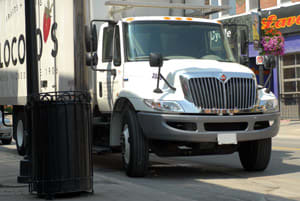
Fuel efficiency hasn't been a high priority for tire makers' medium-duty and regional service offerings - until now. (Photo by Jim Park)
Talk tires with anyone in the long-haul truckload sector, and fuel economy won't be long percolating to the surface. Every mile they run is pure cost, and any savings are big savings.
To the medium-duty crowd and to folks who bash their tires against curbs and drive through potholes large enough to swallow a wheel, however, fuel economy might not be the highest priority. Armored casings and bullet-proof treads are the order of the day. Tires built to be beat up don't lend themselves to low rolling resistance.
But tire makers are now hearing from fleets wanting durable and efficient tires. It's a tall order, but they're on it.
Traditionally, regional fleets or fleets with a higher percentage of non-highway and even off-road miles opted for tires with a solid shoulder and a deeper tread - both hallmarks of the tire designed primarily with durability in mind. Many of these fleets are now crossing over to more of an over-the-road tire, says Chris Tolbert, a business segment marketing manager at Michelin.
"Fleets are diversifying, and we have to keep that in mind as we're developing new product," he says. "Where a fleet might have once run exclusively over the road, they're stopping more often now and making more pick-ups and deliveries en route. What they are doing now looks a lot like a regional application with more turns, more potential for sidewall damage, and certainly additional time on damaged parking lots with potholes and loose gravel."
Changing fleets
Some highway trucks are now behaving like city P&D trucks. At the same time, the P&D fleets are looking for tires with on-highway efficiency and regional durability.
Take the small package delivery truck, for example. There's a lot of twisting and turning in that environment, and scrubbing too, but Tolbert says those fleets want a casing that can be retreaded several times, and for all wheel positions.
"They're running more durable casings built to withstand sidewall shocks," he says. "But they're looking at lower rolling-resistance tires now too. That's not what we would have called a hot-button issue just a short time ago, but it's here now."
That, of course, requires a change in design strategy. You get improved rolling resistance through different tread compounds and shallower tread, which is going to lower the removal miles. Still, the 19.5-inch tire common in P&D applications has some inherent fuel saving qualities. Its smaller air chamber means less sidewall flex, which improves rolling resistance - to a point - like their 22.5 low-profile cousins.
Bridgestone's Guy Walenga, director of engineering, commercial products and technologies, points to the tire's past.
"There was a time when the tire industry was looking closely at the 19.5 as alternative to then-current 22.5-inch tire technology," he says. "That didn't work out the way some were hoping, but now EPA SmartWay is looking at rating the 19.5 tires based on their fuel-saving qualities. Even so, we have to be careful not to take away the tire's traditional measure of performance. It's a regional tire that takes a lot of hits. We'll have to make it stand up, and be more fuel-efficient at the same time."
Walenga says the truck population is changing, and tire makers are responding by bringing technology to local and regional tires that was once the sole domain of the highway haulers.
"The 255 70R 22.5 is still the most common heavy truck tire in the country, but the 245 70R 19.5 is moving up," he says. "It's now the fifth or sixth most common tire, and as delivery fleets expand, those tires will gain even more ground. We'll be looking closely at ways of improving efficiency there, too."
Fuel economy: The be all, end all?
While tire makers do their R&D work on lighter truck tires to improve fuel efficiency, some markets are less concerned about fuel economy, and more with durability and performance. The two aren't mutually exclusive, but to some, the trade-offs aren't worth it.
Take Pacific Gas & Electric for example. With a service area covering more than 75,000 square miles, and terrain as varied as urban areas, deserts, and mountain peaks, tire choices can't be taken lightly. A universally applicable tire for a fleet of 12,000 trucks is out of the question, says Dave Meisel, the utility's director of transportation.
"There's no silver bullet. It's more like silver buckshot," he says. "We do a lot of off-road in this business, and some of the rocky terrain we operate in tears chunks out of the tires. We need a really hard tread compound to resist tearing. In some situations, we need studded tires. As for fuel economy, it's very important to the utility overall, but it's not generally tire-related."
Instead, PG&E uses other technologies to reduce its fuel consumption, such as hybrid power systems, electric power-take-off systems, alternative fuels such as liquefied and compressed natural gas and biodiesel - and retreads in less demanding operating environments.
Environmentally friendly retreads
PG&E's Meisel points to the fact that retreading of light truck tires offers a reduction in carbon dioxide emissions of close to 60 pounds per tire, and even more for larger Class 7 and 8 vehicles.
"Prior to working with Goodyear, we never had confidence in retreads - primarily due to the issue of casing integrity and control," he says. "There were few consistent checks and balances in the process, so if we were to take in one of our tires for a retread, we weren't sure we were getting the same casing back - it could have been someone else's, or it could have been a casing that was on its last legs. To us, it wasn't worth the risk."
According to Matt D'Arienzo, Goodyear's national fleet manager who handles the PG&E account, retread integrity was a legitimate concern, and Goodyear's GTRACs tracking system addresses that.
"Through bar coding and tracking, we're able to ensure that customers are using their own casings and have the history on those casings," he says. "What's more, we have a host of quality control measures in place to inspect tires for any hidden issues."
Meisel estimates that PG&E uses more than 3,000 retreads (in Class 4 through 8 vehicles) over the course of a year, saving more than 45,000 gallons of oil in the manufacturing process. And, D'Arienzo adds, "The first retread drops a tire's cost per mile by 33 percent; a second retread off that casing brings it down by 45 percent; and if you retread a third time, the life cycle cost is reduced by 52 percent."
Whether it's reducing oil consumption in the production of new tires through retreading, or combining fuel-efficient, low-rolling resistance tread and compound designs with durable, street-proof casings, medium-duty tire technology is marching forward as fast as its heavy-duty, on-highway cousin.
"The customers are asking for it," notes Michelin's Tolbert. "The onus is on us to deliver."
The best of both worlds
Combining tread compounds, tread designs, and casing structure to meet the demands of an on-highway tire as well as a combination on- and off-road tire is going to result in trade-offs where neither can be perfectly optimized. Shallower tread, for example, while improving rolling resistance, can reduce puncture resistance, and shorten miles to removal. Thus are some of the challenges faced by tire makers in delivering robust, fuel-efficient tires for split-application service.
That said, Continental and Goodyear are now offering fuel-efficient regional tires claiming a good combination of lower rolling resistance as well as protection from harsh operating environments.
Continental's new HSR2 Eco Plus regional steer tire uses a fuel-efficient compound and a four-rib tread design to improve rolling resistance, and perform better in a combination on- and off-road environment than a straight long-haul steer tire.
"When tested with typical load
More Equipment

How Volvo Updated Its D13 for EPA 2027 [Watch]
Volvo’s updated D13 promises lower emissions without sacrificing performance or fuel economy. Take a closer look at what changed inside the engine in this HDT Spotlight video.
Read More →
Michelin Tire Improves Efficiency and Durability for Regional Fleets
The Michelin X Multi Energy D2 is a regional haul drive tire engineered to help fleets improve fuel efficiency, durability and traction in demanding stop-and-go operations.
Read More →
ZF Expands Commercial Vehicle Push in North America
ZF is expanding its North American commercial-vehicle presence with new transmission applications, electrification, trailer technology and autonomous-driving systems.
Read More →
Tesla Wants a Self-Driving Semi. Are Cameras Enough?
Could Tesla’s camera-only autonomous driving technology work on an 80,000-pound Semi? In this commentary, HDT's Deborah Lockridge takes a look at Tesla, Cybercab, and how autonomous trucks see the road.
Read More →
Kodiak: Driverless Long-Haul Truck Launch on Track for 2026
Kodiak AI says its driverless long-haul safety case is 93% complete and it remains on track to begin commercial operations by year-end 2026.
Read More →
What DOT’s Automated Vehicle Strategy Means for Trucking
The U.S. Department of Transportation issued a new automated-vehicle strategy that outlines plans for driverless-truck regulations, cross-state freight corridors, and federal safety standards.
Read More →
East Coast Port Launches $45M Electric Truck Push
The Port Authority of New York and New Jersey announced millions in incentives for zero-emission drayage trucks, yard tractors, and new charging hubs near the port.
Read More →
PlusAI Going Public to Fund Autonomous Truck Launch
A SPAC deal could provide PlusAI with up to $300 million as it works toward a 2027 commercial launch of factory-built autonomous trucks.
Read More →
NHTSA Moves to Rewrite Truck Fuel-Economy Rules
The National Highway Traffic Safety Administration says it lacks authority to regulate medium- and heavy-duty truck engines separately from complete vehicles, but the existing standards have not yet been eliminated.
Read More →
Detroit Opens Orders for EPA 2027 Engines
Detroit isn’t starting from scratch to meet EPA 2027 diesel emissions standards. Its Gen 6 DD13 and DD15 engines keep much of today’s platform while updating the fuel and aftertreatment systems.
Read More →