




5 Trends Affecting Reefers
Like the rest of the industry, refrigerated transporters are struggling to find and keep drivers. Meanwhile, outside factors range from regulations to the growing popularity of fresh convenience foods and e-commerce.

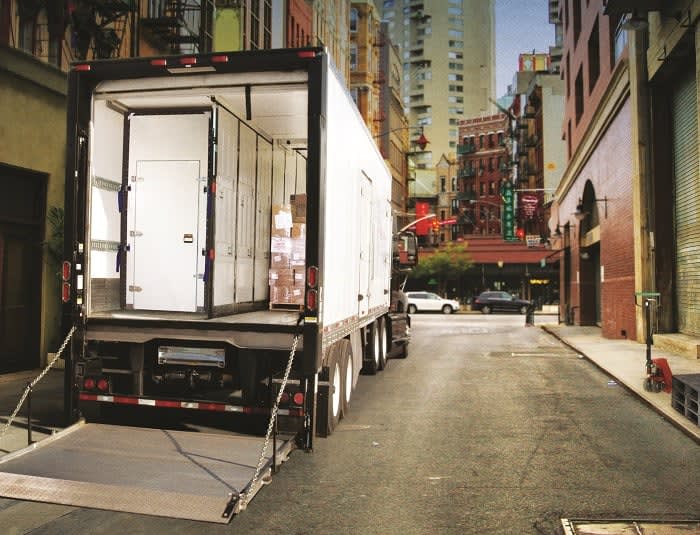
Multi-temp trailers like this Utility 3000R are especially affected by trends such as more fresh delivery and food safety regs. Photo: Utility
Photo: Utility [From HDT files]
The logistics industry changes as U.S. food consumption patterns change,” says Mark Ehrlich, director, van product line at Wabash National. “Equipment is changing as modes of transportation shift in response to the consumption trend.”
Like the rest of the industry, refrigerated transporters are struggling to find and keep drivers. Meanwhile, outside factors range from regulations to the growing popularity of fresh convenience foods and e-commerce.
1. Last mile and fresh food
According to Statistica, U.S. annual online grocery sales amounted to about $14.2 billion in 2017 and are expected to rise to nearly $30 billion by 2021.
Paul Jarossy, director of marketing and new business development for Morgan Corp., says retailers are looking for lower-weight delivery vehicles that allow for drivers without a commercial driver’s license. “Smaller chassis like Ford Transits and Spinter vans are becoming more popular for that segment.” It also means that the weight of the body is crucial. Morgan’s new home grocery body is based on its NexGen platform that uses weight-saving composite walls. “That allows them to add more cargo capacity with a smaller chassis.”
It’s not just home delivery. Look at Sheetz, Jarossy says. This booming convenience store chain also offers burgers, pizzas, sandwiches, salads and other quick-service foods —you can even order online for pickup. “They move product from depot to stores, and there are a lot of stores in the delivery area, so they need to get in and out quickly. Even some of the medium-duty larger reefers are too big, so they’re looking for the smaller trucks.”
2. Focusing on efficiency
For the refrigerated box itself and the refrigeration unit that keeps it cold, efficiency is more important than ever.
For instance, Carrier Transicold says its latest X4 units consume 5 to 22% less fuel than the models they succeeded, and Vector units consume up to 26% less fuel than previous models.
On top of that, electric standby allows reefer units to be plugged into AC power and run without the diesel engine while parked.
Carrier Transicold’s David Brondum, director, product management and sustainability, notes that beyond simple fuel savings, freight efficiency encompasses how many tons of freight are moved with a given amount of fuel. Carrier has cut the weight in its current lineup, Brondum says. “Unit weight savings can be greater than 350 pounds, allowing more cargo to be loaded. The North American Council on Freight Efficiency estimates the value of weight saved for a refrigerated van to be $2 to $5 per pound, based on … fuel savings and revenue generation potential. So a 350-pound weight savings may equate to a value of up to $1,750.”
Solar power is another efficiency play. Third-party vendors offer add-on solar panels. ThermoKing offers ThermoLite panels, which can help lower fuel consumption and reduce emissions while extending battery life. “We are finding that as customers adopt solar as a supplemental fleet power source, their reefers don’t have to restart as often in order to charge batteries; in turn, our customers are saving fuel,” explains Doug Lenz, Thermo King’s vice president product management, marketing and business development.
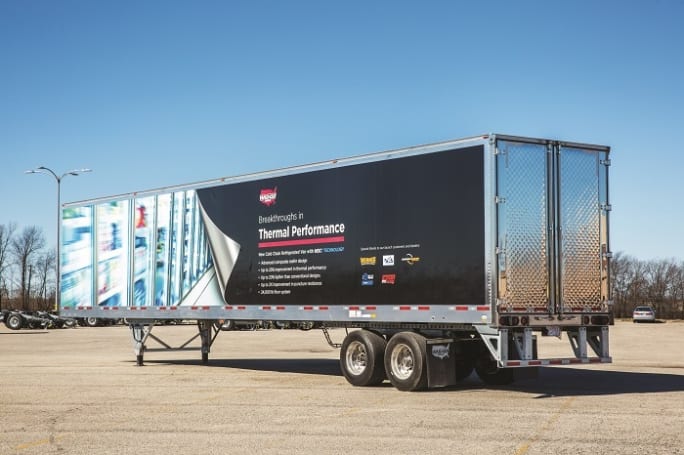
Wabash’s new cold chain series refrigerated trailer uses proprietary molded structural composite with thermal technology (MSCT), which the company says improves thermal performance, saves weight, and improves damage resistance. Photo: Wabash
3. Driver factors & duty cycles
As many fleets move to shorter hauls to get drivers home more often, and as new electronic logging rules put more pressure on loading and unloading times, trailers are taking more of a beating, says Craig Bennett, senior vice president of sales and marketing at Utility Trailer Manufacturing Co.
“You have more forklift traffic on the floors, hitting the walls, hitting the wear bands, and the rear end of the trailer that bangs into the docks.” On top of that, he adds, “everything’s about speed because of [mandatory] ELDs —get the trailer loaded and unloaded [fast]. So the forklift drivers … they don’t really care that much about what happens to the wall or the floor. They’re paid for speed, not delicacy.”
Trailer makers are responding with more standard and optional features to help make trailers more durable. Utility, for instance, increased its trailer floor capacity, offers upgraded liners, and has made detail improvements to the back of the trailer.
4. Advances in materials
All these factors are leading some truck and body makers to develop different materials types of construction. “We’re always looking at better foaming techniques and materials,” Jarossy says, noting that Morgan’s NexGen body uses a block foam, with the wall constructed like a sandwich. “So there’s no voids, so it has a very good R value.”
Wabash National has introduced new molded structural composites, technology used in the aerospace, automotive, and marine industries. “In van applications, we’re improving thermal efficiency by up to 28% while keeping weight comparable to a conventional reefer (20% lighter in some comparisons) and adding a 24,000-pound floor rating,” Ehrlich says.
Body damage can allow water to get into the insulation, adding weight and decreasing the insulating ability, or causing materials to rot or corrode. “Some of the things that typically have been known to be failure modes for reefers are the internal construction of the wall and the floor,” notes Todd Eicher, engineering director and plant manager for Stoughton. Its PureBlue trailer’s platen-foamed sides and roof ensure that the trailer is fully insulated in 360 degrees, with no voids or uneven areas.
Eicher says new reinforced thermal plastics offer higher performance and are more durable than earlier plastics. “Glass-reinforced composite materials are typically going to come at a little bit of a premium on paper compared to wood or metal, but the performance benefits tend to outweigh it.”
Repair costs are another factor. Some newer designs “offer great promise in terms of performance,” Eicher says, “but there’s a lot to be said for maintaining a more conventional design that is going to be familiar to repair shops.”
Bennett says in some applications, tougher duty cycles may call for less cutting-edge materials. “At our test track in southern California, we’ve tested composite materials and plastics, and they don’t perform as well as the current materials we’re using. The plastic cracks, particularly if the duty cycle is increased.”
How those materials are put together makes a difference, he says. Utility uses a foam-in-place technique. The floor, walls, and roof are one continuous envelope of foam.
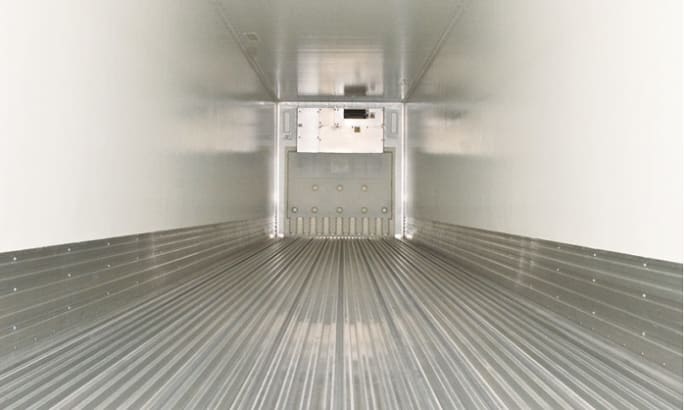
Anti-microbial liners like Great Dane’s Microban can address food safety regulations. Photo: Great Dane
5. Regulations
“Maintaining and recording the cargo temperature per the shipper’s requirements has become a high priority for carriers since the Food Safety Modernization Act became law,” says Chris Lee, Great Dane’s vice president of engineering. Great Dane, for instance, is implementing its integrated FleetPulse telematics system, which it says is the first of its kind. A number of third-party telematics systems are available.
Refrigeration units, of course, have been offering fleets real-time data via telematics for some time. All Precedent units now are equipped from the factory with Thermo King’s asset management system TracKing.
“Fleets must also develop proper cleaning and washing procedures per the shipper’s requirements,” Lee notes, adding that Great Dane offers antimicrobial solutions such as PunctureGuard and ThermoGuard reefer linings featuring Microban.
As Utility’s Bennett notes, “You want an interior that’s very cleanable. The hard places to clean are behind the air return bulkhead — ours easily hinges up to clean behind it —and above it there’s an air return chute in the ceiling” that needs special attention when cleaning.
In addition, “The government has introduced several environmental regulations and policies that are focused on reducing greenhouse gas emissions,” says Wabash’s Ehrlich. Federal GHG2 rules for trailers were put on hold by a court decision last fall. However, California is working on its own version of the GHG rules for trailers.
There is a lot of new technology available to address these trends, says Lee. “However, it is important to remember that the technology must fit one’s operations and should be vetted out by individual fleets. Technology will not provide ROI for a fleet if it does not work properly or fit the needs of its operations.”
Related: ENow Unveils All-Electric, Solar-Powered Refrigerated Trailer
More Equipment

How Volvo Updated Its D13 for EPA 2027 [Watch]
Volvo’s updated D13 promises lower emissions without sacrificing performance or fuel economy. Take a closer look at what changed inside the engine in this HDT Spotlight video.
Read More →
Michelin Tire Improves Efficiency and Durability for Regional Fleets
The Michelin X Multi Energy D2 is a regional haul drive tire engineered to help fleets improve fuel efficiency, durability and traction in demanding stop-and-go operations.
Read More →
ZF Expands Commercial Vehicle Push in North America
ZF is expanding its North American commercial-vehicle presence with new transmission applications, electrification, trailer technology and autonomous-driving systems.
Read More →
Tesla Wants a Self-Driving Semi. Are Cameras Enough?
Could Tesla’s camera-only autonomous driving technology work on an 80,000-pound Semi? In this commentary, HDT's Deborah Lockridge takes a look at Tesla, Cybercab, and how autonomous trucks see the road.
Read More →
Kodiak: Driverless Long-Haul Truck Launch on Track for 2026
Kodiak AI says its driverless long-haul safety case is 93% complete and it remains on track to begin commercial operations by year-end 2026.
Read More →
What DOT’s Automated Vehicle Strategy Means for Trucking
The U.S. Department of Transportation issued a new automated-vehicle strategy that outlines plans for driverless-truck regulations, cross-state freight corridors, and federal safety standards.
Read More →
East Coast Port Launches $45M Electric Truck Push
The Port Authority of New York and New Jersey announced millions in incentives for zero-emission drayage trucks, yard tractors, and new charging hubs near the port.
Read More →
PlusAI Going Public to Fund Autonomous Truck Launch
A SPAC deal could provide PlusAI with up to $300 million as it works toward a 2027 commercial launch of factory-built autonomous trucks.
Read More →
NHTSA Moves to Rewrite Truck Fuel-Economy Rules
The National Highway Traffic Safety Administration says it lacks authority to regulate medium- and heavy-duty truck engines separately from complete vehicles, but the existing standards have not yet been eliminated.
Read More →
Detroit Opens Orders for EPA 2027 Engines
Detroit isn’t starting from scratch to meet EPA 2027 diesel emissions standards. Its Gen 6 DD13 and DD15 engines keep much of today’s platform while updating the fuel and aftertreatment systems.
Read More →