




Watch the full “Beyond ‘Driver Appreciation" webinar on demand
4 Ways Fleets Can Lower Driver Turnover
Two fleets share insights on how going beyond "driver appreciation" helps keep drivers satisfied and reduces turnover.
by Ronnie Wendt
February 8, 2022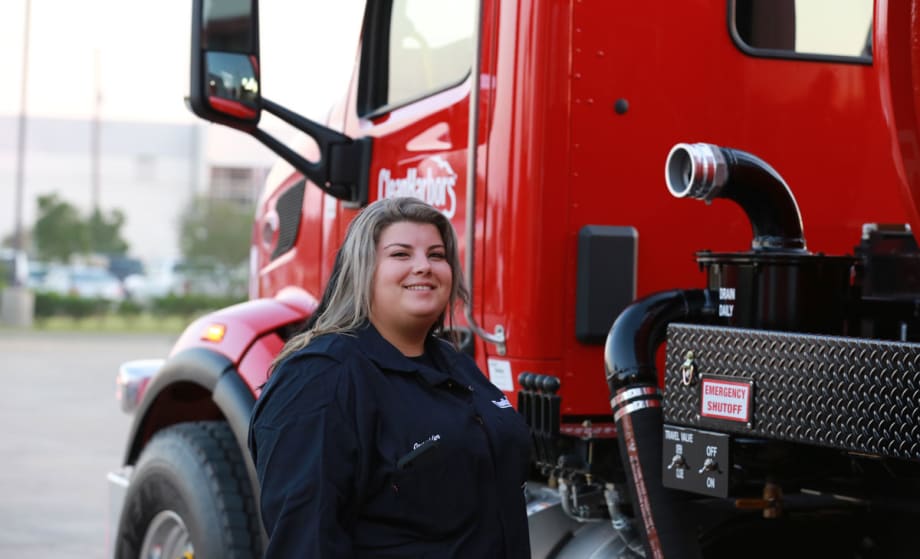
While women drivers traditionally have demanded more regular home time, today a new generation of both male and female drivers is keenly aware of work-life balance.
Photo: Clean Harbors
6 min to read
Hats, barbeques and plaques only go so far in convincing truck drivers that their company appreciates them. These are only short-term fixes for long-term problems, according to panelists in a recent HDT webinar, “Beyond ‘Driver Appreciation.”
The panelists recommend fleets employ four key practices to keep driver turnover at a minimum.
Offer a clear career path for drivers.
Set realistic expectations.
Optimize home-time where possible.
Give a voice to the driver.
1. Offer a Career Path to Success
Officially Debbie Landry has the title of director of driver services at Halvor Lines, a Wisconsin-based fleet that recently made the Truckload Carriers Association’s Best Fleets to Drive For list. But to its drivers, Landry is “vice president of happiness.”
As an expert listener, Landry hears driver concerns and questions and works with managers to solve problems and provide answers.
Out of that came several initiatives to provide drivers with opportunities to advance their careers. For instance, the company launched an entry-level driver training program in Minnesota and Wisconsin to provide paid training to assist drivers with their CDL and over-the-road training.
“During their training, they are at our facilities working with Halvor Lines’ equipment and absorbing the Halvor Lines’ culture, which is based around safety and family,” she said.
Experienced instructors who drove for Halvor Lines in the past educate new hires. The company draws trainers from employees with a desire to teach others. Former drivers also serve on the company’s orientation team, safety team, and as driver managers.
These programs put new opportunities in every driver’s path.
Another example: the fleet helps drivers become owner-operators. Halvor Lines operates 600 tractors, 500 of them company trucks and the rest owner-operators.
The company has qualified more than 100 drivers for its lease-purchase program. “We do our best to set them up for success in a meeting between the driver, our chief strategy officer and myself,” Landry said.” Here, we discuss the program and the driver’s responsibilities as a business owner.”
Loan Mansy, executive vice president of Clean Harbors, an environmental and industrial services provider, also helps employees earn their CDLs. Driver onboarding coordinators ensure drivers meet all federal, state and company-specific training requirements. Managers host employee engagement touchpoints every six months.
“We discuss how they are doing and their career aspirations,” Mansy said. “Many of our executives, including our CEO and COO, were drivers at the beginning of their careers here.”
2. Keep it Real
Desperate times lead to desperate measures. Fleets competing for drivers amid a labor shortage may make promises they cannot keep — and that leads to high turnover.
Fleets that want to keep drivers make retention part of their strategy from the beginning by giving every new hire a realistic expectation of the job.
At Halvor, recruiters verify drivers’ skills and verify home time, driver pay, and travel lanes, but Landry takes this effort a step further. “Recruiters can qualify a driver, but I dig in deeper in one-on-one interviews to discuss lifestyle and expectations [and provide] information they may not have considered,” she explained.
In these chats, Landry discusses:
Being away from home and its challenges. “We talk about being away from home, who they are leaving behind, and how they have prepared their family for this change,” she said.
Living in a truck. Landry describes trucks as “mini apartments.” Company trucks have two beds, a refrigerator, inverters, and satellite TV. “Drivers are often surprised they will not sleep in hotels every night,” she said.
Driving challenges. Landry makes sure drivers understand they may drive at night, through the mountains, or in inclement weather conditions.
Map reading and road sign skills. “I explain they are not driving a car and cannot just rely on GPS,” she said.
Halvor Lines’ Driver Training Department conducts similar interviews with prospective trainees (drivers who have graduated from an accredited driving school) prior to orientation. The interviews help match new hires to over-the-road trainers.
3. Get Drivers Home More
The demands of long-haul trucking can challenge even the most committed driver. Adequate home time helps fleets retain drivers with families at home. Nothing says to a driver that a fleet doesn’t appreciate them like a lack of respect for family commitments.
At Clean Harbors, 14% of drivers are women (double the industry average), who often want to be home at night.
“However, it’s not just women who want to this,” Mansy said. “Male drivers also don’t want to miss their children’s lives. They are putting priority on family first. And younger-generation drivers don’t want to be on the road 24/7. Work-life balance is important to them.”
Clean Harbors offers some local routes. But many of its routes are long-haul journeys that take drivers away for days. The company is considering a relay trucking model to ease the sting. In this model, drivers change over every few hundred miles through a network of change-over stops. This strategy helps drivers return to their home base every day.
Halvor Lines already offers relay trucking. “We have terminals in Minnesota, Wisconsin, Iowa and Indiana, so we can offer relays from terminal to terminal to provide drivers with needed home time,” Landry said.
The fleet also allows drivers to take a passenger or pet with them. “Sometimes home time is less important if they have a pet or family member with them.”
4. Put On Your Listening Ears
Satisfied drivers report feeling their opinions matter to the companies they work for. Clean Harbors commits to hearing from drivers in a few ways:
Local level. Branch managers meet with drivers at morning crew out and at end-of-day crew in.
Corporate level. The Clean Harbors Drivers Committee, staffed by the director of employee engagement, hosts a monthly call for key driver reps and driver types. A forum lets drivers share feedback on how the company can improve.
Driver level. The company is creating four driver committees: Class A drivers, equipment operators, box truck drivers, and Safety-Kleen drivers. Regional SVPs, National Business Line SVPs, and Regional HR business partners will lead the committees.
Mansy outlines the steps to establish driver engagement committees, noting it’s important to walk before you run.
Pick one driver group with the highest turnover and set up a pilot driver committee.
Select committee leaders who are passionate about their drivers and have enough seniority to give resources and execute action plans.
Start with a select group of drivers whose input you value.
Open to a larger group after the pilot ends.
At a time when the American Trucking Associations estimates a shortage of over 80,000 truck drivers, fleets must do all they can to hire the right drivers and keep the drivers they have. Drivers stay with fleets that offer a path to success, clear expectations, work-life balance, and let them give input.
Subscribe to Our Newsletter
More Drivers

Platform Science Adds Dispatch and Safety Tools
Four additions to PS Fleet help fleets monitor loads, manage driver coaching, share truck locations and adjust video system settings.
Read More →
When Language Stops the Truck: The Return of ELP Out-of-Service Orders
English language proficiency rules for commercial drivers aren’t new, but renewed out-of-service enforcement has raised the stakes. Here’s what carriers need to know before a driver reaches a roadside inspection.
Read More →
Samsara Launches Custom AI Agent Builder
Agent Studio lets fleets create AI tools for hours-of-service monitoring, reporting and driver support, including agents that communicate by phone.
Read More →
Trucker Path Expands Reserved Parking Network
Trucker Path has added close to 6,000 more truck parking spaces to its Trucker Path Reserved Parking Network with the addition of Safe Truck Parking.
Read More →
EEOC Sues Texas Trucking Company Over Driver Age Limits
The agency says Trancasa USA rejected applicants over 65 and applied tougher driving-record standards to those over 60.
Read More →
Nussbaum, Roehl Announce Second Driver Pay Increase This Year
This year has seen a swath of major truck driver pay increases as freight capacity has tightened.
Read More →
From One Generation to the Next: How Mentorship Builds Safer Truck Drivers
After three decades in trucking, Harold Perry shares what he's learned about driver safety, mentorship, and helping the next generation build confidence behind the wheel.
Read More →
Truck Drivers Need More Than Another Alert
Fleets have more visibility into truck health, safety events, and driver activity than ever. The next challenge is turning all that information into useful guidance for the person who has to decide what to do next.
Read More →
FMCSA Removes 110 Truck Driver Training Schools from Certified ELDT List
Federal regulators also are targeting more than 160 additional training providers and launching a nationwide audit of third-party CDL skills testers as part of a broader crackdown on trucking fraud.
Read More →
Hours of Service Pilot Programs: FMCSA Readies for 2027 Rollout
Two pilot programs could eventually reshape hours-of-service rules, giving truck drivers options to pause their 14-hour clock or use longer split sleeper rest periods.
Read More →