




Related: NACFE Fleets Saved Almost $900 Million in Fuel Costs
3 Fleets Share Fuel-Saving Strategies
Sustainability and fuel savings strategies vary greatly depending on each fleet’s operations and applications. Some motor carriers may even need to adopt multiple strategies and specs for different parts of their fleet. Three fleets with different operations share their sustainability and fuel economy tactics.
by James Menzies and Deborah Lockridge
February 27, 2020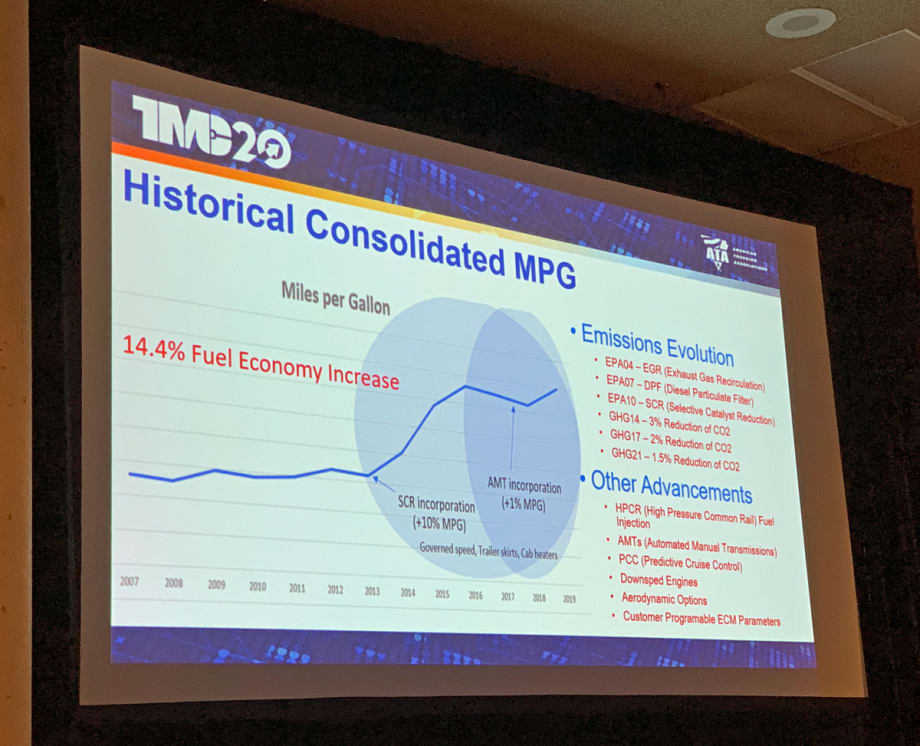
J.B. Hunt saw fuel economy increase by 14% between 2007 and 2019.
Photo: Deborah Lockridge
5 min to read
Sustainability and fuel savings strategies vary greatly depending on each fleet’s operations and applications. Some motor carriers may even need to adopt multiple strategies and specs for different parts of their fleet.
A panel discussion at the American Trucking Associations’ Technology & Maintenance Council’s Annual Meeting in Atlanta Feb. 25 featured three fleets with different operations and varying sustainability and fuel economy tactics.
J.B. Hunt: Complex Operations
Tommy Cottingham, director of maintenance and procurement with J.B. Hunt, pointed out that the complex operations of the Arkansas-based company make a one-size-fits-all approach to fuel economy impossible. Dedicated Contract Services is the most challenging because of its equipment diversity – everything from typical highway trucks to ones equipped with PTOs and cranes to final-mile box trucks; with trailers ranging from dry van to dumps, car haulers, and more. Then there’s the intermodal group, doing drayage and regional, with a lot of urban environments that “lend themselves to damage” of things like aerodynamic add-ons. And in its truckload division, other people pull a large portion of its 7,000 trailers on a daily basis.
Cottingham said the fleet saw fuel economy increase by 14% between 2007 and 2019. Some of the strategies that helps with that were the adoption of EPA-2010-tech trucks with selective catalytic reduction (SCR), which offered better fuel economy than their predecessors.
Between 2013 and 2018 the company has been replacing its trailer fleet. “Every one of our dry vans are now equipped with skirts and low rolling resistance tires,” said Cottingham. “For a few years there, we saw a really good pickup in fuel economy.”
Spec’ing automated manual transmissions delivered another 1% improvement, and further gains were seen when the company adopted adaptive cruise control and incentivized drivers to use cruise by offering a higher top speed of 65 mph while in cruise. The fleet believes in 13-liter engines and higher drive axle gear ratios, as well as customer-programmable engine options – but hasn’t been able to find an auxiliary power unit that works in its application.
Aerodynamics have also contributed to J.B. Hunt’s success. “Aerodynamics is very important,” he said. Even in operations that aren’t classic long-haul that gain the most aero benefit. Its own data on intermodal drayage trucks in Chicago found that while the fuel-tank skirts do incur damage at times, but Cottingham said the fuel economy gains are worth it. One aerodynamic option J.B. Hunt does not employ are low-valance air dams, which are prone to damage.
The company continues to evaluate new technologies, and is currently looking at tire inflation systems, rear trailer aero devices, and wheel covers and fairings. When evaluating technologies, the company looks for an 8% return on invested capital, which generally ensures there’ll be an ROI in real world operating conditions.
Hirschbach: Don't Overlook the Driver
John Vesey, a lease-operator with Hirschbach who also spent four years in the office, urged fleets in attendance to not overlook the driver’s role in fuel economy, noting they can swing fuel economy as much as 30% in either direction. Hirschbach uses quarterly fuel-based incentives to encourage drivers to use cruise control, minimize idling, etc.
“You want buy-in from your drivers,” he said. “For us compliance is a culture, making sure the drivers understand you can be sustainable and still be profitable.”
As far as equipment, he said, “it seems a lot of fleets get stuck looking at the whole bigger picture all at once” and get overwhelmed. “Start out with just one thing, like aero, idle and throttle governors, having a lower rear end ratio, lightweighting.” Once you’ve tackled pretty standard areas like that, he said, then you can fine tune your efforts by working on things such as low-viscosity lubricant and emerging technology like solar.
Vesey also emphasized the importance of relationships with vendors. “Research is a key to building trust,” he said, recommending fleets ask for third-party tests and for customer contacts, and do plenty of research, asking vendors questions, and making sure they can actually deliver.
C&S Wholesale: Clean-Sheet Project
C&S Wholesale Groceries runs about 1,000 power units and 7,200 trailers. It’s the largest wholesale grocery distributor in the U.S. But when Vice President Chris Trajkovski got there about five years ago, the fleet really wasn’t worried about fuel economy. “We’re a hundred-year-old warehouse company that was very, very good at procurement and purchasing,” he said. But for fuel economy, he had to start with a clean sheet.
About five years ago, C&S Wholesale Groceries began a "clean sheet" fuel economy project.
Photo: Deborah Lockridge
“What I’ve seen is a lot of people try to bolt a lot of things on, but if you don’t have the basics buttoned down, it’s really tough to get there.”
He and his team embarked on a program that took about six months, developing a complex, robust ROI calculator.
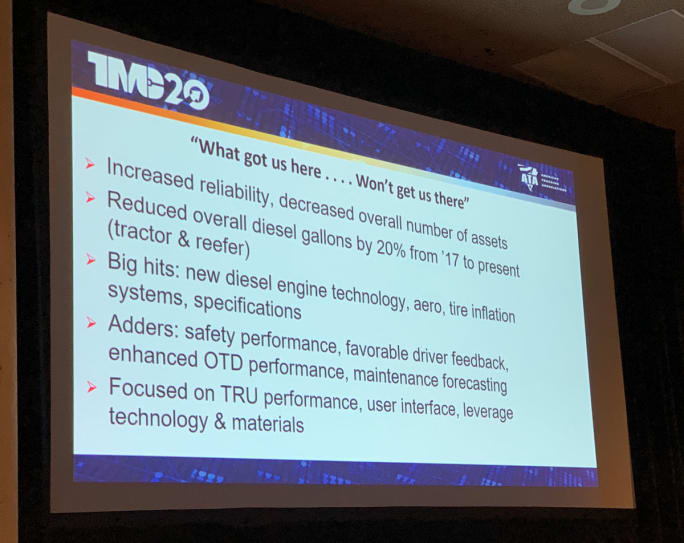
One of the big tactics was smoothing out replacement cycles to take advantage of new fuel-saving technologies. “A quarter of our tractors get replaced every year,” said. “We don’t have these peaks and valleys. We did the same thing with reefers and dry vans.” Since 2017, C&S Wholesale Groceries has decreased its diesel consumption by 20%. It has also increased reliability and enhanced driver satisfaction. “Stabilizing the fleet with a replacement plan was really key,” Trajkovski said.
“I can’t downplay the importance of specifications,” he added. The team went through its specs line by line and went through every option, asking, “what does this mean, and what will it get us if we do this option?” he said. “There were little nuggets in there that delivered efficiency and uptime as well.”
The company also has leveraged telematics, and It’s testing electric transport refrigeration units.
“We ask folks who introduce new things, ‘how does it work outside of the lab?’ We’re not a tester of technology, nor are we going to be. We ask the question, can we integrate it into the fleet, and is it durable and reliable. The latest and greatest technology doesn’t do us any good if it doesn’t deliver the groceries at the end of the day.”
Subscribe to Our Newsletter
More Equipment

How Volvo Updated Its D13 for EPA 2027 [Watch]
Volvo’s updated D13 promises lower emissions without sacrificing performance or fuel economy. Take a closer look at what changed inside the engine in this HDT Spotlight video.
Read More →
Michelin Tire Improves Efficiency and Durability for Regional Fleets
The Michelin X Multi Energy D2 is a regional haul drive tire engineered to help fleets improve fuel efficiency, durability and traction in demanding stop-and-go operations.
Read More →
ZF Expands Commercial Vehicle Push in North America
ZF is expanding its North American commercial-vehicle presence with new transmission applications, electrification, trailer technology and autonomous-driving systems.
Read More →
Tesla Wants a Self-Driving Semi. Are Cameras Enough?
Could Tesla’s camera-only autonomous driving technology work on an 80,000-pound Semi? In this commentary, HDT's Deborah Lockridge takes a look at Tesla, Cybercab, and how autonomous trucks see the road.
Read More →
Kodiak: Driverless Long-Haul Truck Launch on Track for 2026
Kodiak AI says its driverless long-haul safety case is 93% complete and it remains on track to begin commercial operations by year-end 2026.
Read More →
What DOT’s Automated Vehicle Strategy Means for Trucking
The U.S. Department of Transportation issued a new automated-vehicle strategy that outlines plans for driverless-truck regulations, cross-state freight corridors, and federal safety standards.
Read More →
East Coast Port Launches $45M Electric Truck Push
The Port Authority of New York and New Jersey announced millions in incentives for zero-emission drayage trucks, yard tractors, and new charging hubs near the port.
Read More →
PlusAI Going Public to Fund Autonomous Truck Launch
A SPAC deal could provide PlusAI with up to $300 million as it works toward a 2027 commercial launch of factory-built autonomous trucks.
Read More →
NHTSA Moves to Rewrite Truck Fuel-Economy Rules
The National Highway Traffic Safety Administration says it lacks authority to regulate medium- and heavy-duty truck engines separately from complete vehicles, but the existing standards have not yet been eliminated.
Read More →
Detroit Opens Orders for EPA 2027 Engines
Detroit isn’t starting from scratch to meet EPA 2027 diesel emissions standards. Its Gen 6 DD13 and DD15 engines keep much of today’s platform while updating the fuel and aftertreatment systems.
Read More →