




121 Ways to Save Fuel: Technology
From the equipment you spec and maintain, to the fuel you buy, to driver training and incentives, you’ll find tips for nearly any type of fleet.
60. Look into truck platooning
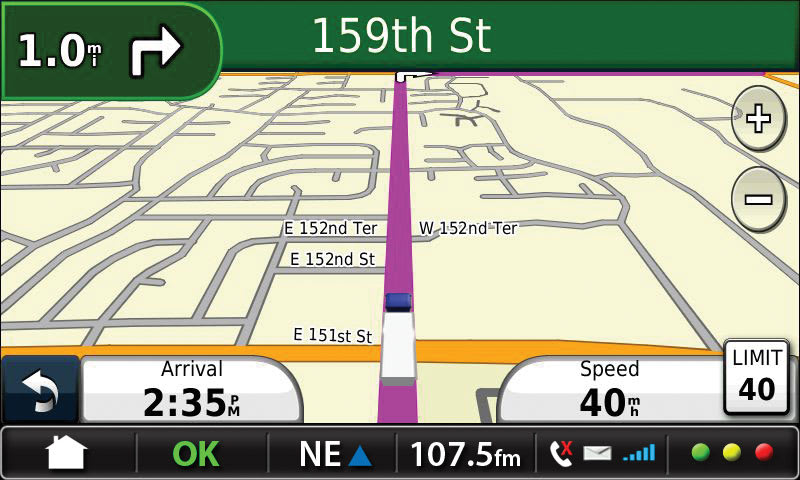
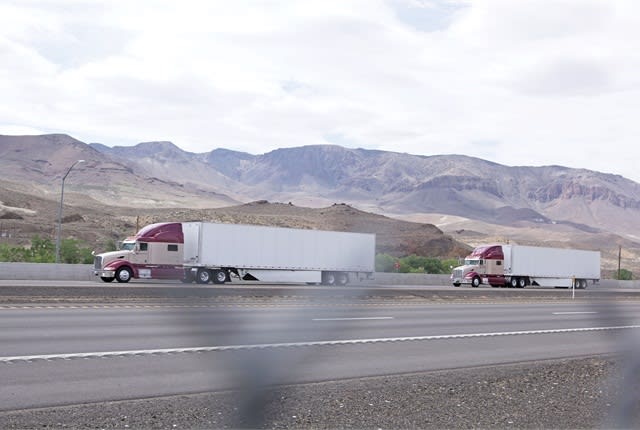
It’s not quite ready for prime time, but Peloton Technology, based in Menlo Park, Calif., is looking for fleets to test its two-truck platooning system, which can save fuel by creating a smooth air flow over a pair of tractor-trailers.
The technology uses a forward collision avoidance system and vehicle-to-vehicle communication to allow two trucks to travel closer together than would normally be safe.
Josh Switkes, Peloton CEO, says the system combines forward-looking radar, intelligent braking and the V2V link to allow the trucks to travel close together, reducing drag and saving fuel in the process. In a test with C.R. England last year, he says, they achieved a 10% improvement in fuel efficiency for the following truck and a 4.5% increase for the front truck.
Trucks can only be paired in a platoon if conditions warrant, and then only through Peloton’s cloud-based platooning operations center.
Once the system is engaged, the active safety systems from both trucks are linked, extending their effectiveness. A display panel in the front truck can show what the following truck’s forward-facing camera sees, while the following truck can see what the front truck’s camera sees.
The key to the system is the response time of the forward collision avoidance system, which controls braking and acceleration. A truck driver needs 1 to 2 seconds to react when a vehicle in front of him slows – thus the need for more following distance. The Peloton system, on the other hand, reacts in a fraction of a second, making a shorter following distance safe.
The technology combines wireless DSRC and cellular communications, sensors and active safety devices, with the core function to synchronize acceleration and braking between pairs of tractor-trailer combinations. During platooning, the drivers retain control of the system and the vehicles’ steering.
When not platooning, the trucks still reap benefits, including collision avoidance, brake and tire diagnostics and video displays of blind spots.
Switkes says the company’s nationwide network operations center is being developed and will coordinate trucks seeking a platooning partner on the road — even trucks from different fleets. The center uses geo-fencing to limit platooning only to safe roads and under safe conditions and with safe drivers. It also collects diagnostic and analytical data from the vehicles within the system.
61. Use your telematics information
Much as a vehicle’s telematics system gathers information from various components, trucking management software ties all that and more together in the back office to allow fleets to make the best decisions possible.
Randy Seals, customer advocate at McLeod Software, says fleets are making progress controlling fuel use “by using all the available data, data mining, integrating software and vendor partnerships to educate not only the driver but the people behind the scenes to make better decisions.” And bringing all of that data together is the job a fleet’s TMS was designed to do.
Your TMS should provide a seamless flow of information from shipper to provider to driver, and back again, says Dave Wangler, president of TMW Systems. This enables better decision-making, including consideration of factors that affect how much you spend on fuel.
62. Track that fuel data
There are many options to help you keep track of data such as fuel consumption, mpg, idle time, hard braking and road speed.
“You will always want to track fuel mileage by driver and by unit,” says J.J. Keller. “This will allow you to locate drivers with poor driving techniques, theft, and underperforming drivers or vehicles.”
63. Optimize your routes
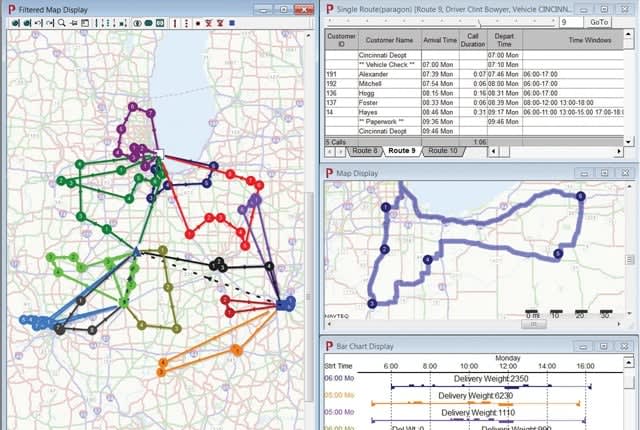
Effective routing has been a problem for carriers since before computers were invented, but today’s technologies provide another tool for solving this problem.
“The problem hasn’t changed. What’s changed is we have much more technology,” says Ken Weinberg, Carrier Logistics Inc.
For LTL or multi-stop trucking, automated routing systems help fleets produce better pickup and delivery plans, which can mean fewer trucks on the road as well as more efficient routes for those that are dispatched. For a company with 100 or more trucks on the road a day, reducing each truck’s mileage by 10% — which is about what most routing packages claim — adds up to savings.
Automated routing systems will also work with dock software so that trucks are loaded in the correct order to prevent drivers having to back track.
William Salter, CEO and president, Paragon Software Systems, says a good routing system achieves a balance between making routes that get all the work done and routes that are more efficient – in other words, the software makes sure a single vehicle is fully used rather than send out two half-full trucks.
64. Avoid left turns
As you’re optimizing routes, think about left turns.
UPS learned through time studies that avoiding left-hand turns conserves fuel, saves time, lowers emissions and avoids collisions. UPS managers experimented with the routes, eliminating left-hand turns to see if it led to increased efficiency. It worked. For the past several decades, UPS has designed routes in a series of loops with as few left-hand turns as possible.
Originally this was done manually, but today UPS has technology that automates the process for minimizing left-hand turns. Today, UPS managers combine personal and historical experience with computer programs to design delivery routes.
65. Use predictive analytics to forecast pickups
Many routing software vendors now build predictive analytics into their systems so fleets can anticipate pickups for each route.
Ordinarily, route planning for a day’s deliveries is completed before the pickup work is slotted in – the delivery and pickup are treated as distinct operations. But by combining the two with predictive analytics to forecast pickups, carriers can take advantage of additional opportunities to reduce mileage.
66. Manage the route on the road
For truckload carriers, the routing problem is different than LTL. While it’s important that the best truck-specific route is developed before a truck starts a trip, keeping the truck on that route is more important. Drivers may deviate from a route plan for a number of reasons – some valid, others less so – eating up more fuel.
U.S. Xpress, for instance, uses ALK Technologies’ PC*Miler routing software. It has a RouteSync module that connects planned routes in the back office with the navigated route in the cab, alerting drivers when they are going off route and enabling them to quickly return to the planned route.
Tom Flies, chief operating officer for Cadec, says carriers are looking at dynamic routing that would consider a host of factors in managing routes: traffic, weather conditions, customer demands, truck performance, hours-of-service and others. Using data tools to combine these factors with typical routing information gives fleets the capability to alter routes in real-time.
67. Use turn-by-turn navigation
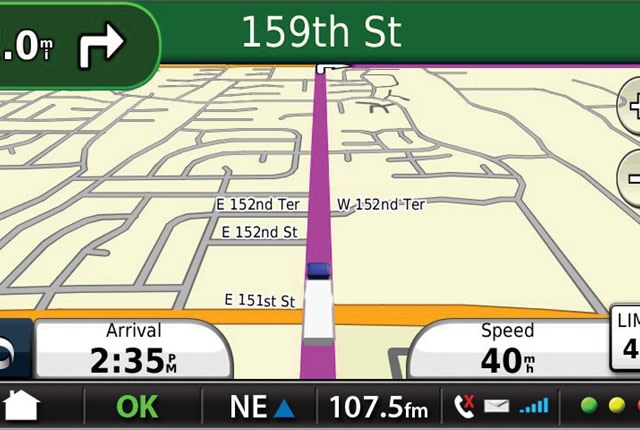
Turn-by-turn navigation systems in the truck cab help drivers get to their destination. Products, such as those from Rand McNally, ALK, Telogis, and others, provide truck-specific, turn-by-turn instructions that help drivers avoid missing a turn and having to backtrack, and keep them away from low overpasses and “no trucking” streets.
68. Use GPS/telematics
GPS location/tracking/telematics systems can help pull together various technologies to help reduce fuel use.
Norm Ellis, vice president of sales and marketing at Omnitracs, says when mobile communication/telematics systems first appeared, they provided about four applications, with positioning and messaging the key ones. “Today we have about 50 applications.”
Mark Wallin, vice president of product marketing at Telogis, says a telematics platform provides the foundation for gathering, transmitting and organizing a variety of data that fleets can put to use in their fuel-saving efforts.
69. Put analytics to work on mpg
Vusion’s mpg analytics dashboard, introduced earlier this year, collects and analyzes data that impacts fuel use, the company says. It helps managers identify areas that need improvement and in making buying/trading decisions. Data sources include the engine control module, GPS, dispatch, vehicle and fuel purchases. The dashboard presents visual comparisons that give a detailed picture of each vehicle, each driver, and how performance factors affect fuel economy.
Tom Fansler, Vusion’s president, said that without an automated system, “it would be hard for a fleet to understand how it’s performing in fuel economy relative to its peer group.”
70. Use data to find your fuel-wasting trucks
Aggressive data collection and analysis allows fleet managers to drill down into their operations and isolate the causes of fuel-guzzling vehicles, notes FleetAdvantage in its white paper, Leveraging Big Data to Maximize Fuel Economy.
For example, Terry Clouser, VP of fleet services at Fleet Advantage, points to Maines Paper & Food Service, which already had excellent fuel economy. But close data analysis found that some drivers, using a 10-speed transmission, spent as much as 40% of their time in 9th gear — sometimes with engines running up to 1,650 rpm — so they could accelerate or decelerate faster.
That’s well out of the “sweet spot” of 1,150 and 1,350 rpm and was costing the company about $2,000 a year per truck operating 100,000 miles per year.
The engine control modules were adjusted to get better driver compliance. Trucks were programmed to prohibit the driver from exceeding 1,650 rpm, and torque is taken away at 1,500 rpm. If drivers remain in 9th gear, their road speed is reduced.
RELATED: 121 Ways to Save Fuel
More Fleet Management

Color Match Smarter: Tools That Restore & Perform
For fleet managers and collision repair professionals keeping heavy-duty trucks on the road, getting the color right the first time isn't just about appearance — it's about efficiency, turnaround time, and bottom-line results. Discover how today's digital color tools are transforming the repair process from guesswork to precision.
Read More →
FMCSA Pauses Biennial-Update Enforcement Amid Motus Transition
Carriers whose updates were due on or after June 1 have more time, while FMCSA works to stabilize its new registration system and warns of phishing sites impersonating its new carrier registration system, Motus.
Read More →
2026 Blueprint for Countering Smarter Supply Chain Theft
Cargo theft is no longer just the cost of doing business. It's a multi-billion-dollar criminal enterprise exploiting vulnerabilities across your fleet, drivers, and supply chain.
Read More →


How Telematics Improves Visibility, Control, and Performance in Refrigerated Fleets
Explore how telematics help refrigerated fleets improve visibility, uptime, efficiency, compliance, and cargo protection across connected cold chain operations.
Read More →
What the U.S.-Canada Trade War Means for Trucking
Escalating U.S.-Canada tariffs could disrupt cross-border freight, reduce truck volumes, raise costs, and create new uncertainty for carriers on both sides of the border.
Read More →
What Are Trucking’s Top Concerns for 2026?
The American Transportation Research Institute wants to know what's worrying trucking fleet managers, drivers, and other stakeholders in its annual Industry Issues survey.
Read More →
American Trucking Associations Looks for a New Leader
ATA President and CEO Chris Spear abruptly left his job at the association on August 21, at a pivotal time for the trucking industry.
Read More →
Public Wi-Fi Cybersecurity Risks: How Truck Drivers and Fleets Can Protect Their Data
Public Wi-Fi can expose truck drivers and fleets to credential theft, malware, and other cyber threats. Here’s how to reduce the risk on the road.
Read More →
For Nicky Cupp, Fleet Innovation Starts With Frustration
HDT Truck Fleet Innovator Nicky Cupp turns everyday pain points at Fraley & Schilling into opportunities for better technology and smarter processes.
Read More →
Adam Buttgenbach’s Approach to Electric Trucks: Start With Where They Fit
HDT Truck Fleet Innovator Adam Buttgenbach helped PepsiCo build one of North America’s largest EV fleets by focusing on where electric trucks make operational sense.
Read More →