





Don't miss the interactive timeline of HDT's history.
100 Years of Covering Trucking: The 1990s
The 1990s brought increased government focus on the environment and truck safety, as well as a communications revolution. HDT covered it all.
June 9, 2022
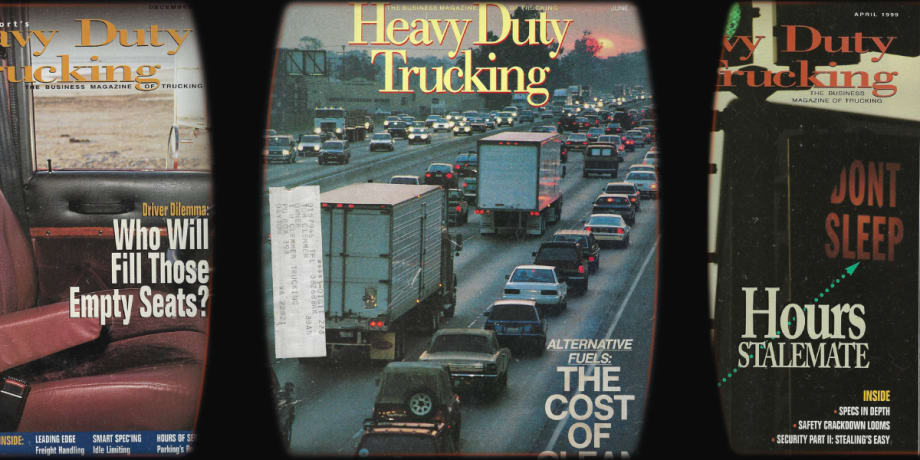
When HDT covered the 1990s, the trucking industry was in a regulatory evolution.
Graphic: HDT
4 min to read
The 1990s brought increased government focus on the environment and truck safety, as well as a communications revolution. HDT covered it all.
1990s: Regulations and Safety
After the federal deregulation of the economic aspects of trucking in 1980, in 1994, economic regulation was prohibited at the state level. In 1996, the Interstate Commerce Commission was abolished. By 1999, Congress, believing the trucking industry had too friendly a relationship with the Federal Highway Administration’s Office of Motor Carriers, passed a law creating a separate trucking safety administration.
No matter what agency was in charge, it was clear that throughout the 1990s, there was an increased focus on truck driver safety.
On April 1, 1992, all drivers of trucks over 26,000 pounds were required to have the new Commercial Driver’s License. HDT reported that a shortage of testing facilities would result in about 500,000 truckers missing the deadline.
In 1995, Congress repealed the national maximum 55-mph speed limit, and we explored the issue of speed over the next year with cover stories such as “The Price of Speed” and “How Fast is Too Fast.” HDT’s editors hit the road for an in-person look in “Close Encounters of the Driver Kind.”
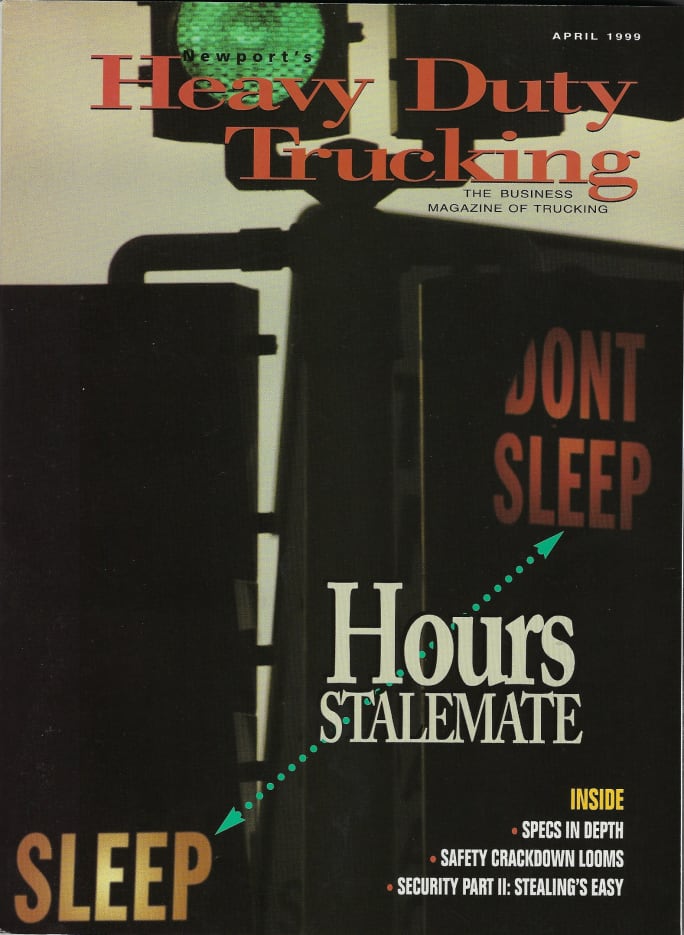
Attention turned to truck driver fatigue and Congress passed a law requiring a rewrite of hours-of-service rules. A February 1996 HDT cover said, “The Crunch is on: Hours of Service.” In 1997, cover stories tackled driver fatigue and sleep apnea. We reported on how the DOT missed the March 1999 Congressional deadline with an April cover story, “Hours Stalemate.” The proposal still had not been published by the end of the year.
With all the attention to trucking safety often drawing attention to unsafe “bad-apple” drivers, the industry worked to improve its public image. HDT covered topics such as how fleets should establish media policies (1995), sharing the road (1996) and the Share America Convoy (1997).
1990s: Drivers
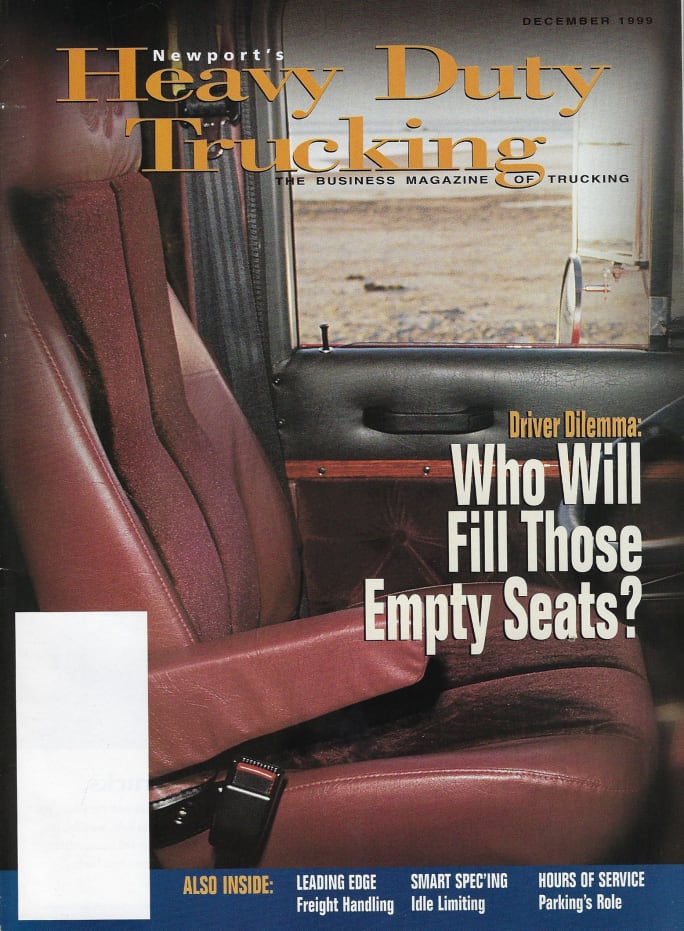
As we neared the end of the decade, fleets were concerned about finding drivers. An April 1997 story looked at driver compensation, as a driver wage survey “indicates significant adjustments as fleets chase J.B. Hunt pay hike.” By December 1998, a cover story explored, “What Makes Drivers Happy?” And we closed out the decade with a December 1999 cover, "Driver Dilemma: Who Will Fill Those Empty Seats?
1990s: Communications
The 1990s saw the birth of a communications revolution. Cell phones were becoming more affordable. The decade brought us text messages, the first camera phone, the 3G network, and the first mobile phone with GPS.
But few truckers had mobile phones. Qualcomm was the first to introduce a satellite-based tracking and communication system. White domes housing the antennas perched on the top of cabs, while a large keyboard device with a small green text screen was tethered inside the cab. The company’s Omnitracs system was so well-known that for a long time, many drivers would refer to any in-cab tracking and communications system as “a Qualcomm.” By the mid-90s there were competitors such as HighwayMaster, Rockwell (which would later become Meritor) and Orbcomm.
In November 1997, an HDT article explored the impact of these tracking systems with the feature “Privacy Rights: Feds Crossing the Line?”
And, of course, there was the Internet and the World Wide Web. HDT launched its website, www.truckinginfo.com, in the latter half of the 1990s. An April 1997 magazine article looked at “Trucking and the Internet” and told readers how to set up and maintain a website. (It was a lot harder back then.)
1990s: Equipment
Engine emissions and fuel economy were the big equipment stories in the 1990s.
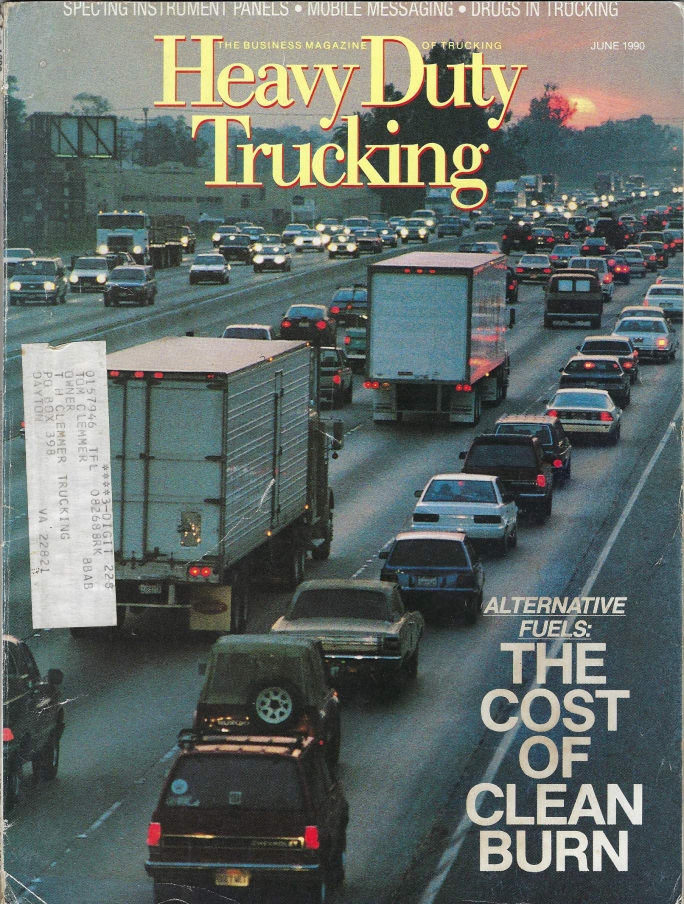
In June 1990, the cover story, “The Cost of Clean Burn,” explored alternative fuels for trucks, noting that “looming emission deadlines have put alternative-fuel research on the fast track. But additional costs and operational impacts for fleets may not be known for some time.”
Despite fears that new EPA regulations would mean the end of diesel, engine makers produced 1991 engines that were more fuel-efficient than their predecessors. The key breakthrough was electronic controls.
A March 1994 cover story, “Sky’s the Limit,” explored programming engines. The April 1997 cover story gave readers a look at the new diesel engines coming in 1998, as “demand for higher horsepower and increasingly strict emissions regs push new diesel engine designs.”
By 1998, all new air-braked trucks and trailers were required to have antilock brakes. ABS had come a long way since the “121” debacle of the 1970s, thanks to electronics. However, HDT reported there were still challenges. “The burning issue continues to be power between the tractor and trailer.”
Other equipment advances in the 1990s included early electronic stability control and electronically automated manual transmissions. Cab-over-engine tractors were losing ground in popularity to conventionals, and the last new Class 8 cabover introduced in the U.S. was the Freightliner Argosy in 1998.
Subscribe to Our Newsletter
More Fleet Management

Sponsored•September 16, 2026
Color Match Smarter: Tools That Restore & Perform
For fleet managers and collision repair professionals keeping heavy-duty trucks on the road, getting the color right the first time isn't just about appearance — it's about efficiency, turnaround time, and bottom-line results. Discover how today's digital color tools are transforming the repair process from guesswork to precision.
Read More →
FMCSA Pauses Biennial-Update Enforcement Amid Motus Transition
Carriers whose updates were due on or after June 1 have more time, while FMCSA works to stabilize its new registration system and warns of phishing sites impersonating its new carrier registration system, Motus.
Read More →
Sponsored•September 14, 2026
2026 Blueprint for Countering Smarter Supply Chain Theft
Cargo theft is no longer just the cost of doing business. It's a multi-billion-dollar criminal enterprise exploiting vulnerabilities across your fleet, drivers, and supply chain.
Read More →


Sponsored•September 1, 2026
How Telematics Improves Visibility, Control, and Performance in Refrigerated Fleets
Explore how telematics help refrigerated fleets improve visibility, uptime, efficiency, compliance, and cargo protection across connected cold chain operations.
Read More →
What the U.S.-Canada Trade War Means for Trucking
Escalating U.S.-Canada tariffs could disrupt cross-border freight, reduce truck volumes, raise costs, and create new uncertainty for carriers on both sides of the border.
Read More →
What Are Trucking’s Top Concerns for 2026?
The American Transportation Research Institute wants to know what's worrying trucking fleet managers, drivers, and other stakeholders in its annual Industry Issues survey.
Read More →
American Trucking Associations Looks for a New Leader
ATA President and CEO Chris Spear abruptly left his job at the association on August 21, at a pivotal time for the trucking industry.
Read More →
Public Wi-Fi Cybersecurity Risks: How Truck Drivers and Fleets Can Protect Their Data
Public Wi-Fi can expose truck drivers and fleets to credential theft, malware, and other cyber threats. Here’s how to reduce the risk on the road.
Read More →
For Nicky Cupp, Fleet Innovation Starts With Frustration
HDT Truck Fleet Innovator Nicky Cupp turns everyday pain points at Fraley & Schilling into opportunities for better technology and smarter processes.
Read More →
Adam Buttgenbach’s Approach to Electric Trucks: Start With Where They Fit
HDT Truck Fleet Innovator Adam Buttgenbach helped PepsiCo build one of North America’s largest EV fleets by focusing on where electric trucks make operational sense.
Read More →