




10 Things Truck Drivers Do to Get Pulled Over
A longtime state patrol officer offers his real-world observations on the most common reasons truck drivers get pulled over.
iStockPhoto
iStockPhoto
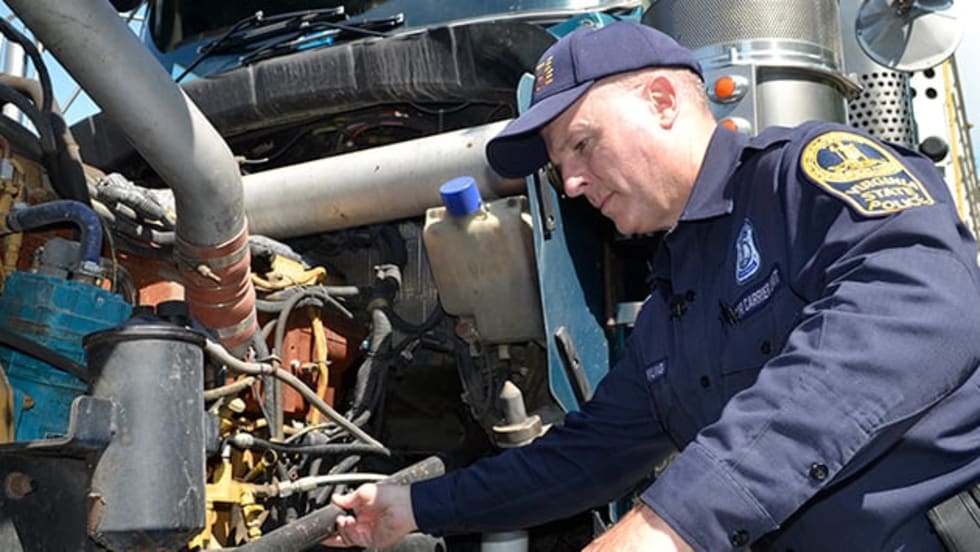
In my experience as a state patrol sergeant, there are a number of heavy-duty truck driver behaviors or situations that “stood out” from the norm when enforcing commercial motor vehicle safety on the highway -- and often result in a citation.
Not every violation mentioned below necessarily results in a citation, but it will, at a minimum, be a reason for a traffic stop and a possible warning. And many of the violation warnings will be evaluated in FMCSA’s safety measurement systems.
1. Following too close
When considering the perception and reaction time of 1.5 seconds, less than 2 seconds exists for the driver to see, acknowledge, and act by steering or braking to avoid a crash.
When trucks are following less than a truck length behind another, it’s obviously too close and an easy traffic stop. Of course, much more distance is needed to just fulfill the perception and reaction time and to meet most states’ following distance laws.
2. Speeding
Most commercial motor vehicle officers would prefer to have a reason for a CMV stop rather than random inspections. Speeding is rather easy to find and typically coupled with the above following too close.
Again, many stops may just be a warning, but the truck driver “gave reason” for the traffic stop, and now it’s an opportunity to review the driver’s credentials and the vehicle’s equipment.
3. Lane deviations
Not all lane deviations are unsafe or prohibited by state traffic laws, but for those that are, it’s an easy stop. For the others, significant deviations raise reasonable concerns relating to the driver’s possible illness, fatigue, or impairment.
Typically, once it’s observed that it was not simply a “push of the wind,” officers will initiate a traffic stop for deviations from the traffic lanes that are not typical or stand out from the norm for the conditions and roadway surface.
These stops frequently result in the observance of driver distraction with onboard electronics — and a high frequency of record of duty status concerns, as it’s a stop that was not anticipated by the driver.
4. Inattentiveness
Most officers have observed a truck that was approaching a lane closure or traffic stop at a high speed. At the last moment the driver finally takes the aggressive crash avoidance actions. I have had to drive out of the way to prevent a collision, even with red/blue lights activated and the siren blaring.
These drivers are of high concern to be stopped for illness or fatigue. They demonstrated a threat to themselves or others.
5. Improper load securement
Cargo securement violations literally stare the officer in the face. When equipment is loaded on a flatbed, it’s clearly in plain view, and securement methods, number of devices, and general condition can be readily observed. Any observed deficiency will result in a traffic stop.
While enclosed trailers are out of view during transportation, they will be checked during an inspection. It’s not uncommon to find heavy items or containment systems simply lined down the center of the trailer with no side-to-side securement.
We have seen our fair share of rollovers as a result of non-compliance where cargo has shifted when the drivers felt “it was too heavy to move.”
Related: 5 Things Drivers Never Should Do at the Scene of an Accident
6. Use of handheld phone
If the mirrors are properly adjusted, drivers using a handheld phone is just too easy to observe, particularly in an unmarked cruiser or a patrol vehicle.
Of course the concern relates back to attentiveness and the driver’s ability to respond quickly if crash avoidance is required.
7. Lighting violations
Many of the observed lighting violations could easily be avoided with a proper pre-trip and post-trip inspection.
The filaments of standard bulbs may “connect” and re-connect” with vibrations. In winter a person who has an inoperative headlamp could give it a slight tap and it’s now “working,” but of course it’s very temporary and certainly not a proper repair.
The frequent observation of required lighting devices and perhaps replacement lenses/bulbs carried on the units will reduce on-the-road observances. LED lamps are also promising for reducing lighting violations by eliminating that filament separation.
8. Improper registration or credential display
Although this is not a safety violation, it is a reason to initiate a traffic stop. What a great opportunity to “scratch and sniff,” as I would say.
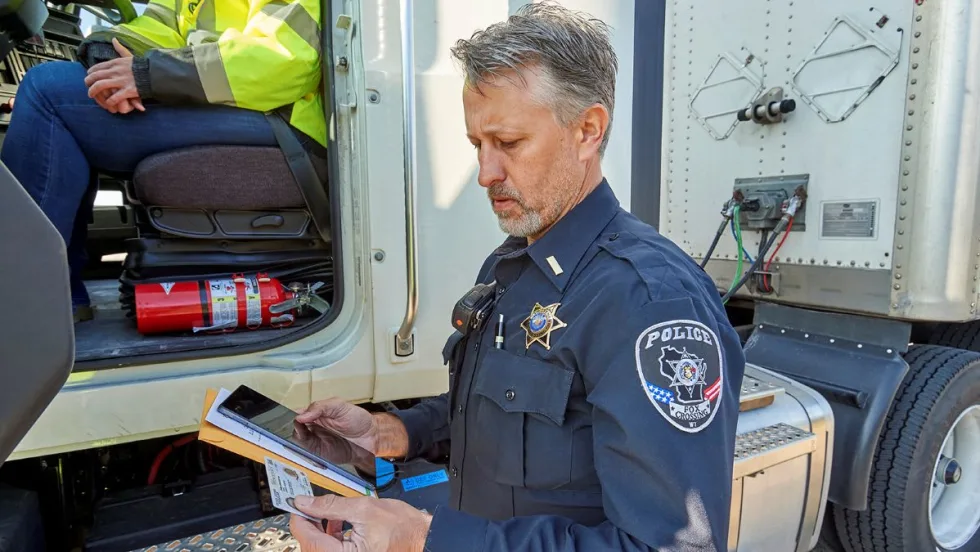
A CMV officer will at a minimum conduct a Level 3 inspection in this situation. Rest assured that as the officer is walking back and forth, he or she is taking a close look at the equipment, and if a violation is observed it will be upgraded to a Level 2 inspection.
9. Overweight Trucks
Proper weight distribution can prove a challenge for novice drivers. With the dramatic increase of mainline high-speed virtual weigh-in-motion systems, the ease and efficiency of this enforcement strategy has increased carrier contacts for violations.
The system is fantastic in screening a large number of CMVs and highlighting violators, yet minimizing the delays for carriers that are taking proactive measures with weight compliance. The chances are very high an inspection will follow this traffic stop.
10. Failure to obey official traffic signs or signals
Related to overweight violations is overlooking posted signs for weight limitations. Forfeitures where weight violations exist can be staggering, particularly if special weight postings are disregarded.
Other sign violations can also command substantial attention, such as misreading or misjudging a bridge height sign resulting in a bridge strike, where you can expect a CMV inspector to arrive and complete a post-crash inspection.
And failing to follow a state’s lane restriction guidance such as “all trucks use right lane” is entirely preventable.
Mark Abrahamson is a 27-year veteran of the Wisconsin State Patrol. He joined HNI, a non-traditional insurance provider and safety consultancy, in May. A version of this article originally appeared on HNI's Steal These Ideas blog. This article was authored and edited according to the standards of HDT’s editors to provide useful information to our readers.
More Drivers

New Independent Contractor Rule Gives Trucking More Clarity
The Labor Department is once again changing how it determines who's an independent contractor. This time, the rule includes specific examples addressing trucking safety requirements, CDLs, and lease-purchase agreements.

Catching Driver Fatigue is One Thing. What You Do Next Matters Just as Much
Fleets are getting better at detecting driver drowsiness. Few have figured out what should happen next, and that gap is where the real risk still lives.
133 ELDs Revoked as ATA Pushes Certification Reform
FMCSA just removed a record number of electronic logging devices from its registry. ATA says it's time to rethink how ELDs get approved in the first place.
CVSA Sets 2027 International Roadcheck Dates
The annual 72-hour truck inspection blitz will take place May 11–13 across North America. Here's what fleets can expect and what inspectors found during the 2026 event.

FDA Eases Path for Oral-Fluid Testing
Federal actions could advance oral-fluid drug testing for truck drivers, but lab certification delays and marijuana rescheduling questions remain.

Why Hiring Truck Drivers Is Getting Harder
Higher recruiting costs, a shrinking driver pool, and renewed pay competition are raising the stakes for fleets heading into 2027.
Roehl Offers Truck Drivers $10,000 Retention Incentive
Payments begin after the first load and continue in mileage-based installments for eligible experienced drivers joining the fleet.
Platform Science Adds Dispatch and Safety Tools
Four additions to PS Fleet help fleets monitor loads, manage driver coaching, share truck locations and adjust video system settings.
When Language Stops the Truck: The Return of ELP Out-of-Service Orders
English language proficiency rules for commercial drivers aren’t new, but renewed out-of-service enforcement has raised the stakes. Here’s what carriers need to know before a driver reaches a roadside inspection.

Samsara Launches Custom AI Agent Builder
Agent Studio lets fleets create AI tools for hours-of-service monitoring, reporting and driver support, including agents that communicate by phone.