





Read HDT's May cover story, Trucking Through the Pandemic
'Subdued' May Class 8 Orders Reflect Economic Uncertainty Caused by Pandemic Lockdowns
May orders for Class 8 trucks, while up significantly from the dismal April levels, were still down nearly 40% compared to last year, according to preliminary figures from ACT Research and FTR.
June 3, 2020
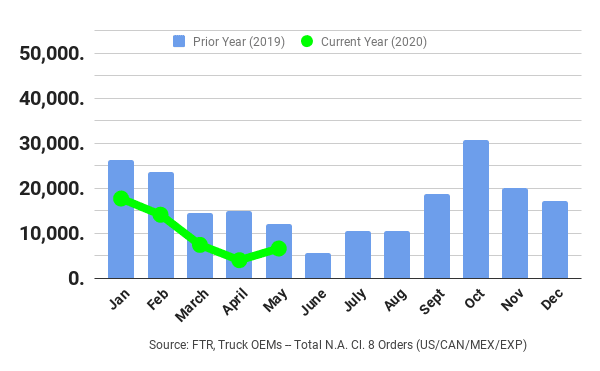
FTR North American Class. orders have tracked below year-ago levels throughout 2020.
Graph: FTR
2 min to read
May orders for Class 8 trucks, while up significantly from the dismal April levels, were still down nearly 40% compared to last year, according to preliminary figures from ACT Research and FTR.
FTR reported a "subdued" order level of 6,600 units, while ACT reported 6,700 units. That’s up around 60% from April, depending on which company’s numbers you look at, but down 37-38% from last year. According to FTR, Class 8 net orders for the last 12 months total 155,000 units.
Fleets remain reluctant to order trucks, with a patchwork of varying COVID-19 restrictions across most states causing economic turmoil. Orders are expected to continue to increase modestly, according to FTR. Freight volumes have picked up some after bottoming out in Mid-April. The recovery is expected to be slow and uneven, FTR notes, saying June should be a better indicator as more economic activity resumes.
“Most of the country still had some severe restraints in place for part of May,” said Don Ake, vice president commercial vehicles. “It is difficult for fleets to plan for future equipment needs under these highly abnormal conditions. Carriers are more worried about what’s happening today, about their manpower needs and short-term issues, than ordering trucks.”
Medium-duty truck orders, Class 5-7, improved 5.3% from the previous month but were down 57% from the year-ago May volume, according to ACT.
“Reflecting the state of the broader economy, there was little to cheer about in May’s industry order activity,” said Kenny Vieth, ACT president and senior analyst, also nothing the impact of COVID-related lockdowns at the start of the month and a slow reopening occurring through May in most areas.
In addition, Vieth noted, “Restarting the manufacturing sector from a full stop was only partly successful, as Mexico’s lockdowns remained in effect well after the U.S. began to reopen, resulting in challenging supply-chain dynamics and fragmented supplier sourcing.”
More Equipment

How Volvo Updated Its D13 for EPA 2027 [Watch]
Volvo’s updated D13 promises lower emissions without sacrificing performance or fuel economy. Take a closer look at what changed inside the engine in this HDT Spotlight video.
Read More →
Michelin Tire Improves Efficiency and Durability for Regional Fleets
The Michelin X Multi Energy D2 is a regional haul drive tire engineered to help fleets improve fuel efficiency, durability and traction in demanding stop-and-go operations.
Read More →
ZF Expands Commercial Vehicle Push in North America
ZF is expanding its North American commercial-vehicle presence with new transmission applications, electrification, trailer technology and autonomous-driving systems.
Read More →
Tesla Wants a Self-Driving Semi. Are Cameras Enough?
Could Tesla’s camera-only autonomous driving technology work on an 80,000-pound Semi? In this commentary, HDT's Deborah Lockridge takes a look at Tesla, Cybercab, and how autonomous trucks see the road.
Read More →
Kodiak: Driverless Long-Haul Truck Launch on Track for 2026
Kodiak AI says its driverless long-haul safety case is 93% complete and it remains on track to begin commercial operations by year-end 2026.
Read More →
What DOT’s Automated Vehicle Strategy Means for Trucking
The U.S. Department of Transportation issued a new automated-vehicle strategy that outlines plans for driverless-truck regulations, cross-state freight corridors, and federal safety standards.
Read More →
East Coast Port Launches $45M Electric Truck Push
The Port Authority of New York and New Jersey announced millions in incentives for zero-emission drayage trucks, yard tractors, and new charging hubs near the port.
Read More →
PlusAI Going Public to Fund Autonomous Truck Launch
A SPAC deal could provide PlusAI with up to $300 million as it works toward a 2027 commercial launch of factory-built autonomous trucks.
Read More →
NHTSA Moves to Rewrite Truck Fuel-Economy Rules
The National Highway Traffic Safety Administration says it lacks authority to regulate medium- and heavy-duty truck engines separately from complete vehicles, but the existing standards have not yet been eliminated.
Read More →
Detroit Opens Orders for EPA 2027 Engines
Detroit isn’t starting from scratch to meet EPA 2027 diesel emissions standards. Its Gen 6 DD13 and DD15 engines keep much of today’s platform while updating the fuel and aftertreatment systems.
Read More →